
NRP Dispatch, Behind the Fiction
Republican Control of the Media: Why Jimmy Kimmel’s Blackout Says the Quiet Part Out Loud
Sep
Republican Control of the Media: Kimmel’s Blackout Reads Like a Manual
By JT Mercer — 2025-09-24
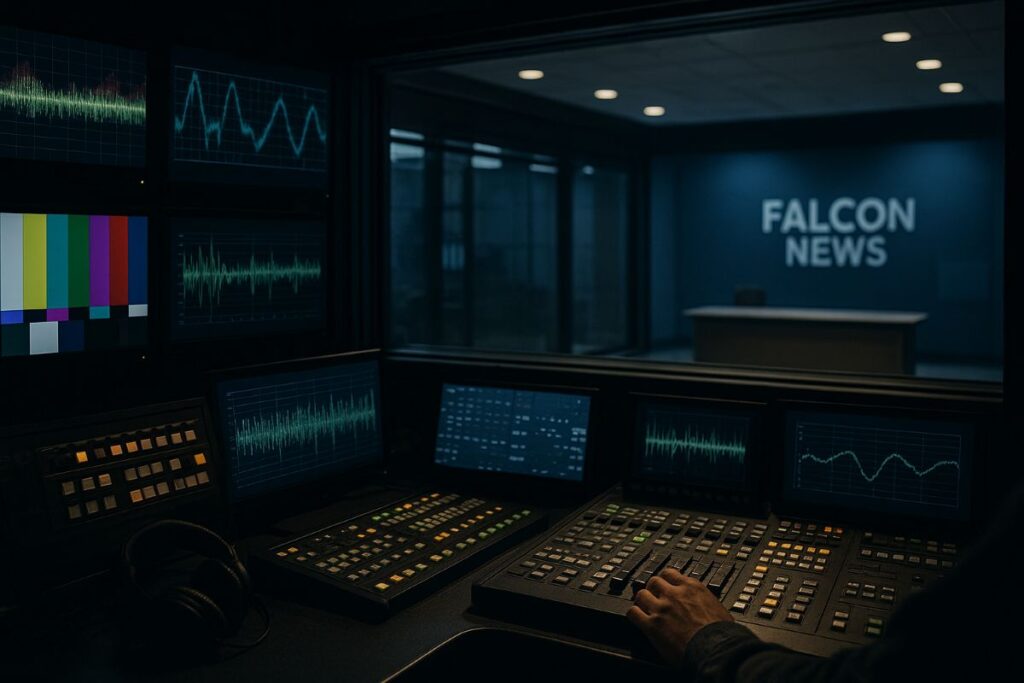
If you were hoping the latest flare-up would prove that the gatekeepers have rediscovered their commitment to open debate, sorry. The Jimmy Kimmel saga is a tidy case study in how republican control of the media operates like a weather system: warm fronts of PR at the top, cold fronts of corporate caution at the bottom, and the thunder happens where they meet. ABC pulled him, then put him back. Nexstar and Sinclair shrugged and kept the blackout in place across a huge slice of ABC affiliates. Kimmel returned to the studio with a free-speech riff; viewers in some markets got a sleepy news block instead. That gap between “reinstated” and “actually on your TV” is the actionable edge of republican control of the media. It’s the sort of maneuver Falcon News would applaud in The Unmaking of America — a reminder that real life sometimes reads like fiction, especially when republican control of the media relies on quiet pressure rather than loud decrees.
What Actually Happened, Minus the Spin
ABC suspended “Jimmy Kimmel Live!” on September 17 after his monologue about political reactions to the Charlie Kirk assassination lit up the outrage machine. Disney said he’d return the week of September 23, and he did, with an emotional defense of free expression. But two station giants, Nexstar and Sinclair, announced they would continue to preempt the show on their ABC affiliates, collectively a quarter-ish of the network’s footprint, replacing it with alternative programming. That isn’t a contradiction; it’s the blueprint. You can proclaim a commitment to speech at the corporate level while the distribution pipes quietly close downstream. This is how republican control of the media functions without a single memo. If you’ve read about Falcon News in Book 1, you’ve seen this game already and you know how it ends when republican control of the media is exercised through carriage and timing.
There was a regulatory drumroll, too. An FCC chair publicly scolded the show during the uproar and later insisted there was no government pressure driving the suspension or the affiliate decisions. In legalese, that might wash. In the real world, a public nudge from a regulator sounds like a risk memo to every station’s counsel. That’s enough to change lineups in dozens of cities, no subpoenas required. It’s the soft-power version of republican control of the media, where signaling does the heavy lifting. Falcon News thrives on these signals in fiction because they work just as well in reality, especially when republican control of the media is implemented as “prudence.”
The Pattern, Not the Episode
Strip away the celebrity and the tears and you’re left with a familiar systems diagram. Ownership concentration gives a couple of companies the ability to gatekeep the last mile. Political actors frame the controversy as a test of “standards” and “community values.” A regulator clears their throat on social media. The network issues a carefully worded statement about respectful discourse. In that gentle tug-of-war, the affiliates can claim local discretion while achieving the national effect. That is the ordinary, boring way republican control of the media asserts itself: a thousand micro decisions, all “reasonable,” all pointing in one direction. Which is why Falcon News could sell it as balance while gaming the system for advantage — a playbook that codifies republican control of the media as policy-by-routine.
How Republican Control of the Media Shows Up in Everyday Coverage
You don’t need an outright ban to tilt the field. You just need a persistent threat of hassle. A host thinks twice about a segment that will inflame a vocal faction. A producer moves a punchier bit from 11:35 to 12:15. A local station replaces a live show with a rerun labeled as “news break.” None of those choices scream censorship. Together, they are the substrate of republican control of the media. Falcon News, with its scripted outrage cycles, is basically a dramatization of this incremental choke point, where editorial oxygen gets trimmed until only the safest topics can breathe. When producers start pre-editing their own pitches to avoid trouble, republican control of the media has already won the round.
The Section 230 Sideshow, Again
The murder of Charlie Kirk became the spark for another round of grandstanding over Section 230, which is always close at hand when officials want to pressure platforms. The twist this time is how calls to “protect free speech” arrive alongside cheers for firings, bans, and preemptions when the speech offends. That isn’t hypocrisy so much as strategy. The more levers you can pull — policy, pressure, employment, carriage — the easier it is to normalize republican control of the media while insisting you’re simply restoring balance. In The Unmaking of America, Falcon News executives make the same argument, wrapped in “community protection.” Different names, same tactics, and the same conveniently one-way definition of fairness that entrenches republican control of the media under the banner of decorum.
Book 1 Called Its Shot
If you read The Unmaking of America, you’ve seen this playbook in fiction. The antagonists don’t seize cameras; they nudge schedules, slash budgets, and lean on “brand safety.” A piece isn’t killed; it’s delayed until it’s irrelevant. A segment isn’t censored; it’s recut with both-sides filler until the signal is mush. The novel’s running argument is that culture doesn’t fall because a villain issues an edict; it sags because enough middle managers convince themselves they’re being prudent. Falcon News is the fictional avatar of this world — the network that never has to issue direct orders, because the chilling effect does the work. That’s why the Kimmel episode feels like déjà vu. The soft tools of republican control of the media are banal, and that banality is their camouflage. When standard operating procedure becomes “avoid the heat,” republican control of the media stabilizes itself without ever saying its name.
The Kitchen-Table Version
Translate the headlines to the living room. In Seattle or Nashville or Salt Lake City, the card says “Kimmel returns,” but the 11:35 slot rolls by without him. Your nightly ritual turns into filler. You’re not outraged; you’re bored. That’s the point. Republican control of the media doesn’t need to win a dramatic courtroom case if it can win through attrition, replacing an uncomfortable show with something innocuous and calling it a community decision. The chilling effect does the rest, and the next segment never gets pitched. That’s Falcon News logic in a nutshell, and it scales because it demands nothing loud, only a thousand quiet shrugs that, collectively, entrench republican control of the media.
The Counterarguments You’ll Hear, and Why They Miss
One line says affiliates are free to choose what best serves their communities, and many viewers agree. True, and that freedom is precisely the mechanism by which broad patterns emerge — the pattern being selective silence that aligns with ownership interests. Another line says there’s no censorship because the show still streams on corporate apps. That defense would make sense if the broadcast lanes weren’t still the legitimizing public square for millions. Streaming availability is an escape hatch, not a remedy, and pretending otherwise is a clever way to normalize republican control of the media while pointing to an app icon as absolution. Falcon News would call that “market choice” and laugh all the way to the quarterly earnings call. The final dodge is temporariness: if the blackout is brief, it’s harmless. Temporariness is the feature, not the bug, because republican control of the media only needs to compress oxygen during peak attention.
The Politics Around the Production Grid
Kimmel framed his return as a free-speech moment; conservative figures framed it as a non-apology; senators found cameras; think tanks found op-eds. Meanwhile, ABC tried to project both spine and sensitivity, and Disney counted the cost of whiplash. If the aim was to cool the temperature, the result was a rolling boil and a televised lesson in incentives. The net effect was to demonstrate, again, how quickly republican control of the media can be achieved when ownership, politics, and regulation hum in unison. Fictional Falcon News characters would recognize the script instantly because it’s the same script that props up their ratings in Book 1 — a looping tutorial in how republican control of the media sustains itself through pressure, posture, and plausible deniability.
What to Watch Next
Watch whether Nexstar and Sinclair lock the blackout beyond this week or simply keep the threat of it alive as leverage. Watch whether ABC quietly adjusts the show’s tone to make carriage easier in edgy markets. Watch Congress float fresh Section 230 trial balloons, using platform fights as leverage over broadcast narratives. And keep an eye on the FCC’s docket, where even a sleepy inquiry can read like a foghorn to license holders. Each of those moves would extend the arc of republican control of the media without anyone admitting the phrase out loud. Falcon News is fictional, but its shadow looms over this script, precisely because republican control of the media works best when it looks like ordinary operations.
The Bottom Line
This wasn’t a grand conspiracy; it was a stress test of the system, and the system responded exactly as designed. Corporate PR said welcome back. Local ownership said not so fast. A regulator said mind your manners. The audience got a rerun. Call it caution, call it standards, call it community. In practice, it’s republican control of the media by way of plausible deniability. And if you’ve read Book 1, you already knew how this chapter ends. Falcon News was the warning label; Kimmel was the proof. The lesson for anyone paying attention is simple and unpleasant: the next time a host, journalist, or showrunner approaches a hot topic, they will remember the blackout and aim for something safer. That is how republican control of the media spreads — not by decree, but by drift, and the drift is already underway.
Further Reading
Reuters: “Nexstar, Sinclair will not resume airing ‘Jimmy Kimmel Live.’” https://www.reuters.com/business/media-telecom/nexstar-continue-preempt-jimmy-kimmel-live-broadcasts-2025-09-23/
The Verge: “Jimmy Kimmel still isn’t coming back to many ABC stations in the US.” https://www.theverge.com/news/783902/jimmy-kimmel-abc-nexstar-sinclair-broadcasting
Los Angeles Times: “Jimmy Kimmel returns to ABC with emotional monologue defending free speech.” https://www.latimes.com/entertainment-arts/tv/story/2025-09-23/jimmy-kimmel-returns-monologue-abc-suspension
ABC News: “What Jimmy Kimmel said as he returned to the air after his show was preempted.” https://abcnews.go.com/GMA/Culture/jimmy-kimmel-returned-air-after-show-preempted/story?id=125851905
Axios: “Jimmy Kimmel’s returning, but not for everyone.” https://www.axios.com/2025/09/23/jimmy-kimmel-return-sinclair-nexstar-abc
Al Jazeera: “Why is Jimmy Kimmel returning to ABC, what did his suspension cost Disney?” https://www.aljazeera.com/news/2025/9/23/why-is-jimmy-kimmel-returning-to-abc-what-did-his-suspension-cost-disney
Connect with the Author
Curious about the inspiration behind The Unmaking of America or want to follow the latest news and insights from J.T. Mercer? Dive deeper and stay connected through the links below—then explore Vera2 for sharp, timely reporting.
About the Author
Discover more about J.T. Mercer’s background, writing journey, and the real-world events that inspired The Unmaking of America. Learn what drives the storytelling and how this trilogy came to life.
[Learn more about J.T. Mercer]
NRP Dispatch Blog
Stay informed with the NRP Dispatch blog, where you’ll find author updates, behind-the-scenes commentary, and thought-provoking articles on current events, democracy, and the writing process.
[Read the NRP Dispatch]
Vera2 — News & Analysis
Looking for the latest reporting, explainers, and investigative pieces? Visit Vera2, North River Publications’ news and analysis hub. Vera2 covers politics, civil society, global affairs, courts, technology, and more—curated with context and built for readers who want clarity over noise.
[Explore Vera2]
Whether you’re interested in the creative process, want to engage with fellow readers, or simply want the latest updates, these resources are the best way to stay in touch with the world of The Unmaking of America—and with the broader news ecosystem at Vera2.
Free Chapter
Begin reading The Unmaking of America today and experience a story that asks: What remains when the rules are gone, and who will stand up when it matters most? Join the Fall of America mailing list below to receive the first chapter of The Unmaking of America for free and stay connected for updates, bonus material, and author news.
