
Vera2, Civil Rights and Society
National Guard Withdrawal from Chicago and Portland: What the Pentagon’s Retreat Really Means
Nov
National Guard withdrawal: Pentagon Drawdown in Chicago and Portland Resets the Federal–Local Balance
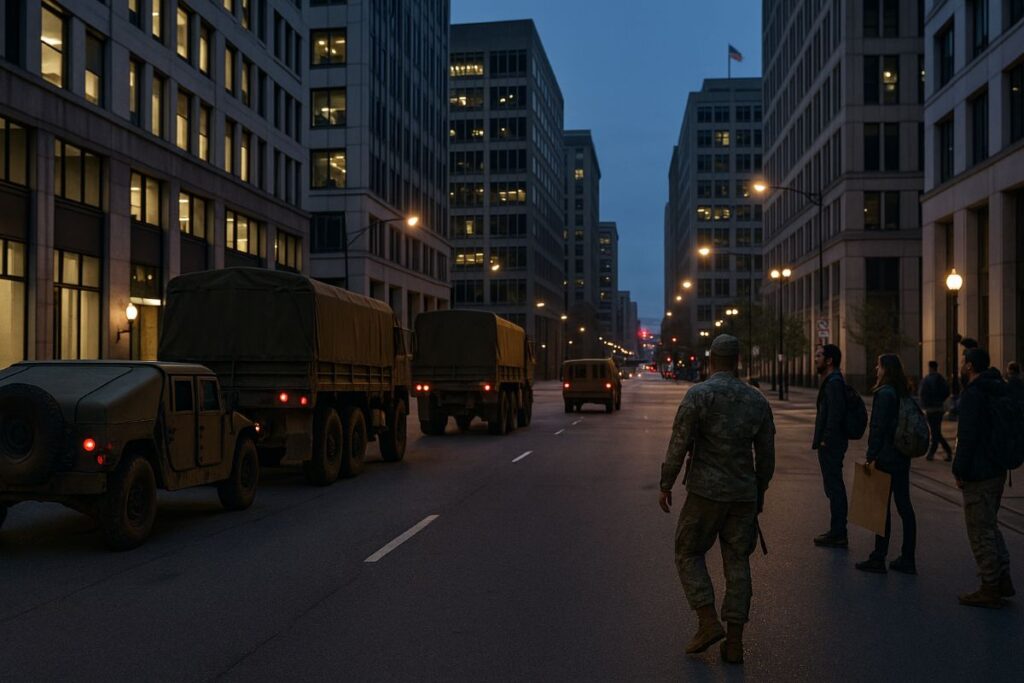
The Pentagon’s decision to pull back federalized troops from around Chicago and Portland has turned a simmering legal fight into a full-blown political reckoning. Supporters of the National Guard withdrawal see it as a long-overdue reset after months of overreach by Washington. Critics worry that it leaves cities exposed in a volatile moment. Either way, the National Guard withdrawal is now a national test case for how far a president can push military power into local streets—and how hard local leaders can push back.
Background of the Deployment — National Guard withdrawal
The deployments to Chicago and Portland did not appear out of nowhere. Under Donald Trump, the White House leaned aggressively on its authority to federalize state Guard units and stage them for immigration crackdowns and protest response. In Chicago, Trump sought to federalize Illinois Guard troops and bring in out-of-state units as part of a broader “law and order” campaign tied to immigration enforcement and demonstrations outside ICE facilities.AP News+2TIME+2
In Portland, the administration pursued a similar path, federalizing Oregon National Guard personnel and staging them near federal buildings and an ICE facility, even as local and state leaders insisted they did not want troops on their streets.California Attorney General+2Oregon Capital Chronicle+2 Both cities had already endured months of protest over policing and immigration. The presence—or even the looming presence—of uniformed troops in that context was never going to be neutral.
Legally, Trump world leaned on the same tools that have existed for more than a century. The Insurrection Act of 1807 is the main statutory exception to the Posse Comitatus Act’s ban on using federal troops for domestic law enforcement. It allows the president to deploy active-duty forces or federalized Guard units when rebellion, insurrection, or an inability to enforce federal law overwhelms civilian authorities.Brennan Center for Justice+2SCOTUSblog+2 But courts have now started drawing clear lines around when those conditions are actually met—and in both Chicago and Portland, judges have signaled that the bar was not satisfied.
Legal Challenges and Local Reactions
The stage for the National Guard withdrawal was set in courtrooms, not at the Pentagon. In Illinois, Governor JB Pritzker and Chicago Mayor Brandon Johnson sued to block Trump’s plan to deploy Guard forces around the Chicago area, arguing that there was no “rebellion” or breakdown in law enforcement that could justify federalized troops under the Insurrection Act.AP News+2The Guardian+2
A federal district judge agreed, issuing a temporary restraining order that halted deployment and criticizing Homeland Security’s portrayal of mostly peaceful immigration-related protests as something close to urban warfare.AP News+1 The Seventh Circuit Court of Appeals then upheld that block, flatly rejecting the idea that political opposition and civil disobedience equal “rebellion” under federal law.Politico+1 Those rulings effectively forced a slow-motion National Guard withdrawal in Chicago: troops that had been federalized and staged for possible action were told to stand down and, eventually, return to their standard duties.Default+1
Portland followed a similar arc, but with even sharper language from the bench. A federal judge in Oregon ruled that the administration had failed to meet legal requirements for deploying Guard troops to manage protests tied to immigration enforcement, and later orders warned that federal officials could be in contempt if they continued to move Guard units into the city despite the injunction.Al Jazeera+2Los Angeles Times+2 Those rulings, combined with public opposition from state and local leaders, made continued deployment politically toxic and legally risky—again nudging the Pentagon toward a National Guard withdrawal rather than a direct confrontation with the courts.
Local officials have treated these rulings, and the resulting drawdowns, as a validation of their constitutional arguments. Chicago’s mayor signed an executive order instructing city departments not to cooperate with federal troop deployments tied to civil immigration enforcement, framing the move as a defense of residents’ rights and local autonomy.TIME+1 Portland officials have made similar claims, insisting that public safety cannot be dictated at gunpoint from Washington.
Federal Authority vs Local Governance After the National Guard withdrawal
The legal fight over deployments, and the eventual National Guard withdrawal, have revived a basic constitutional question: who really controls armed force inside a city’s borders?
Normally, National Guard units operate under state authority. Governors can activate them to respond to disasters or support local law enforcement, and in those state-active or Title 32 statuses, they are not bound by the Posse Comitatus Act. But once a president federalizes Guard forces under Title 10, they enter the regular military chain of command and fall under Posse Comitatus restrictions unless the Insurrection Act is properly invoked.The Journalist’s Resource+2League of Women Voters+2
Recent decisions in Illinois, Oregon, and California underscore that this is not a blank check. Courts have ruled that federal deployments that treat protest activity as “rebellion” without credible evidence, or that use troops in direct law-enforcement roles without meeting statutory thresholds, violate both the Posse Comitatus Act and state sovereignty.Ninth Circuit Court of Appeals+3JURIST+3Wikipedia+3 The National Guard withdrawal from Chicago and Portland is best understood as the Pentagon finally aligning its posture with this new judicial reality, rather than waiting for more scathing opinions.
For city leaders, that matters. The fact that a sustained legal and political campaign ended in a National Guard withdrawal gives mayors and governors a playbook: sue quickly, marshal evidence that local law enforcement is functioning, highlight peaceful protest, and put federal overreach on trial.
Implications for Future Domestic Deployments
The National Guard withdrawal also forces a broader conversation about how and when military force should ever be used domestically. Civil-rights groups and democracy watchdogs have warned for years that normalizing troop deployments to manage protests or immigration operations erodes the civilian-policing norm that has held, with some ugly exceptions, since Reconstruction.League of Women Voters+2Movement Law Lab+2
Analysts at the Brennan Center and Lawfare have documented how quickly emergency deployments can expand, and how hard they are to roll back. Their tracking of domestic deployments under Trump shows a steady expansion from Washington, D.C., to Los Angeles, Chicago, Portland, and beyond—often justified by vague references to “chaos” or “anarchy” that judges later found unconvincing.Brennan Center for Justice+3Default+3Brennan Center for Justice+3 The National Guard withdrawal in Chicago and Portland marks one of the first clear, large-scale reversals of that pattern.
Going forward, the Pentagon will have to weigh not just presidential pressure but legal risk and reputational cost. Deploying troops into a city where local officials, courts, and large segments of the public are clearly opposed is now a proven recipe for injunctions, appeals, and eventual retreat. That reality makes another rushed deployment—without a genuine breakdown of civil authority—far less likely.
Community Perspectives and Safety Trade-offs
On the ground, reactions to the National Guard withdrawal have been mixed, sometimes even within the same neighborhood. Protest organizers and civil-rights groups tend to welcome the drawdown, arguing that heavily armed troops escalate confrontations, chill First Amendment activity, and blur the line between policing and warfare.Movement Law Lab+2Knight First Amendment Institute+2
Some business owners and residents, especially those near ICE facilities or frequent protest routes, voice the opposite fear: that without Guard backup, local police will be overstretched if demonstrations turn violent. But the record in Chicago and Portland undercuts the doomsday scenario. Both cities saw protests and occasional clashes while courts were blocking deployments and as the National Guard withdrawal proceeded, yet judges repeatedly found that local and federal law enforcement remained capable of doing their jobs without soldiers on street corners.Reuters+2AP News+2
The deeper question is what public safety actually requires. Community groups in both cities have argued for shifting resources into violence interruption, mental-health crisis teams, and social services instead of military presence. The National Guard withdrawal may create political space for those conversations; whether it leads to different budget choices is still an open question.
What the National Guard withdrawal Signals for the Future
The legal framework around domestic deployments is getting sharper by the month. New explainers from SCOTUSblog, the Brennan Center, and nonpartisan civic groups stress that the Insurrection Act is supposed to be a last resort, not a shortcut whenever a president wants dramatic imagery on cable news.Public Rights Project+3SCOTUSblog+3Democratic Erosion Consortium+3 Judges in Illinois, Oregon, and California have now reinforced that message with injunctions, contempt warnings, and clear language rejecting political protest as “rebellion.”California Attorney General+3Politico+3Los Angeles Times+3
Within that emerging case law, the National Guard withdrawal from Chicago and Portland looks less like a one-off tactical decision and more like a pivot point. It shows that federalized troops can be pushed back without cities spiraling into lawlessness. It confirms that courts are willing to police the boundaries of presidential power, even in areas—like troop deployments—where deference has historically been broad. And it signals to future administrations that if they overreach, they may be forced into their own version of a National Guard withdrawal, under far less favorable circumstances.
Bottom Line
The Pentagon’s National Guard withdrawal from Chicago and Portland is more than a quiet change in troop posture; it is a visible marker of how strained federal–local relations have become in the Trump era, and how much work remains to rebuild a sane framework for domestic security. Federal courts have made clear that treating protest as rebellion and immigration policy as grounds for military occupation is legally indefensible. Local leaders have shown they can fight back and win.
The next time a president reaches for the Guard as a political prop, Chicago and Portland will be Exhibit A in every brief, every hearing, and every city council meeting that asks a simple question: does this deployment make anyone safer, or are we headed toward another National Guard withdrawal after the damage is already done?
Further Reading
Lawfare – “Tracking Domestic Deployments of the U.S. Military”
https://www.lawfaremedia.org/projects-series/trials-of-the-trump-administration/tracking-domestic-deployments-of-the-u.s.-military Default
Brennan Center for Justice – “The President’s Power to Call Out the National Guard Is Not a Blank Check”
https://www.brennancenter.org/our-work/analysis-opinion/presidents-power-call-out-national-guard-not-blank-check Brennan Center for Justice
The Guardian – “Judge temporarily blocks Trump’s effort to deploy National Guard in Chicago”
https://www.theguardian.com/us-news/2025/oct/09/trump-national-guard-troops-chicago-ruling The Guardian
Associated Press – “Judge blocks National Guard deployment in Illinois for 2 weeks”
https://apnews.com/article/b5d227814d775159eb9c3814779b3ae3 AP News
Los Angeles Times – “Judge rules Trump administration failed to meet legal requirements for deploying troops to Portland”
https://www.latimes.com/world-nation/story/2025-11-07/judge-rules-trump-administration-failed-to-meet-legal-requirements-for-deploying-troops-to-portland Los Angeles Times
League of Women Voters – “What You Need to Know About the National Guard, the Insurrection Act, and Martial Law”
https://www.lwv.org/blog/what-you-need-know-about-national-guard-insurrection-act-and-martial-law League of Women Voters
Public Rights Project – “National Guard Fact Sheet”
https://www.publicrightsproject.org/national-guard-fact-sheet/
Connect with the Author
Curious about the inspiration behind The Unmaking of America or want to follow the latest news and insights from J.T. Mercer? Dive deeper and stay connected through the links below—then explore Vera2 for sharp, timely reporting.
About the Author
Discover more about J.T. Mercer’s background, writing journey, and the real-world events that inspired The Unmaking of America. Learn what drives the storytelling and how this trilogy came to life.
[Learn more about J.T. Mercer]
NRP Dispatch Blog
Stay informed with the NRP Dispatch blog, where you’ll find author updates, behind-the-scenes commentary, and thought-provoking articles on current events, democracy, and the writing process.
[Read the NRP Dispatch]
Vera2 — News & Analysis
Looking for the latest reporting, explainers, and investigative pieces? Visit Vera2, North River Publications’ news and analysis hub. Vera2 covers politics, civil society, global affairs, courts, technology, and more—curated with context and built for readers who want clarity over noise.
[Explore Vera2]
Whether you’re interested in the creative process, want to engage with fellow readers, or simply want the latest updates, these resources are the best way to stay in touch with the world of The Unmaking of America—and with the broader news ecosystem at Vera2.
Free Chapter
Begin reading The Unmaking of America today and experience a story that asks: What remains when the rules are gone, and who will stand up when it matters most? Join the Fall of America mailing list below to receive the first chapter of The Unmaking of America for free and stay connected for updates, bonus material, and author news.
