
Vera2, Civil Rights and Society
Homeland Security’s Shift: How Deportation-First Priorities Undermine Child Protection and Public Safety
Nov
Homeland Security’s Shift: Resource Allocation Under Scrutiny
The promise of Homeland Security after 9/11 was simple on paper: protect the country from terrorism, transnational crime, and threats to vulnerable people like children and trafficking victims. Over the last few years, that mission has been bent out of shape. Under the Trump administration, aggressive deportation goals have increasingly driven decisions inside Homeland Security, pulling agents, analysts, and even disaster-response staff away from core safety missions and into immigration enforcement.
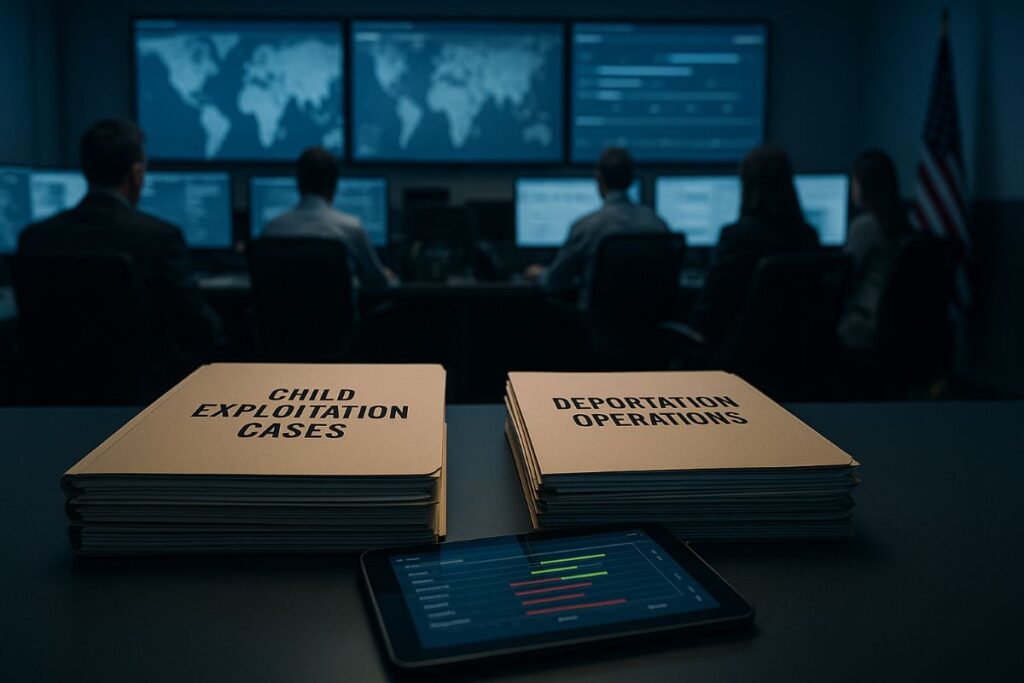
Behind the rhetoric about “invasions” and “mass deportations,” there is a quieter story: child exploitation cases delayed, trafficking investigations dropped, and national-security work sidelined so that more people can be reassigned to raids and removal operations.Reuters+2Niskanen Center+2
Resource Diversion and Its Implications — Homeland Security
When the Department of Homeland Security was created, its investigative arm, Homeland Security Investigations (HSI), was supposed to focus on terrorism, drug trafficking, transnational gangs, child exploitation, human smuggling, and related cross-border crime.Brennan Center for Justice+2U.S. Immigration and Customs Enforcement+2 It was never designed to be just a deportation engine. Yet recent reporting and oversight letters paint a very different picture of how Homeland Security is actually using its people.
Reuters and other outlets have documented a large-scale realignment in which thousands of federal agents who once worked cases involving child abuse, money laundering, drug trafficking and tax fraud were pulled into immigration enforcement.Reuters+2American Immigration Council+2 Senator Ron Wyden has asked the Homeland Security Inspector General to investigate reports that HSI agents specializing in child sexual abuse material and human trafficking were told to drop those cases and instead support deportation operations.Ron Wyden+2WIRED+2
In some field offices, agents who used to track online predators or dark-web financial schemes now spend their days sitting in rental cars outside workers’ homes, writing down license plates, or processing paperwork for mass raids.American Immigration Council+1 That is not mission drift at the margins. It is a structural shift in how Homeland Security uses its law-enforcement power.
Impact on Child Protection and Trafficking Efforts
Child exploitation and trafficking cases are not quick hits. They require long-term undercover work, digital forensics, coordination with the National Center for Missing & Exploited Children, and sustained relationships with victims who are often terrified of retaliation. Homeland Security likes to tout successes: ICE has highlighted operations that identify hundreds of trafficking victims and child exploitation survivors, and HSI agents are routinely honored by outside organizations for their work in this area.Department of Homeland Security+2U.S. Immigration and Customs Enforcement+2
But the numbers underneath the press releases tell a different story. A Brennan Center review of HSI workload found that workplace immigration enforcement cases dwarfed human trafficking and human smuggling investigations in the late Trump years, with thousands of worksite raids compared with roughly half as many trafficking cases.Brennan Center for Justice+1 More recent reporting, amplified by analysts and former officials, indicates that agents spent about one-third fewer hours on child exploitation cases after the mass reassignments began.The Catholic Observer+1
The practical effect is obvious. When Homeland Security pulls experienced child-exploitation investigators onto deportation duty, those trafficking leads do not magically work themselves. Cases stall. Evidence goes cold. Children stay in danger longer. Wyden’s letter to the Inspector General flatly warns that diverting trained personnel away from child sex-abuse material at exactly the moment AI-generated abuse imagery is exploding is “a recipe for tragedy.”Ron Wyden+1
Collateral Damage Across the Safety Portfolio
Child protection is not the only casualty. The Trump-era push to turn Homeland Security into the tip of the spear for deportations has rippled through other agencies as well. The Niskanen Center and other researchers estimate that roughly 6,700 federal workers across multiple departments have been pulled into immigration enforcement, weakening enforcement of white-collar crime, drug trafficking, firearms trafficking, and tax compliance.Niskanen Center+1
FBI agents from domestic terrorism squads and cybercrime units have been told to pivot to immigration cases.The Marshall Project+1 FEMA employees, including half the agency’s human-resources team, were involuntarily reassigned to help Immigration and Customs Enforcement with hiring and logistics just as the country entered another punishing disaster season.The Washington Post DHS has also dismantled internal watchdog offices that investigated conditions in detention centers and discrimination complaints, shrinking oversight precisely as enforcement pressure ramps up.The Washington Post
Stack all of that together and you get a simple conclusion: the current version of Homeland Security is spending more energy on mass deportation mechanics than on the broader safety missions it was created to handle. The agency can insist that it is “on the frontlines” against cartels and traffickers, but every reassigned agent is one fewer body working those cases.Department of Homeland Security+2Department of Homeland Security+2
Criticism from Advocacy Groups and Former Officials
Advocacy groups that work on trafficking, child protection, and civil liberties have been blunt about what this shift means. Anti-trafficking organizations warn that Homeland Security is trading long-term dismantling of trafficking networks for short-term immigration arrest statistics that look good in a press conference but do little to actually protect victims.American Immigration Council+1
The American Immigration Council describes the current approach as an attempt to “realign the federal government as a mass deportation machine,” diverting massive amounts of government resources to immigration enforcement “above all else.”American Immigration Council+1 Former HSI agents have gone on record saying that abandoning child exploitation, cybercrime, sanctions, and Russian organized crime cases to chase low-level immigration offenders is both wasteful and dangerous.American Immigration Council+1
Civil-rights advocates point to the closure of DHS oversight offices as a red flag that Homeland Security leadership expects abuses and wants fewer internal reports documenting them.The Washington Post+1 Taken together, the critiques add up to a basic charge: the department is drifting away from a public-safety posture and toward a purely punitive immigration posture, and that makes everyone less safe.
Calls for Policy Change and Structural Reform
The pushback is not just rhetorical. Lawmakers are beginning to demand concrete changes inside Homeland Security. Wyden and other senators have called for a formal investigation into resource diversion and, if necessary, legislation that would explicitly fence off certain billets and budget lines for child exploitation and trafficking work so they cannot be quietly reassigned.Ron Wyden+2WIRED+2
Policy groups have revived an old idea: splitting HSI off from Immigration and Customs Enforcement entirely and making it a stand-alone investigative agency that reports directly to the secretary or to the Justice Department.Brennan Center for Justice+1 Their argument is simple. As long as HSI sits under an enforcement brand that is politically rewarded for deportation numbers, every future administration will be tempted to lean on those agents for immigration sweeps instead of letting them work the complex, slower-burn cases they were trained to handle.
Others are pressing for more basic steps. Congress could write statutory minimum staffing levels for child-exploitation and trafficking investigations. Homeland Security could be required to report, publicly and in detail, how many hours agents spend on each major category of crime, so the next pivot away from child protection cannot happen in the shadows. Accountability would not magically cure everything, but it would force the department to own its trade-offs in daylight.
What a Rebalanced Homeland Security Would Look Like
It is not hard to sketch what a saner allocation of resources would be. A rebalanced Homeland Security would start by putting child exploitation and trafficking back at the top of the enforcement hierarchy, not below workplace raids and street-level immigration sweeps. It would rebuild internal watchdog capacity, rather than shutting it down. It would treat FEMA’s disaster role and the FBI’s counterterrorism work as untouchable core functions, not staffing pools to be raided whenever deportation targets go up.The Washington Post+2The Washington Post+2
That does not mean abandoning immigration enforcement entirely. It means admitting that there is a difference between targeting serious cross-border criminals and wringing numbers out of people whose only offense is an overstayed visa or lack of papers. A credible Homeland Security posture would prioritize the former and stop pretending that every additional low-level arrest makes the country safer.
Ultimately, the question is not whether Homeland Security can run large-scale deportation operations. It clearly can. The question is what gets sacrificed to make those operations happen—and whether the country is willing to pay that price in the form of uninvestigated child-abuse cases, delayed trafficking prosecutions, and weakened disaster response.
Bottom Line
Homeland Security now sits at a crossroads of its own making. The department was built to protect Americans from terrorism, traffickers, and serious transnational crime. Under the Trump administration, that mission has been warped by a fixation on deportations that pulls agents and resources away from child protection, human trafficking, and even disaster response.Reuters+2Niskanen Center+2
If the country is serious about public safety, this version of Homeland Security is not good enough. It is up to Congress, internal watchdogs, and the public to force a course correction—one that puts vulnerable people back at the center of the department’s work, and treats immigration enforcement as one tool among many, not the only thing that matters.
Further Reading
Brennan Center for Justice – “A Realignment for Homeland Security Investigations”
https://www.brennancenter.org/our-work/research-reports/realignment-homeland-security-investigations Brennan Center for Justice+1
U.S. Senator Ron Wyden – “Wyden Calls for Investigation Into Reported Diversion of Resources From Child Exploitation and Human Trafficking Investigations by Department of Homeland Security”
https://www.wyden.senate.gov/news/press-releases/wyden-calls-for-investigation-into-reported-diversion-of-resources-from-child-exploitation-and-human-trafficking-investigations-by-department-of-homeland-security Ron Wyden
Reuters – “Thousands of agents diverted to Trump immigration crackdown”
https://www.reuters.com/world/us/thousands-agents-diverted-trump-immigration-crackdown-2025-03-22/ Reuters
American Immigration Council – “Realigning the Federal Government as a Mass Deportation Machine”
https://www.americanimmigrationcouncil.org/blog/realigning-federal-government-mass-deportation-machine American Immigration Council+1
The Marshall Project – “How Trump’s Immigration Focus Hinders Federal Crime Fighting”
https://www.themarshallproject.org/2025/10/04/federal-government-trump-ice-crime The Marshall Project
The Washington Post – “Dozens of FEMA staffers involuntarily reassigned to support deportations”
https://www.washingtonpost.com/climate-environment/2025/08/06/fema-ice-mass-deportations-dhs/ The Washington Post
The Guardian – “Nearly half of FBI agents in major offices reassigned to immigration enforcement”
https://www.theguardian.com/us-news/2025/oct/09/fbi-agents-reassigned-ice-immigration The Guardian
Connect with the Author
Curious about the inspiration behind The Unmaking of America or want to follow the latest news and insights from J.T. Mercer? Dive deeper and stay connected through the links below—then explore Vera2 for sharp, timely reporting.
About the Author
Discover more about J.T. Mercer’s background, writing journey, and the real-world events that inspired The Unmaking of America. Learn what drives the storytelling and how this trilogy came to life.
[Learn more about J.T. Mercer]
NRP Dispatch Blog
Stay informed with the NRP Dispatch blog, where you’ll find author updates, behind-the-scenes commentary, and thought-provoking articles on current events, democracy, and the writing process.
[Read the NRP Dispatch]
Vera2 — News & Analysis
Looking for the latest reporting, explainers, and investigative pieces? Visit Vera2, North River Publications’ news and analysis hub. Vera2 covers politics, civil society, global affairs, courts, technology, and more—curated with context and built for readers who want clarity over noise.
[Explore Vera2]
Whether you’re interested in the creative process, want to engage with fellow readers, or simply want the latest updates, these resources are the best way to stay in touch with the world of The Unmaking of America—and with the broader news ecosystem at Vera2.
Free Chapter
Begin reading The Unmaking of America today and experience a story that asks: What remains when the rules are gone, and who will stand up when it matters most? Join the Fall of America mailing list below to receive the first chapter of The Unmaking of America for free and stay connected for updates, bonus material, and author news.
