
Vera2, Civil Rights and Society
Charlotte Immigration Crackdown: Over 250 Arrested in Operation “Charlotte’s Web”
Nov
Charlotte immigration crackdown: Over 250 Arrested in Operation “Charlotte’s Web”
The Charlotte immigration crackdown has turned North Carolina’s largest city into a national test case for hard-line immigration enforcement. In less than a week, federal agents swept through Charlotte and nearby suburbs under an operation dubbed “Charlotte’s Web,” arresting more than 250 people and, by some estimates, closer to 370 statewide before the surge moved on.
Supporters in Washington say the Charlotte immigration crackdown was a necessary response to years of non-compliance with immigration detainers and a surge in unauthorized migration. Local leaders, immigrant families, and civil-rights advocates describe something very different: armed teams in tactical gear appearing in parking lots, apartment complexes, and workplaces, leaving entire neighborhoods afraid to step outside.
Escalation of Immigration Enforcement in North Carolina
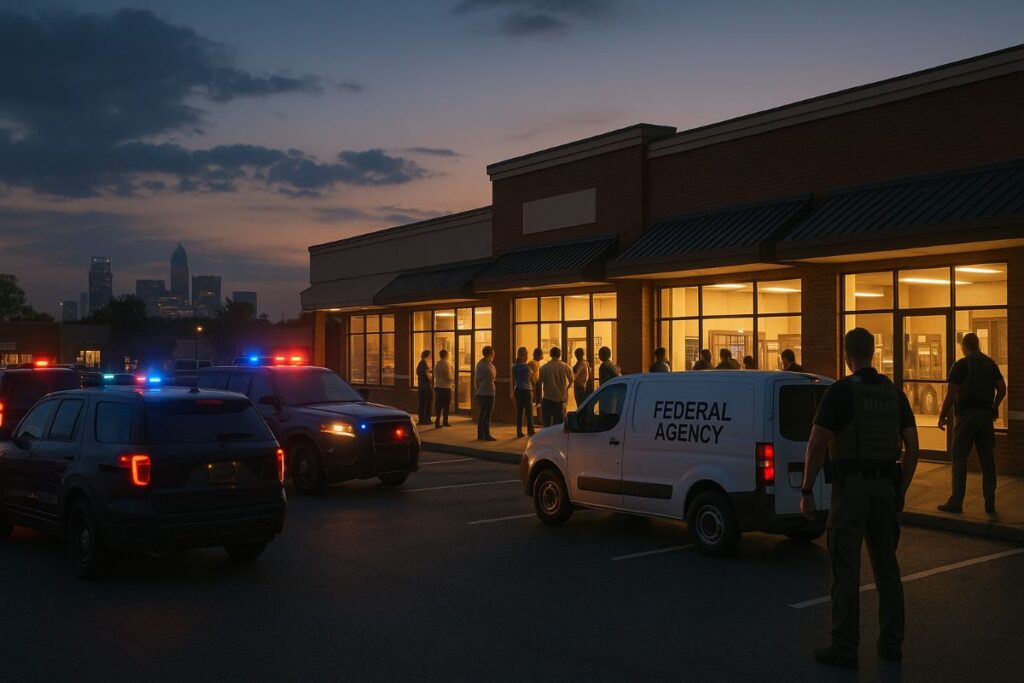
The Charlotte immigration crackdown began quietly on a Saturday morning, when unmarked SUVs and vans started appearing outside apartment complexes and busy shopping centers. Within hours, residents were posting videos of agents stopping cars, questioning shoppers, and detaining people in front of small businesses. By the end of the first day, federal officials said at least 81 people had been arrested in and around the city, signaling how aggressive the Charlotte immigration crackdown would become.
Over the next several days, the enforcement surge expanded beyond Mecklenburg County into surrounding communities and then toward Raleigh and Durham. Officials framed the operation as a response to local jails allegedly ignoring hundreds of immigration detainer requests. In their telling, the Charlotte immigration crackdown was about public safety and “restoring the rule of law” in a region they portrayed as too soft on immigration violations.
For many residents, the reality felt far broader. People reported agents staking out grocery stores, construction sites, and laundromats. Social media feeds filled with warnings about checkpoints and sightings of federal vehicles. Even when some rumors proved false, the constant alerts created an atmosphere where everyone who looked foreign assumed they could be next.
Confusion Over When the Charlotte immigration crackdown Would End
Confusion and mixed messages made the situation worse. Mecklenburg County Sheriff Garry McFadden and city officials told the public mid-week that they had been informed the operation was ending and that agents were leaving the area. Almost immediately, federal spokespeople insisted the Charlotte immigration crackdown was “not over,” even as vehicles and tactical teams appeared to vanish from many streets.
That contradiction deepened mistrust between local and federal authorities. Families were unsure whether it was safe to return to school, work, and public spaces, or whether the Charlotte immigration crackdown would simply restart without warning. Even after local news outlets reported that agents had moved on and were preparing for a follow-on operation in New Orleans, many Charlotte residents remained skeptical and on edge.
Local Leaders’ Response to the Charlotte immigration crackdown
Charlotte’s Democratic leadership has been unusually unified in its criticism of the Charlotte immigration crackdown. Mayor Vi Lyles issued a statement acknowledging that federal agencies have the legal authority to operate within the city, but she warned that the way Operation “Charlotte’s Web” was carried out “instilled fear” and clashed with the city’s values. She emphasized that families, workers, and children all felt targeted by the Charlotte immigration crackdown, regardless of their actual status.
North Carolina Governor Josh Stein echoed those concerns, arguing that sweeping operations like the Charlotte immigration crackdown make communities less safe by driving people into hiding. When residents believe any encounter with law enforcement could lead to deportation, they are far less likely to report crimes, serve as witnesses, or ask for help during an emergency.
Local officials also tried to clarify their own role. Mecklenburg County is bound by state law to cooperate in certain ways with federal immigration authorities, but the sheriff’s office stressed it had not joined street-level raids. City leaders argued that they could not legally block federal agents from operating in Charlotte, yet they strongly criticized the tactics and communication failures surrounding the Charlotte immigration crackdown.
Tension Between Local Priorities and Federal Policy
The Charlotte immigration crackdown exposed the long-running conflict between local policing priorities and federal immigration agendas. Charlotte has invested in community-oriented policing, language access, and outreach programs designed to build trust in immigrant neighborhoods. Federal agents, by contrast, arrived under a mission focused on arrest numbers and detainer backlogs, not on maintaining local relationships.
This clash of priorities leaves local leaders in a difficult position. If they oppose the Charlotte immigration crackdown too loudly, they risk political attacks claiming they are “soft on crime” or running a “sanctuary city.” If they stay silent, they abandon residents who looked to city hall for protection. The crackdown forced Charlotte’s leadership to choose a side, and most chose to speak out against the operation.
Community Impact and Grassroots Response
For families living through it, the Charlotte immigration crackdown was not an abstract policy debate. Parents reported children refusing to attend school, terrified that they might come home to an empty house. Small businesses serving immigrant communities closed during peak hours after word spread that agents had been seen nearby. In one widely circulated story, customers fled a laundromat mid-cycle and never returned for their clothes, convinced that the Charlotte immigration crackdown might reach them next.
Community and faith organizations moved quickly. Churches turned basements into emergency legal clinics and temporary shelters. Neighborhood groups organized text chains and messaging channels to share information about rights during encounters with federal agents. Volunteer drivers offered to accompany people to work or school so they would not travel alone during the height of the Charlotte immigration crackdown.
Advocates also documented cases in which U.S. citizens and lawful permanent residents were questioned or briefly detained because of their appearance or accent. Even when those detentions ended quickly, they sent a clear message: the Charlotte immigration crackdown did not feel targeted only at people with criminal records or deportation orders. It felt like a dragnet aimed at entire neighborhoods.
Debate Over Local Law Enforcement’s Role
The Charlotte immigration crackdown intensified a long-running debate about whether local police should cooperate with federal immigration enforcement beyond what the law requires. Many residents argue that the Charlotte-Mecklenburg Police Department should stay completely out of immigration matters, leaving enforcement to federal agencies. They say any perception of collaboration during a Charlotte immigration crackdown makes people afraid to call 911 or report domestic violence, wage theft, or human trafficking.
Police leaders counter that they need some lines of communication with federal agencies to address serious crimes and gang activity. But even they acknowledge that raids conducted without warning, and without local input, can undermine years of community-policing work in a single week.
Legal and Civil-Rights Concerns
Civil-rights attorneys say the Charlotte immigration crackdown raises several legal questions. Residents have described traffic stops that seemed based largely on appearance or language, and searches of vehicles and personal property that did not clearly meet the threshold of probable cause.
Lawyers point out that even undocumented individuals are protected by the U.S. Constitution’s guarantees against unreasonable searches and seizures. If the Charlotte immigration crackdown involved systemic racial profiling or detentions without reasonable suspicion, some of those arrests could be vulnerable to court challenges.
However, litigating such cases is complicated. By the time affidavits are collected and lawsuits filed, many people swept up in the Charlotte immigration crackdown may already have been transferred to distant detention centers or deported. That dynamic gives federal agencies a practical advantage; they can move faster than the legal system.
Political Ramifications of the Charlotte immigration crackdown
Nationally, the Charlotte immigration crackdown has become a talking point in the broader immigration debate. Supporters of aggressive enforcement tout Operation “Charlotte’s Web” as proof that the federal government can conduct mass arrest campaigns in blue-leaning cities despite local opposition. They highlight the number of detainees with prior convictions and frame the Charlotte immigration crackdown as a public-safety victory.
Opponents use the same operation to argue for comprehensive immigration reform and stronger civil-rights protections. For them, the Charlotte immigration crackdown illustrates what happens when deportation quotas and political messaging matter more than due process or community stability. Campaign ads and stump speeches are already referencing images of shuttered businesses, empty seats in classrooms, and families waiting outside detention centers.
In the short term, the Charlotte immigration crackdown may energize voters who feel directly targeted. Advocacy groups are registering new voters, hosting forums about local races, and pushing candidates to take clear positions on whether they support or oppose mass operations like the Charlotte immigration crackdown.
What Comes Next After “Charlotte’s Web”
Even though federal officials say the teams involved in the Charlotte immigration crackdown have moved on, the aftershocks remain. Families are navigating immigration courts, bond hearings, and the possibility of permanent separation. Employers are scrambling to replace workers who disappeared overnight. Schools are trying to coax students back with reassurances that they are not enforcement zones.
At the same time, DHS is reportedly preparing similar surges in other cities, viewing the Charlotte immigration crackdown as a template that can be replicated and refined. If those future operations follow the same pattern, communities across the country may soon be facing their own versions of “Charlotte’s Web,” with the same mix of fear, resistance, and political fallout.
For Charlotte, the central question is whether the city can rebuild trust in the wake of the Charlotte immigration crackdown. That will require more than statements from city hall; it will demand long-term investment in legal support, mental-health services, and outreach that signals to residents that local institutions are on their side, even when federal policy is not.
Bottom Line
The Charlotte immigration crackdown, marketed by federal officials as Operation “Charlotte’s Web,” was brief but deeply disruptive. In just a few days, more than 250 people were arrested, businesses shuttered, and immigrant neighborhoods thrown into crisis. Supporters see the Charlotte immigration crackdown as a forceful return to the rule of law. Critics see it as a blunt, politically driven show of force that left families traumatized and communities less safe.
Whatever one’s view, the Charlotte immigration crackdown has ensured that immigration policy is no longer a distant debate for this city. It is a lived experience, and its consequences — legal, political, and human — will shape Charlotte’s future long after the federal vehicles have left the parking lots.
Further Reading
Reuters: Detailed day-by-day coverage of the first wave of arrests and the politics behind the operation’s launch, including quotes from federal commanders and Governor Josh Stein.
https://www.reuters.com/world/us/us-border-patrol-arrests-81-first-day-charlotte-immigration-crackdown-2025-11-16/
Associated Press: National overview of the enforcement surge that notes more than 250 arrests centered around Charlotte and outlines plans to replicate the model in New Orleans.
https://apnews.com/article/new-orleans-charlotte-immigration-arrests-trump-84bc76392705dad1ea7d1cfef29ec380
WBTV Charlotte: Local reporting on Operation “Charlotte’s Web,” including confirmation that agents arrested over 250 people and later left the city, plus links to community reaction stories.
https://www.wbtv.com/2025/11/20/border-patrol-agents-involved-charlottes-web-operation-have-left-city-sources-say/
Spectrum News: Explainer on how the crackdown spread from Charlotte to Raleigh and Durham, with on-the-ground accounts of protests, school absences, and shuttered businesses.
https://spectrumlocalnews.com/nc/triad/news/2025/11/19/border-patrol-arrests-250-nc
The Guardian: First-person stories from Charlotte residents and business owners about life during the raids, including the role of local bakeries and churches as hubs of resistance.
https://www.theguardian.com/us-news/2025/nov/20/charlotte-north-carolina-ice-raids
Connect with the Author
Curious about the inspiration behind The Unmaking of America or want to follow the latest news and insights from J.T. Mercer? Dive deeper and stay connected through the links below—then explore Vera2 for sharp, timely reporting.
About the Author
Discover more about J.T. Mercer’s background, writing journey, and the real-world events that inspired The Unmaking of America. Learn what drives the storytelling and how this trilogy came to life.
[Learn more about J.T. Mercer]
NRP Dispatch Blog
Stay informed with the NRP Dispatch blog, where you’ll find author updates, behind-the-scenes commentary, and thought-provoking articles on current events, democracy, and the writing process.
[Read the NRP Dispatch]
Vera2 — News & Analysis
Looking for the latest reporting, explainers, and investigative pieces? Visit Vera2, North River Publications’ news and analysis hub. Vera2 covers politics, civil society, global affairs, courts, technology, and more—curated with context and built for readers who want clarity over noise.
[Explore Vera2]
Whether you’re interested in the creative process, want to engage with fellow readers, or simply want the latest updates, these resources are the best way to stay in touch with the world of The Unmaking of America—and with the broader news ecosystem at Vera2.
Free Chapter
Begin reading The Unmaking of America today and experience a story that asks: What remains when the rules are gone, and who will stand up when it matters most? Join the Fall of America mailing list below to receive the first chapter of The Unmaking of America for free and stay connected for updates, bonus material, and author news.
