
Vera2, Global Affairs
Zelensky US peace plan: What Kyiv’s Engagement With Washington Really Means
Nov
Zelensky US peace plan: What Kyiv’s Engagement With Washington Really Means
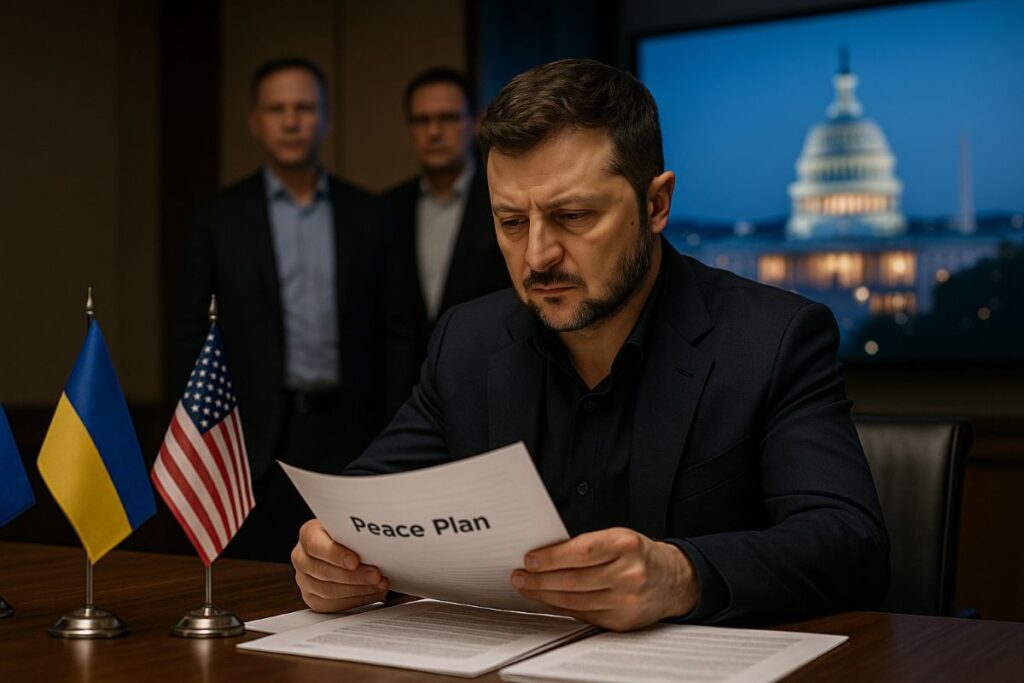
Ukraine’s government has confirmed that it is studying a US-backed draft proposal to end the war with Russia and that President Volodymyr Zelensky is ready for what he calls “honest” work with Washington on the ideas it contains. In Kyiv and in Western capitals, the phrase Zelensky US peace plan has quickly become shorthand for one of the most controversial diplomatic gambits of the war so far.
Behind that phrase is a 28-point framework emerging from talks between the United States and Russia that would lock in a ceasefire, impose strict limits on Ukraine’s future security options, and offer Russia major concessions on territory and sanctions relief. Ukraine’s leadership says it is willing to engage with the proposals, but only within the boundaries of its long-stated “red lines” on sovereignty and territorial integrity.Reuters+1
As the Zelensky US peace plan moves from rumor to active diplomatic project, the stakes are enormous: not just for Ukraine’s future, but for the credibility of Western security guarantees and the global response to territorial aggression.
Background: How We Got to the Zelensky US peace plan
The war began in 2014 with Russia’s annexation of Crimea and escalated into a full-scale invasion in February 2022. Since then, Ukraine has depended heavily on Western military, financial, and intelligence support to blunt Russia’s advances and to try to retake occupied territory. Early peace talks in 2022, including those in Turkey, collapsed over core issues like NATO membership, security guarantees, and the status of Crimea.Wikipedia
By 2025, Ukraine was under mounting pressure. Russian forces had resumed grinding offensives, Western weapons pipelines were increasingly politicized, and public patience in the US and Europe was eroding. Against this backdrop, US officials quietly began drafting a new proposal in consultation with Moscow, a process first exposed by investigative reporting and later confirmed by American and Ukrainian officials.Axios+1
The result is what media and diplomats now refer to as the Zelensky US peace plan: a US-authored framework that Kyiv did not initiate but is now being asked to consider.
What’s Reportedly in the US Draft
While the full text has not been officially released by Washington or Kyiv, multiple outlets that have seen the draft describe a broadly consistent set of terms.The Guardian+3AP News+3Sky News+3
According to those reports, the Zelensky US peace plan would:
Recognize Ukraine’s sovereignty but require it to cede the entire Donbas region to Russia, with Crimea, Luhansk, and Donetsk treated as de facto Russian territory, including by the United States.
Freeze front lines in parts of Kherson and Zaporizhzhia, leaving Russia in control of significant additional territory.
Bar Ukraine from joining NATO and limit the presence of foreign troops on its soil, though EU membership would remain possible.
Cap Ukraine’s armed forces at roughly 600,000 troops, down from around one million currently serving under arms.
Require Ukraine to abandon long-range strike capabilities and accept restrictions on Western military aid over time.
Offer Ukraine US security guarantees that are robust on paper but constrained in practice, with enforcement mechanisms and compensation for Washington’s role still vague or conditional.
Lift many sanctions on Russia, reopen the door to forums like the G8, and offer long-term economic arrangements that would partially reintegrate Moscow into Western markets.
Some versions of the draft also describe a US-led “Peace Council” chaired by the American president to oversee implementation, alongside large reconstruction funds for Ukraine.New York Post+2The Independent+2
In other words, the Zelensky US peace plan as described publicly looks less like a clear Ukrainian victory and more like a managed freeze that locks in many of Russia’s battlefield gains in exchange for promises of future protection.
How Zelensky Is Positioning the Zelensky US peace plan
Publicly, Zelensky is walking a tightrope. After meeting senior US military officials, he said he was ready for “honest” work with Washington on “their vision” of how to end the war, but he stopped short of endorsing any specific concession.Reuters+1
Key Ukrainian officials have repeated three core principles:
Ukraine’s sovereignty and internationally recognized borders, including Crimea, cannot be legally abandoned.
Ukraine must retain the right to self-defense and to maintain armed forces capable of deterring future aggression.
Any deal must be perceived as just by Ukrainian society, not imposed from outside.
At the same time, Kyiv acknowledges that its room for maneuver is shrinking. The Zelensky US peace plan arrives after years of exhausting war, partial Russian advances, and growing doubts about whether Ukraine can fully restore its 1991 borders by force. The leadership’s message is essentially that it will examine the plan, bargain hard, and refuse to cross certain red lines even if the US is pushing for quicker compromise.
European Pushback and Fears of Appeasement
European reactions to the Zelensky US peace plan have been sharply critical. Leaders from EU states, particularly in Eastern and Northern Europe, have warned that codifying Russian territorial gains would reward aggression and undermine the security of every state bordering a revisionist power.The Guardian+2The Guardian+2
Their concerns fall into several categories:
Strategic precedent: If Russia can invade, occupy, negotiate, and keep land, what prevents similar moves against Moldova, Georgia, or even NATO members later?
Alliance unity: A US-brokered deal that sidelines Europe could fracture the transatlantic coalition built since 2022 and weaken deterrence in other theaters.
Legal and moral norms: EU governments have invested heavily in the idea of a “just and lasting peace,” as reflected in UN resolutions that explicitly call for full respect of Ukraine’s territorial integrity.Wikipedia
European capitals are now scrambling to influence the process, convening summits and coalition formats to push for stronger security guarantees for Kyiv and to ensure they are not merely spectators to a US-Russia negotiation over the future of the continent.Wikipedia+1
Russia’s View: Opportunity, but Not Victory
From Moscow’s perspective, the Zelensky US peace plan is an opening, not a final victory. Russian officials have signaled cautious optimism, noting that many of their long-standing demands — including recognition of territorial gains, limits on NATO, and sanctions relief — are now at least on the table.Reuters+1
At the same time, the Kremlin complains that Washington has not yet engaged in detailed talks and that nothing has been formally agreed. Russian messaging serves two goals: putting pressure on Kyiv by portraying the war as “pointless and dangerous” to continue, and framing the US proposal as evidence that Russia’s military pressure is working.
If the Zelensky US peace plan stalls or collapses, Moscow will argue that it was Ukraine, not Russia, that rejected “reasonable” peace terms.
Hard Choices for Kyiv
For Ukraine, the Zelensky US peace plan crystallizes a set of agonizing dilemmas.
Accepting territorial losses and limits on sovereignty could end the war sooner, save lives, and unlock massive reconstruction funds. But it might also fracture the political system, delegitimize the leadership in the eyes of many citizens, and leave the country vulnerable to future coercion from a neighbor that has just been rewarded for invasion.
Rejecting the plan outright would preserve Ukraine’s formal red lines and align with the instincts of many in Ukrainian society. It would also risk alienating a key patron at a time when ammunition stocks, air defenses, and financial support are under strain.
In simple terms, the Zelensky US peace plan forces Kyiv to confront a choice between imperfect peace under pressure and continued war with uncertain prospects.
What Washington Is Really Trying to Achieve
From the US side, the Zelensky US peace plan reflects a blend of strategic fatigue, domestic politics, and a desire to reallocate attention and resources to other crises. The US has poured tens of billions of dollars into supporting Ukraine, faced increasingly polarized debates in Congress, and watched other flashpoints — from the Middle East to the Indo-Pacific — demand more bandwidth.
The proposed framework aims to:
Freeze the conflict before it escalates further or drags NATO into direct war.
Stabilize European security enough to focus on other global priorities.
Shift the narrative from open-ended support for Ukraine to a story of delivering “peace,” even if that peace is contested and partial.
Whether that calculation holds up over time depends on whether the Zelensky US peace plan actually produces a durable settlement or merely a pause before another round of violence.
Scenarios: Where the Zelensky US peace plan Could Go
Several paths are plausible from here.
One scenario is a heavily revised agreement that trims back some of the most controversial concessions, strengthens security guarantees, and is endorsed by Ukraine, the US, and core European states. That would still mean compromise, but one framed as a genuinely multilateral effort.
Another scenario is a shallow “deal” that Kyiv signs under pressure but that Ukrainian society never truly accepts. In that case, political instability, underground resistance in occupied territories, and renewed military clashes would be almost inevitable.
A third scenario is outright rejection. Ukraine could declare that the Zelensky US peace plan violates its constitutional principles and instead push for a different peace track grounded in existing UN and EU frameworks for a “just and lasting” peace. That would likely prolong the war and deepen uncertainty over future Western support.
None of these outcomes fully satisfies every player. That, more than anything, underscores how far the conflict has moved from any easy win-lose narrative.
Bottom Line
The Zelensky US peace plan is not simply another talking point in a long war. It is an attempt by Washington to codify a new security order in Eastern Europe at a moment when Ukraine is under enormous strain, Russia is entrenched, and Europe is wary of being sidelined.
For Ukrainians, the question is whether any version of this proposal can deliver security and justice without betraying the sacrifices already made. For the US and Europe, it is whether they are willing to defend, in practice, the principle that borders cannot be changed by force — or whether they are prepared to accept a compromise that future historians may judge as appeasement.
Whatever Kyiv ultimately decides, the Zelensky US peace plan has forced the world to confront the hardest questions about how this war ends, and at what cost.
Further Reading
Reuters provides detailed reporting on Zelensky’s comments about “honest” work with Washington on the US-backed plan, alongside European objections to the scale of Ukrainian concessions being discussed: https://www.reuters.com/world/europe/europeans-push-back-us-plan-that-would-force-concessions-ukraine-2025-11-20
The Associated Press offers an in-depth look at a leaked version of the draft, describing how the peace plan would formalize Russian control over parts of Donbas and constrain Ukraine’s military and NATO ambitions: https://apnews.com/article/33545b140c5bfbbc5e9061a739802e54
Axios traces how the US secretly worked with Russia to develop the draft before it was formally shared with Kyiv, shedding light on the internal logic and political calculations behind the initiative: https://www.axios.com/2025/11/19/ukraine-peace-plan-trump-russia-witkoff
The Guardian and other European outlets examine why many EU leaders see the proposed concessions as a reward for aggression and a direct challenge to Europe’s own security principles: https://www.theguardian.com/world/2025/nov/21/trump-ukraine-peace-plan-zelenskyy-territory-ceded-nato-russia-g8
An article from the US Army War College explores what a “just” peace in Ukraine might look like, using just-war theory to argue for outcomes that deter future aggression rather than simply freezing current front lines: https://publications.armywarcollege.edu/News/Display/Article/4218028/a-more-perfect-peace-can-the-russia-ukraine-war-end-justly/
Connect with the Author
Curious about the inspiration behind The Unmaking of America or want to follow the latest news and insights from J.T. Mercer? Dive deeper and stay connected through the links below—then explore Vera2 for sharp, timely reporting.
About the Author
Discover more about J.T. Mercer’s background, writing journey, and the real-world events that inspired The Unmaking of America. Learn what drives the storytelling and how this trilogy came to life.
[Learn more about J.T. Mercer]
NRP Dispatch Blog
Stay informed with the NRP Dispatch blog, where you’ll find author updates, behind-the-scenes commentary, and thought-provoking articles on current events, democracy, and the writing process.
[Read the NRP Dispatch]
Vera2 — News & Analysis
Looking for the latest reporting, explainers, and investigative pieces? Visit Vera2, North River Publications’ news and analysis hub. Vera2 covers politics, civil society, global affairs, courts, technology, and more—curated with context and built for readers who want clarity over noise.
[Explore Vera2]
Whether you’re interested in the creative process, want to engage with fellow readers, or simply want the latest updates, these resources are the best way to stay in touch with the world of The Unmaking of America—and with the broader news ecosystem at Vera2.
Free Chapter
Begin reading The Unmaking of America today and experience a story that asks: What remains when the rules are gone, and who will stand up when it matters most? Join the Fall of America mailing list below to receive the first chapter of The Unmaking of America for free and stay connected for updates, bonus material, and author news.
