
Trump and Mamdani: A Surprising Political Alliance
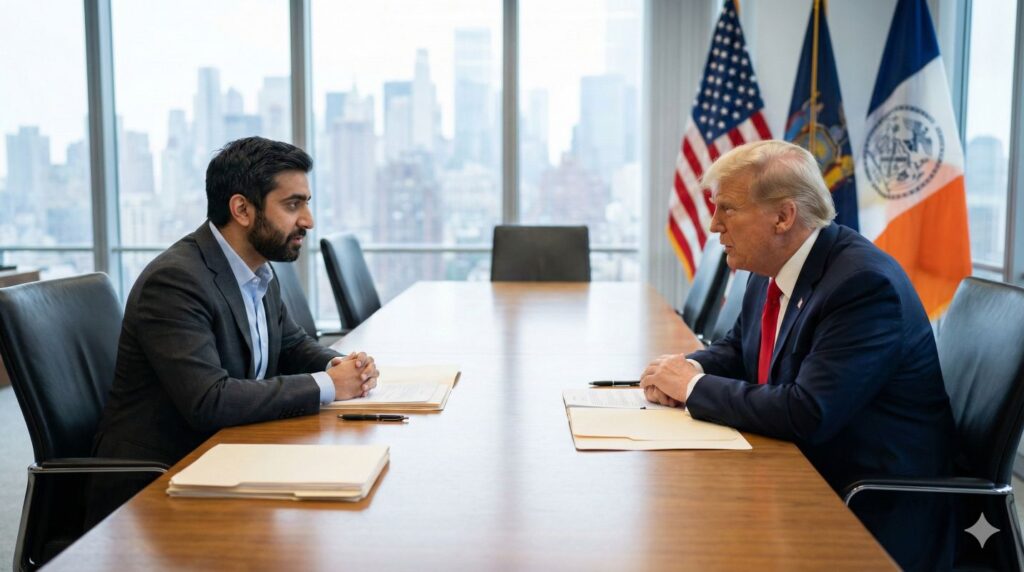
Trump and Mamdani were never supposed to end up in the same room, much less leave it looking like partners instead of sworn enemies. Yet on November 21, 2025, the two men sat down for a private meeting in New York and, at least for an afternoon, put away the labels that have defined them in the national conversation: “fascist” for Trump, “communist” or “radical socialist” for Mamdani. The quiet, almost businesslike tone of the encounter caught even seasoned political observers off guard.
For New Yorkers, the stakes are real. A newly elected mayor whose platform is built on aggressive affordability measures now has to coexist with a president who has already threatened to withhold federal funds from the city and has attacked him personally. The Guardian+1 The question is whether this moment between Trump and Mamdani is a genuine pivot toward cooperation or simply a tactical pause in an ongoing political war.
Context: Who Trump and Mamdani Are Now
To understand why the Trump and Mamdani meeting matters, you have to understand how far apart they start.
Donald Trump, now in his second stint as president, built his political brand on a right-wing populist message: hard lines on immigration, aggressive law-and-order rhetoric, skepticism toward global institutions, and a promise to put “forgotten Americans” first. His first term included a push for large federal infrastructure spending, though much of it remained more slogan than built concrete. Trump White House Archives+1
Zohran Mamdani, by contrast, rose from Queens assemblyman and democratic socialist organizer to become New York City’s first Muslim and South Asian mayor, winning the 2025 race on an unapologetically left-wing agenda centered on rent freezes, fare-free buses, universal childcare, and city-run grocery stores. People.com+2The Guardian+2 His campaign leaned heavily into economic justice, immigrant rights, and Palestinian solidarity, making him a lightning rod for conservative media and for Trump himself, who labeled him a communist and questioned his loyalties. Wikipedia+1
That is the backdrop against which Trump and Mamdani walked into a conference room on November 21. For months, their relationship had been defined by mutual attacks. The fact that they were now trading briefing packets instead of insults was not a small shift.
The November 21 Meeting: From Threats to Transaction
The November 21 meeting between Trump and Mamdani was formally framed as a discussion on federal-city cooperation. According to people familiar with the agenda, staff on both sides came prepared to talk about three main topics: public safety, economic recovery, and infrastructure support for New York City.
The atmosphere reportedly surprised even insiders. Instead of the combative television persona he usually adopts when talking about “radical left cities,” Trump opened with a scripted acknowledgement of Mamdani’s historic election and nodded to New York’s “special place” in his own life and brand. Mamdani, who had spent the campaign calling out Trump’s attacks on immigrants and Muslims, responded with a deliberately calm statement about his responsibility to all New Yorkers, including those who voted against him.
For one afternoon, Trump and Mamdani treated each other less like caricatures and more like negotiating partners. That does not erase the past, but it matters for what comes next.
Shared Goals: Where Trump and Mamdani Overlap
The core of the Trump and Mamdani conversation appears to be brutally pragmatic: money, safety, and visible results.
Both men know New York is facing real strain. The city has been hit by rising housing costs, uneven post-pandemic recovery, ongoing migrant pressures, and persistent fears about crime in certain neighborhoods. Mamdani’s platform centers on making the city more affordable and humane; Trump’s instincts point toward visible order, job creation, and construction-heavy projects that he can hold up as evidence of “making America strong again.” Wikipedia+1
Those priorities collide, but they also overlap. If Trump can claim credit for federal dollars that repair subway lines, stabilize public housing, or fund major bridge and tunnel upgrades, he wins headlines and imagery that fit his infrastructure narrative. If Mamdani can channel that money into projects that lower costs for working-class New Yorkers and improve basic services, he can argue he is delivering on his campaign promises without raising local taxes as aggressively as critics fear.
At least on paper, Trump and Mamdani can both benefit from a structured deal: federal infrastructure and safety funds in exchange for high-profile joint announcements and visible progress on streets, transit, and housing.
Political Risks for Both Sides
None of this happens in a vacuum, and Trump and Mamdani both face real political risk from appearing together.
For Trump, embracing Trump-branded law-and-order politics while simultaneously meeting with one of the most prominent democratic socialists in the country cuts against the “no compromise” image that a large slice of his base demands. Right-wing media personalities have already attacked Mamdani as “anti-police,” “anti-Israel,” and “pro-communist,” framing him as proof of a supposedly dangerous leftward drift in blue cities. Wikipedia+1 Sitting down with someone they have demonized could be read as weakness.
For Mamdani, the danger is even more immediate. His base includes activists, organizers, and young voters who see Trump as an existential threat, not just a political opponent. Many of them are deeply skeptical of any outreach that looks like normalization or appeasement. They remember that Trump threatened to cut off funds to New York and personally targeted Mamdani during the mayoral race. The Guardian+1 To those supporters, the image of Trump and Mamdani shaking hands is not a hopeful symbol; it is a warning sign.
Each man is wagering that the tangible benefits of cooperation will outweigh the backlash. That is a cold, strategic calculation on both sides.
Public Reaction and Media Framing
Public reaction to the Trump and Mamdani meeting has tracked the broader polarization of American politics. Urban voters tend to lean Democratic and are more likely to support progressive policies like those Mamdani campaigned on, while rural voters remain strongly Republican and deeply loyal to Trump. Pew Research Center+2Pew Research Center+2 A high-profile meeting between these two symbolic figures becomes a proxy fight over whether any cross-camp cooperation is acceptable.
Conservative media outlets have emphasized the idea that Trump is “big enough” to sit down with a rival and demand concessions on crime and immigration. Progressive commentators have split into camps: some argue that Mamdani is showing maturity by engaging with power to deliver material gains for working-class New Yorkers, while others warn that Trump will use photos and quotes from the meeting to launder his image without making meaningful concessions.
Centrist and legacy outlets, meanwhile, have treated the story as both a local governance issue and a national test of whether polarization has any practical limits. The subtext is blunt: if Trump and Mamdani can at least talk, it strengthens the argument that other leaders are hiding behind outrage instead of doing the hard work of governing.
Historical Parallels: When Enemies Cut Deals
There is precedent for fierce rivals cutting deals when infrastructure and city budgets are on the line. Trump himself held televised meetings with Democratic and Republican lawmakers in 2018 to sell his infrastructure vision, emphasizing roads, bridges, airports, and broadband while trying to strike a bipartisan tone. Trump White House Archives+1 New York mayors going back decades have wrestled with presidents they attacked on the campaign trail when it came time to negotiate over transit, housing, and disaster relief. Cozen O’Connor
What makes the Trump and Mamdani moment different is the intensity of the ideological gap. Mamdani is not a centrist Democrat cutting a routine budget compromise; he is a democratic socialist who ran on taxing the wealthy, expanding public ownership, and redefining public safety. Wikipedia+1 Trump, for his part, has built his recent political identity on railing against “radical left cities” and painting leaders like Mamdani as threats to American values. The distance between their bases is wider than in older, more transactional eras of New York–Washington politics.
That is why any sustained collaboration would be a genuine break from current norms, not just another photo-op.
What This Could Mean for New York
For New Yorkers, the practical question is simple: does any of this produce results?
In the best-case scenario, the Trump and Mamdani relationship evolves into a tense but functional partnership. Federal funds for transit, public housing modernization, green school retrofits, and flood-resilience projects could move faster if both sides agree to package them as joint wins. That kind of progress would fit Mamdani’s emphasis on climate and equity while giving Trump tangible projects to point to as proof that he can “fix” cities critics say he abandoned. Wikipedia+1
On public safety, there is room for a hard bargain: Trump wants visible enforcement and headlines about crime dropping; Mamdani wants community-based approaches, mental health interventions, and investments that address root causes. A smart policy team could frame a blended strategy as “comprehensive safety,” with both sides taking credit for the pieces that speak to their voters.
The worst-case scenario is equally clear. Trump and Mamdani could revert to insult-trading, with the meeting remembered only as a brief, cynical pause before the next funding threat or press-conference broadside. In that outcome, New Yorkers gain nothing except another reminder that national polarization is strong enough to override local needs.
Bottom Line: Will Trump and Mamdani Matter Beyond the Photo?
The Trump and Mamdani meeting is less about whether two men can get along and more about whether the political system still has room for transactional cooperation across an ideological canyon. In a climate where urban and rural America increasingly live in different political realities, any attempt at collaboration is going to feel suspect to one side or the other. Pew Research Center+2Catalist+2
If Trump and Mamdani follow through with concrete agreements on infrastructure, affordability, and public safety, they will have shown that even bitter adversaries can still cut deals when the incentives line up. If they do not, this will be remembered as just another carefully managed photo-op—one more fleeting moment in a long timeline of performative outrage.
Either way, New Yorkers will judge the alliance not by how many times Trump and Mamdani appear together on camera, but by whether subways run more reliably, rents stop spiraling, streets feel safer, and federal dollars actually reach the neighborhoods that need them most.
Further Reading
People Magazine’s coverage of Zohran Mamdani’s historic 2025 mayoral victory in New York City provides background on his rise from Queens organizer to City Hall and the progressive agenda he campaigned on: https://people.com/zohran-mamdani-defeats-andrew-cuomo-nyc-mayor-election-11837136 People.com
The Guardian’s profile of Zohran Mamdani as New York’s new democratic socialist mayor explores his political roots, his policy platform, and what his election signals for the future of urban progressivism: https://www.theguardian.com/us-news/2025/nov/04/zohran-mamdani-profile The Guardian
Another Guardian report details Mamdani’s all-female transition team and recounts Trump’s earlier threats to withhold federal funding from New York City, framing the tension that made the Trump–Mamdani meeting so unlikely: https://www.theguardian.com/us-news/2025/nov/05/zohran-mamdani-transition-team The Guardian
The official New York State Assembly biography of Zohran K. Mamdani offers a concise look at his background, legislative work, and policy priorities before his successful mayoral run: https://nyassembly.gov/mem/Zohran-K-Mamdani New York Assembly
Pew Research Center’s analysis of partisanship in rural, suburban, and urban communities explains the structural polarization that makes any Trump–city-mayor cooperation politically risky: https://www.pewresearch.org/politics/2024/04/09/partisanship-in-rural-suburban-and-urban-communities/ Pew Research Center
For broader context on the current level of political polarization in the United States and how it shapes attitudes toward cross-party cooperation, see the overview of political polarization in the U.S.: https://en.wikipedia.org/wiki/Political_polarization_in_the_United_States Wikipedia
Trump’s own past efforts to frame himself as an infrastructure president, including meetings with bipartisan lawmakers, are documented in archived White House remarks: https://trumpwhitehouse.archives.gov/briefings-statements/remarks-president-trump-meeting-bipartisan-members-congress-infrastructure/ Trump White House Archives
Connect with the Author
Curious about the inspiration behind The Unmaking of America or want to follow the latest news and insights from J.T. Mercer? Dive deeper and stay connected through the links below—then explore Vera2 for sharp, timely reporting.
About the Author
Discover more about J.T. Mercer’s background, writing journey, and the real-world events that inspired The Unmaking of America. Learn what drives the storytelling and how this trilogy came to life.
[Learn more about J.T. Mercer]
NRP Dispatch Blog
Stay informed with the NRP Dispatch blog, where you’ll find author updates, behind-the-scenes commentary, and thought-provoking articles on current events, democracy, and the writing process.
[Read the NRP Dispatch]
Vera2 — News & Analysis
Looking for the latest reporting, explainers, and investigative pieces? Visit Vera2, North River Publications’ news and analysis hub. Vera2 covers politics, civil society, global affairs, courts, technology, and more—curated with context and built for readers who want clarity over noise.
[Explore Vera2]
Whether you’re interested in the creative process, want to engage with fellow readers, or simply want the latest updates, these resources are the best way to stay in touch with the world of The Unmaking of America—and with the broader news ecosystem at Vera2.
Free Chapter
Begin reading The Unmaking of America today and experience a story that asks: What remains when the rules are gone, and who will stand up when it matters most? Join the Fall of America mailing list below to receive the first chapter of The Unmaking of America for free and stay connected for updates, bonus material, and author news.
