
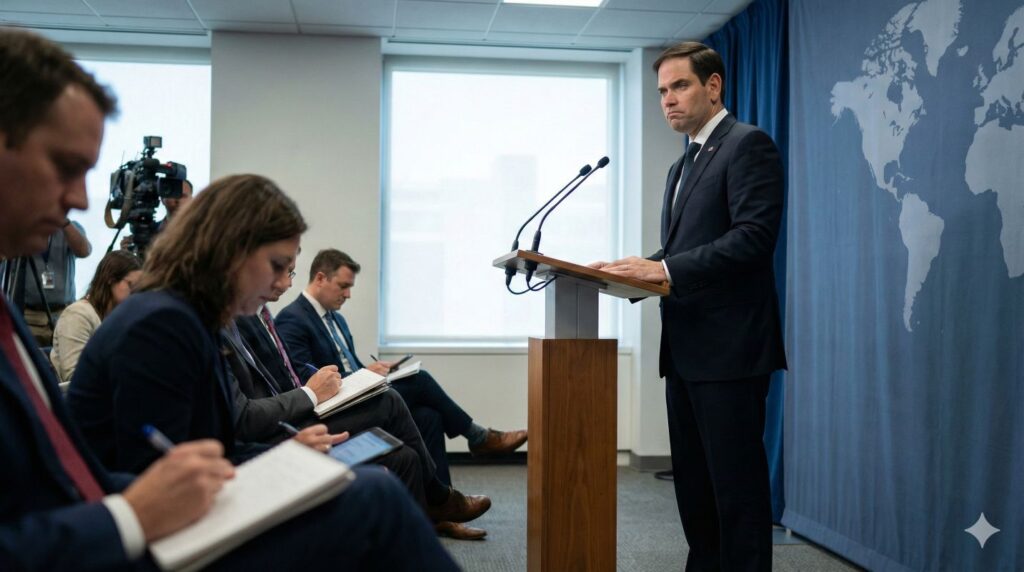
Rubio’s Assertion on the Ukraine peace plan’s Authorship
Secretary of State Marco Rubio’s insistence that the United States authored the Ukraine peace plan has turned what should have been a dry diplomatic document into a political and geopolitical stress test. The fight is not just about who typed the first draft of the Ukraine peace plan. It is about who owns the outcome of the war, who carries the blame if it goes wrong, and whether Washington is quietly shifting from open-ended support for Kyiv to a managed climbdown with Moscow.
Rubio’s pushback against lawmakers who say he described the Ukraine peace plan as Russian in origin is more than a semantic correction. At a moment when Congress is split over continued aid, public patience is thinning, and allies are nervous, claiming U.S. authorship is an attempt to reassert control over a process that increasingly looks like it is being driven by raw fatigue rather than strategy.
The Immediate Dispute Around the Ukraine peace plan
The controversy began when lawmakers from both parties emerged from briefings and suggested Rubio had framed the Ukraine peace plan as a Russian initiative that Washington was merely channeling. In their telling, it sounded like the U.S. was legitimizing a Moscow-designed framework that would freeze Russian gains and limit Ukraine’s future military options.
Rubio responded by insisting that the Ukraine peace plan originated inside the U.S. government, shaped by American diplomats, security officials, and legal advisers. His argument is simple: if the United States is going to put its weight behind an agreement that may redefine Ukraine’s borders and security architecture, then the United States must be clearly seen as the architect, not a courier delivering someone else’s blueprint.
This debate is happening against the backdrop of very real proposals. Reporting has already described a 28-point U.S.-backed framework that would cap Ukraine’s military, restrict NATO’s presence, recognize some Russian territorial control de facto, and channel frozen Russian assets into reconstruction and joint ventures. Reuters+1 That is exactly the kind of deal that makes authorship politically radioactive.
Why the Ukraine peace plan’s Authorship Matters
Authorship of the Ukraine peace plan is not a vanity credit. It is an accountability marker. If Washington truly designed the key trade-offs in the Ukraine peace plan, then Washington is responsible for the consequences: for any territory Ukraine is pushed to relinquish, for any limits on its armed forces, and for any loopholes Russia can exploit later.
Historically, Russia has used “peace agreements” like the Minsk accords to consolidate gains and buy time. Those deals froze the front line without really resolving the underlying conflict, and they ultimately failed to prevent a full-scale invasion. Wikipedia+1 When critics look at the current Ukraine peace plan, they measure it against that history: are we repeating the mistake of locking in an unstable status quo, or finally learning from it?
If the Ukraine peace plan is seen as Russian-authored, it is dead on arrival in Kyiv and likely in parts of Europe. If it is seen as genuinely U.S.-authored, it may survive longer, but it also becomes a direct test of American judgment and reliability. That is why Rubio is so determined to claim ownership—and why opponents are just as determined to force him to wear the details.
Narrative Control and U.S. Strategy
There is also a narrative dimension. For years, U.S. officials have insisted that “nothing about Ukraine without Ukraine,” while at the same time exploring off-ramps, ceasefires, and long-term security compacts. Western aid has reached well over a hundred billion dollars when you combine supplemental appropriations, defence assistance, and broader support programs. Ukraine Oversight+1
In that context, whoever is credited with drafting the Ukraine peace plan is effectively declaring who gets to shape the endgame. Rubio’s line is that the United States must do that job, because the United States is paying most of the bill and carrying most of the diplomatic weight. His critics argue that if the Ukraine peace plan looks more like a face-saving exit for Washington and Moscow than a just peace for Kyiv, the authorship label will be a liability, not an asset.
Political Reactions in Washington
The domestic reaction breaks along familiar fault lines. Ukraine hawks, both Republican and Democrat, fear that the Ukraine peace plan is being used to dress up a retreat. They point to frameworks that would lock in Russian control over Crimea and parts of Donbas and limit Ukraine’s NATO options, and they see a replay of earlier “frozen conflicts” that only postpone the next round of war. European Council on Foreign Relations+1
Skeptics of further aid see the Ukraine peace plan differently. For them, Rubio’s claim of authorship is overdue acknowledgment that the U.S. cannot fund an open-ended conflict while domestic priorities pile up at home. They are less concerned with who wrote the Ukraine peace plan and more focused on using it as the lever to end what they view as an expensive stalemate.
Public opinion offers politicians plenty of cover. Surveys show a growing share of Americans—especially Republicans—say the U.S. is providing too much support to Ukraine, even as a substantial minority still believes the U.S. has a responsibility to help. Pew Research Center+2Pew Research Center+2 That ambivalence allows Rubio to argue that a credible Ukraine peace plan is necessary, while opponents can argue it concedes too much or arrives too late.
How Allies and Ukraine View the Ukraine peace plan
Outside Washington, the authorship fight looks different. European governments have learned the hard way that half-measures in Ukraine become full-blown crises later. They remember how the Minsk agreements failed to stop Russian escalation and how years of “managing” the conflict set the stage for the 2022 invasion. Wikipedia+1
For them, the central question is whether the Ukraine peace plan aligns with Ukraine’s own “peace formula,” not whether Rubio or some Russian envoy gets credit. President Volodymyr Zelensky’s 10-point initiative focuses on nuclear and energy security, food security, release of prisoners and deported children, full territorial restoration, and binding security guarantees. War Ukraine+2Reuters+2 Any Ukraine peace plan that undercuts those principles is going to face resistance in Kyiv and skepticism in major European capitals.
From Ukraine’s perspective, it is even starker. Kyiv has watched proposals emerge that appear to have been drafted with Western domestic politics, not Ukrainian security, as the first priority. A Ukraine peace plan that caps its forces, accepts “temporary” loss of territory, or makes aid conditional on silence about past atrocities is not really a peace plan; it is a managed capitulation. When that document is then branded as a U.S.-authored Ukraine peace plan, Ukrainians understandably wonder whose side Washington is truly on.
Historical Context: From Minsk to the Current Ukraine peace plan
The shadow of earlier agreements hangs over everything. The Minsk deals were sold as the best available path to peace in 2014–2015, backed by European mediators and tolerated by Washington. They were supposed to secure a ceasefire, pull back heavy weapons, and give Donbas a special status within Ukraine. Wikipedia+1
In practice, they neither resolved the political dispute nor stopped the killing. Russia used the breathing space to rearm and prepare for a larger offensive. Ukrainian politics polarized around the perception that the West was always ready to accept “peace” on Russia’s terms. When people now hear about a new Ukraine peace plan, they immediately compare it to that history and ask whether this is Minsk dressed up in different language.
That is the backdrop against which Rubio is asserting authorship. If this Ukraine peace plan repeats the same structural flaws—locking in Russian gains while offering vague promises of future integration and investment—then having “Made in USA” stamped on it will not fix the underlying problem. It will simply shift the blame squarely onto Washington.
Media Narratives and Public Perception of the Ukraine peace plan
Media coverage has framed Rubio’s claim in two main ways. One narrative emphasizes American leadership: in this telling, the Ukraine peace plan is a hard-headed attempt by the United States to impose a realistic settlement on all parties and prevent an endless war of attrition. Another narrative emphasizes abandonment: here, the Ukraine peace plan is portrayed as a top-down diktat forcing Ukraine to accept permanent losses so Washington can move on.
Most people are not reading the fine print of the Ukraine peace plan. They are reacting to cues: whether Ukrainian leaders speak in favor or against it, whether European allies line up behind it, whether Russia sounds a little too enthusiastic, and whether U.S. politicians talk about it as a victory or simply as “the best we can do.” That is where Rubio’s insistence on authorship cuts both ways. If the Ukraine peace plan is broadly seen as fair and enforceable, he looks like a statesman. If it looks like a lopsided bargain, he owns that too.
What Rubio’s Position Reveals About U.S. Foreign Policy
Rubio’s stance on the Ukraine peace plan exposes a deeper tension inside U.S. foreign policy. For years, American leaders have promised to defend democracy, oppose territorial conquest, and stand by Ukraine “for as long as it takes.” At the same time, they are constantly tracking polling data, budget fights, and the risk of direct confrontation with a nuclear-armed Russia.
Claiming authorship of the Ukraine peace plan is an attempt to square that circle: to show that the United States is still leading, still setting the agenda, and still capable of designing an orderly endgame. Whether that is true depends on what is actually inside the Ukraine peace plan: the territorial lines it draws, the enforcement tools it provides, and the guarantees it offers against the next invasion, not just this one.
If the Ukraine peace plan ultimately protects Ukraine’s sovereignty, gives it real security guarantees, and imposes real costs on Russia for future violations, then the authorship dispute will fade. If it does none of those things, the fact that Rubio insists the United States wrote it will haunt Washington long after the ink is dry.
Further Reading
War in Ukraine: Wide Partisan Differences on U.S. Responsibility and Support — Pew Research Center
https://www.pewresearch.org/politics/2024/07/29/war-in-ukraine-wide-partisan-differences-on-u-s-responsibility-and-support/ Pew Research Center
Here’s How Much Aid the United States Has Sent Ukraine — Council on Foreign Relations
https://www.cfr.org/article/how-much-us-aid-going-ukraine Council on Foreign Relations
U.S. Security Cooperation with Ukraine — U.S. Department of State
https://www.state.gov/bureau-of-political-military-affairs/releases/2025/01/u-s-security-cooperation-with-ukraine State Department
Zelenskyy’s 10-Point Peace Plan Explained — Reuters
https://www.reuters.com/world/europe/what-is-zelenskiys-10-point-peace-plan-2022-12-28/ Reuters
Ukraine’s Peace Formula — Official Ukraine Information Site
https://war.ukraine.ua/faq/zelenskyys-10-point-peace-plan/ War Ukraine
The Past, Present, and Future of U.S. Assistance to Ukraine — CSIS
https://www.csis.org/analysis/past-present-and-future-us-assistance-ukraine-deep-dive-data CSIS
Lessons of the Minsk Deal: Breaking the Cycle of Russia’s War Against Ukraine — Institute for the Study of War
https://understandingwar.org/research/russia-ukraine/lessons-of-the-minsk-deal-breaking-the-cycle-of-russias-war-against-ukraine/
Connect with the Author
Curious about the inspiration behind The Unmaking of America or want to follow the latest news and insights from J.T. Mercer? Dive deeper and stay connected through the links below—then explore Vera2 for sharp, timely reporting.
About the Author
Discover more about J.T. Mercer’s background, writing journey, and the real-world events that inspired The Unmaking of America. Learn what drives the storytelling and how this trilogy came to life.
[Learn more about J.T. Mercer]
NRP Dispatch Blog
Stay informed with the NRP Dispatch blog, where you’ll find author updates, behind-the-scenes commentary, and thought-provoking articles on current events, democracy, and the writing process.
[Read the NRP Dispatch]
Vera2 — News & Analysis
Looking for the latest reporting, explainers, and investigative pieces? Visit Vera2, North River Publications’ news and analysis hub. Vera2 covers politics, civil society, global affairs, courts, technology, and more—curated with context and built for readers who want clarity over noise.
[Explore Vera2]
Whether you’re interested in the creative process, want to engage with fellow readers, or simply want the latest updates, these resources are the best way to stay in touch with the world of The Unmaking of America—and with the broader news ecosystem at Vera2.
Free Chapter
Begin reading The Unmaking of America today and experience a story that asks: What remains when the rules are gone, and who will stand up when it matters most? Join the Fall of America mailing list below to receive the first chapter of The Unmaking of America for free and stay connected for updates, bonus material, and author news.
