
Vera2, Civil Rights and Society
Green Card Interviews: When Spouses of U.S. Citizens Face Arrest at Residency Appointments
Nov
Green Card Interviews Result in Arrests for Spouses of U.S. Citizens
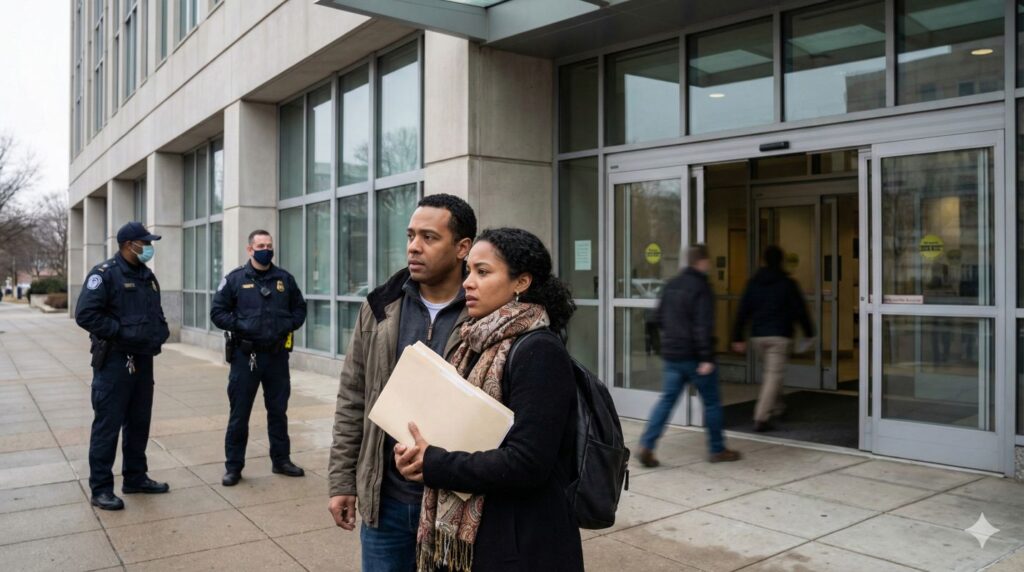
Foreign-born spouses of U.S. citizens are supposed to walk into their final residency appointments expecting closure: proof of a bona fide marriage, a stamp in the passport, and a path to a secure future. Instead, a growing number are being handcuffed and taken into detention at those same Green Card Interviews, accused of past immigration violations and funneled into deportation proceedings. Green Card Interviews that once symbolized stability are becoming flashpoints in a far more aggressive interior enforcement strategy.
This shift has profound implications for family unity, due process, and public trust in the immigration system. It is also happening at a time when federal agencies are rolling back safeguards around “sensitive locations” and expanding the use of fast-track deportation tools, giving Immigration and Customs Enforcement (ICE) broader leeway to target anyone without legal status. migrationpolicy.org+1
What Green Card Interviews Are Supposed To Be
In theory, Green Card Interviews are a benefits process, not an enforcement trap. U.S. Citizenship and Immigration Services (USCIS) was created to focus on administering immigration benefits, while ICE and Customs and Border Protection (CBP) handle enforcement and border security. USCIS+1
For marriage-based cases, the steps usually look like this:
A U.S. citizen files a petition for their spouse.
The spouse submits an application for permanent residence, often disclosing past entries, overstays, or prior removal orders.
USCIS schedules a Green Card Interview to confirm the relationship is real and to verify eligibility.
Historically, couples walked into USCIS field offices expecting tough questions, document checks, and sometimes follow-up visits, but not handcuffs. The underlying assumption was that if the government invited you to resolve your status through Green Card Interviews, it would not simultaneously ambush you for trying to fix your situation.
That assumption no longer holds.
Arrests During Green Card Interviews: How We Got Here
The pattern of arrests at Green Card Interviews is not hypothetical. Civil rights groups documented it clearly in 2018, when several spouses of U.S. citizens in New England were detained at USCIS facilities immediately after marriage interviews. In one widely reported case, Lilian Calderon, a mother of two who had lived in the United States since she was three years old, attended a required interview with her U.S. citizen husband and ended up in ICE detention instead of walking out with progress toward a green card. American Civil Liberties Union+1
Emails unearthed in litigation showed ICE and USCIS coordinating to “spread the interviews over time” so enforcement agents could more easily detain people showing up to legalize their status. The ACLU called it a “trap,” and courts allowed lawsuits against ICE to move forward, recognizing that these kinds of Green Card Interviews raised serious constitutional questions. American Civil Liberties Union+1
Advocacy pressure pushed the government to dial back the practice in some regions. But as administrations changed and enforcement priorities shifted again, ICE signaled it might resume arresting people at interviews to change legal status, effectively re-opening the door to detention at Green Card Interviews for those with past removal orders or other immigration violations. ACLU of Rhode Island+1
A New Enforcement Climate Around Benefits Offices
These arrests at Green Card Interviews are not happening in isolation. They sit inside a much broader interior enforcement push.
Recent policies have:
Expanded the use of expedited removal, a fast-track deportation process that limits access to immigration judges and can send people out of the country based largely on the determination of a single officer. Forum Together+1
Rescinded “protected” or “sensitive” area guidance, making it easier for ICE and CBP to carry out enforcement near places that were once functionally off-limits, such as schools, hospitals, and churches. Department of Homeland Security+2NAFSA+2
Shut down or weakened internal oversight offices inside the Department of Homeland Security (DHS) that had previously fielded complaints, investigated abuses, and served as a check on heavy-handed enforcement. The Washington Post+1
At the same time, ICE has reported record levels of deportations from inside U.S. communities, as opposed to at the border, reflecting a deliberate shift toward more aggressive interior operations. migrationpolicy.org+1
In that context, using Green Card Interviews as arrest points is less an anomaly and more a logical extension of a system that treats any undocumented presence as fair game, even when the person is actively trying to legalize their status through the channels the government itself designed.
Human Cost: Families Torn Apart at the Door
The most immediate impact of arrests at Green Card Interviews is on the families caught in the crossfire.
For many couples, the Green Card Interview is the culmination of months or years of paperwork, fees, and scrutiny. Children often believe a parent is finally “getting papers” and will be safe. When an arrest happens at that moment, the psychological shock is severe. Testimony in lawsuits and advocacy reports describes U.S. citizen spouses watching their partners led away in handcuffs, sometimes without clear information about where they are being taken or how to contact them. ACLU of Massachusetts+1
Once a spouse is detained:
Families may lose their primary breadwinner overnight, triggering immediate financial crisis.
Children experience anxiety, nightmares, and school disruptions. In communities subject to heavy enforcement, schools have reported waves of absences after raids and arrests, as families keep kids home out of fear. The Washington Post
U.S. citizen family members are forced to navigate a maze of detention rules, bond hearings, and immigration court dates—if the detained person even gets a full hearing instead of expedited removal. USAGov+1
When this trauma is tied specifically to Green Card Interviews, it erodes trust in the legal process itself. If showing up for a scheduled residency interview can result in detention, word spreads quickly. People who might have been eligible for relief or adjustment of status decide instead to remain in the shadows, skipping appointments and avoiding any government contact.
That is not a side effect; it is a feature of deterrence-based policy. By making examples out of people at Green Card Interviews, the system sends a broader message: no appointment is truly safe.
Legal and Policy Questions Raised by Green Card Interviews Arrests
The use of Green Card Interviews as arrest sites raises serious legal and policy concerns.
First, there is the question of due process. While immigration proceedings do not carry the full set of criminal procedural protections, noncitizens still have constitutional rights, including the right to fair process before being removed from the country. When ICE arrests someone at Green Card Interviews and shunts them rapidly into expedited removal, the opportunity to present a case, gather evidence, or consult counsel can be drastically curtailed. Forum Together+1
Second, there is the integrity of the benefits system itself. USCIS policy manuals emphasize that officers are supposed to follow clear procedures when adjudicating applications, and that the agency’s role is distinct from enforcement. USCIS+1 But when applicants see Green Card Interviews used as bait for enforcement operations, the line between benefits and enforcement effectively disappears.
Third, there is the principle of family unity. U.S. immigration law has long recognized the importance of keeping families together, particularly in marriage-based cases where a U.S. citizen is sponsoring a spouse. Yet arrests at Green Card Interviews routinely shatter exactly those families, sometimes pushing them into years of separation while cases wind through overloaded immigration courts. ACLU of Massachusetts+1
Finally, there is the broader policy question: does this approach actually make communities safer? Government descriptions of ICE’s mission emphasize targeting threats to public safety and national security. ICE+2Department of Homeland Security+2 But many people detained at Green Card Interviews have no criminal record; their “violation” is a prior deportation order or an overstay. Using limited enforcement resources on these cases undermines claims that the system is focusing on the most dangerous individuals.
How Families Can Reduce Risk Around Green Card Interviews
No one can fully “safe-proof” Green Card Interviews in the current climate, but there are steps families can take to reduce risk and avoid walking in blind.
Couples should know whether the foreign-born spouse has any past removal orders, voluntary departure orders, or criminal convictions, even minor ones. Old cases that seemed “dead” often come back to life during Green Card Interviews because biometric checks surface records from years ago.
Consulting a qualified immigration attorney before attending Green Card Interviews is critical if there is any history of prior entries, prior deportations, or contact with immigration authorities. Attorneys can advise on whether adjustment of status is legally available or whether filing will simply flag the person for enforcement.
Where possible, having legal counsel accompany the couple to Green Card Interviews can make a difference in what happens if ICE appears at the door. At minimum, it ensures there is a professional witness who can act quickly if detention occurs.
Families should understand that they have rights even in civil immigration settings, including the right to remain silent, the right to request to speak with a lawyer, and the right to ask for documentation of any order being served.
None of this eliminates the risk that Green Card Interviews could turn into enforcement events, especially for those with past removal orders. But it shifts families from helpless surprise into informed, if still constrained, decision-making.
Community Response and Pushback
Advocacy organizations are not just documenting these incidents; they are fighting back.
The ACLU and other legal groups have taken ICE to court over arrests at Green Card Interviews, challenging the way the government coordinates between USCIS and enforcement agents and arguing that these practices violate due process and the principle of fair notice. ACLU of Massachusetts+1
Immigrant rights groups are pushing for legislation like the Protecting Sensitive Locations Act, which would limit enforcement actions in and around key public spaces and facilities. While USCIS field offices have not traditionally been classified as “sensitive locations,” the broader push to carve out basic safe zones reflects a growing recognition that enforcement without limits corrodes public trust. American Immigration Council+1
At the state and local level, some officials are working with community organizations to provide Know Your Rights trainings specifically tailored to people heading into Green Card Interviews. Others are pressing federal agencies for transparency: How often are arrests at interviews happening? Under what policies? With what outcomes?
Why Green Card Interviews Arrests Matter Beyond Immigration
The way a country treats people at the most vulnerable points of the system tells you a lot about its actual values.
Arresting spouses at Green Card Interviews sends several messages at once:
It signals that voluntary compliance and good-faith attempts to legalize status will not be rewarded, but punished.
It normalizes the idea that even clearly family-based immigration processes can be weaponized for mass removal.
It spreads fear far beyond those directly targeted, as friends, neighbors, and coworkers reassess whether any contact with the government is safe.
In the long run, that is bad for everyone. Communities where large numbers of people distrust law enforcement and government agencies are less likely to report crimes, cooperate as witnesses, or seek medical care when needed. Children who watch a parent taken away at Green Card Interviews carry that trauma into adulthood, with consequences for health, education, and civic engagement. The Washington Post+1
If the United States is serious about both security and fairness, it cannot continue to use Green Card Interviews as quiet arrest points for people whose primary “offense” is trying to legalize their lives with their families.
Further Reading
ACLU – “Mother of Two Goes to Immigration Interview and Ends Up in ICE Detention”
https://www.aclu.org/news/immigrants-rights/mother-two-goes-immigration-interview-and
ACLU of Massachusetts / Rhode Island – “Court: Case against ICE will move forward”
https://www.aclum.org/press-releases/court-case-against-ice-will-move-forward/
ACLU – “ICE Says It May Once Again Arrest and Detain Immigrants Showing Up For Interviews to Change Their Legal Status”
https://www.aclu.org/press-releases/ice-says-it-may-once-again-arrest-and-detain-immigrants-showing-interviews-change
CBS Boston – “ACLU: Officials Set Up ‘Trap’ To Arrest Immigrants At Legal Status Interviews”
https://www.cbsnews.com/boston/news/immigrants-legal-status-interviews-arrest-trap-ice-boston/
Migration Policy Institute – “A New Era of Immigration Enforcement Unfolds in the U.S. Interior”
https://www.migrationpolicy.org/news/new-era-enforcement-trump-2
USA.gov – “Understand the deportation process”
https://www.usa.gov/deportation-process
DHS – “Immigration Enforcement Overview”
https://www.dhs.gov/topic/immigration-enforcement-overview
Connect with the Author
Curious about the inspiration behind The Unmaking of America or want to follow the latest news and insights from J.T. Mercer? Dive deeper and stay connected through the links below—then explore Vera2 for sharp, timely reporting.
About the Author
Discover more about J.T. Mercer’s background, writing journey, and the real-world events that inspired The Unmaking of America. Learn what drives the storytelling and how this trilogy came to life.
[Learn more about J.T. Mercer]
NRP Dispatch Blog
Stay informed with the NRP Dispatch blog, where you’ll find author updates, behind-the-scenes commentary, and thought-provoking articles on current events, democracy, and the writing process.
[Read the NRP Dispatch]
Vera2 — News & Analysis
Looking for the latest reporting, explainers, and investigative pieces? Visit Vera2, North River Publications’ news and analysis hub. Vera2 covers politics, civil society, global affairs, courts, technology, and more—curated with context and built for readers who want clarity over noise.
[Explore Vera2]
Whether you’re interested in the creative process, want to engage with fellow readers, or simply want the latest updates, these resources are the best way to stay in touch with the world of The Unmaking of America—and with the broader news ecosystem at Vera2.
Free Chapter
Begin reading The Unmaking of America today and experience a story that asks: What remains when the rules are gone, and who will stand up when it matters most? Join the Fall of America mailing list below to receive the first chapter of The Unmaking of America for free and stay connected for updates, bonus material, and author news.
