
Vera2, Global Affairs
South Africa Responds to U.S. G20 Boycott and Threat of Exclusion from 2026 Summit
Nov
-
South Africa responds to U.S. G20 boycott and escalated exclusion
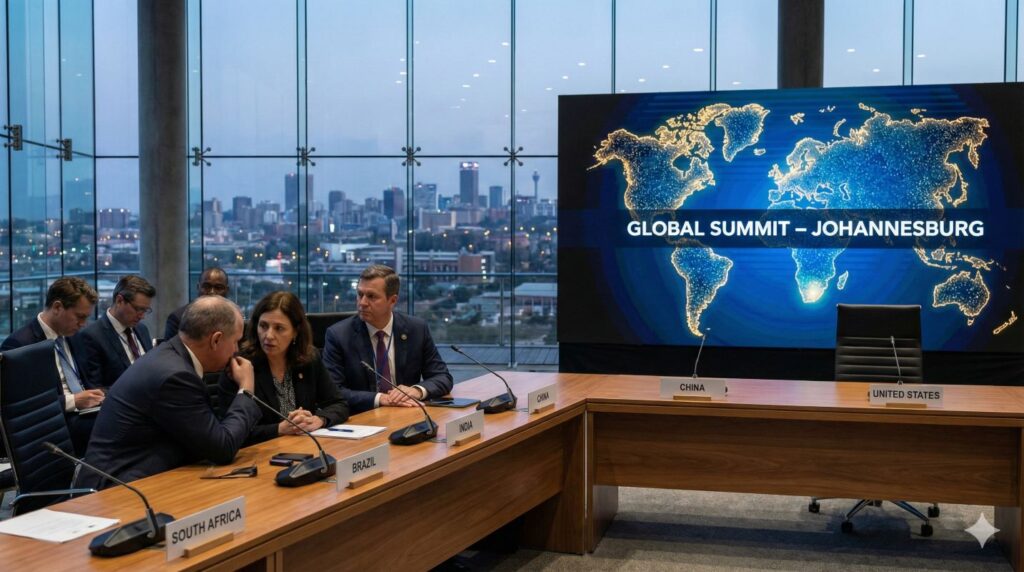
The diplomatic fallout from the U.S. G20 boycott of the Johannesburg summit is not a one-day story. It has triggered a deeper rupture between Washington and Pretoria, sharpened long-running disputes about race and land in South Africa, and raised hard questions about whether the G20 can still function as a credible forum when one of its most powerful members chooses to stay away.
At the center of this standoff is the U.S. G20 boycott justified by claims that South Africa persecutes its white minority, particularly Afrikaner farmers. Those allegations are widely rejected by independent researchers and South African courts, but they are now being used to justify tariffs, aid cuts, a refugee program aimed at white South Africans, and an attempt to bar South Africa from the 2026 G20 summit in Florida. PBS+4AP News+4The Guardian+4
South Africa has chosen not to take this quietly.
Background on the G20 boycott
The Johannesburg summit marked the first time the G20 met on African soil, a symbolic moment for countries arguing that the global economic agenda should reflect the priorities of the Global South. South Africa, as host, pushed issues like climate adaptation finance, debt relief, and widening representation in global institutions to the top of the agenda. Brookings+3AP News+3G20+3
The United States, under President Donald Trump, chose to skip the meeting entirely. The G20 boycott was publicly justified on two grounds: accusations that South Africa’s government discriminates against white Afrikaners and anger over Pretoria’s refusal to let a junior U.S. diplomat formally receive the rotating G20 presidency during the closing ceremony. U.S. officials claimed these issues made South Africa an unfit host and framed the G20 boycott as a principled stand for human rights and protocol. The Guardian+2AP News+2
Most independent observers were not convinced. Fact-checks have consistently found no evidence of a state-backed “genocide” or systematic campaign to “kill white farmers,” despite high overall crime levels that affect South Africans of all races. Wikipedia+3Wikipedia+3Al Jazeera+3 International experts on post-apartheid inequality point out that white South Africans still hold disproportionate wealth and land compared with the Black majority, even as the country battles deep poverty, unemployment, and violent crime that cut across racial lines. Wikipedia+2THE DANDELION PHILOSOPHY+2
Seen in that context, the G20 boycott looks less like a narrowly targeted protest and more like one more step in an already deteriorating relationship, layered on top of revived tariffs, a major aid freeze, and a U.S. refugee program specifically for white South Africans. Wikipedia+2Carnegie Endowment+2
Apartheid’s legacy and today’s realities
South Africa’s post-apartheid record is messy but not mysterious. Since 1994 the country has built formal democratic institutions, extended the franchise to all adults, and dismantled the legal architecture of white rule. At the same time, economic inequality remains among the worst in the world, and much of that inequality still tracks the old racial lines. Wikipedia+2Al Jazeera+2
That complexity is exactly why many South Africans view the G20 boycott as a deliberate distortion. It takes a real problem – high rural crime and incomplete land reform – and forces it into the frame of a “racial persecution” narrative that conveniently aligns with a broader “white genocide” conspiracy theory. PBS+1
South Africa’s official response
South Africa’s government has responded to the G20 boycott in stages: first by refusing to bend protocol to accommodate the absent U.S. delegation, then by publicly contesting the narrative coming out of Washington, and finally by denouncing the subsequent move to bar South Africa from the 2026 G20 meeting in Florida. Reuters+4The Guardian+4AP News+4
President Cyril Ramaphosa used his closing remarks at the Johannesburg summit to underscore that South Africa had followed G20 rules by properly handing over the presidency, even with the U.S. seat empty. He framed the U.S. absence as a political choice, not a procedural failure, and insisted that the G20 should remain an inclusive forum even when members disagree fiercely. G20 Conference+3The Guardian+3AP News+3
After President Trump announced that South Africa would not be invited to the 2026 summit in Miami, Pretoria’s language hardened. Officials branded the decision “punitive” and said it was based on “misinformation” and “distortions” about the country’s internal policies. They rejected the idea that Washington can unilaterally exclude a founding member of the group and emphasized that the G20 is a multilateral forum, not a U.S.-owned club. The Guardian+2Reuters+2
South Africa’s foreign ministry has also reminded observers that, for decades, U.S. administrations of both parties viewed democratic South Africa as a strategic partner, with cooperation on health, trade, security, and regional diplomacy. That history sits awkwardly next to the current rhetoric portraying Pretoria as a rogue state engaged in racial persecution. Wikipedia+2State Department+2
Domestic politics inside South Africa
Inside South Africa, the G20 boycott is playing into existing debates about foreign policy and national pride. Critics of the ruling African National Congress argue that Ramaphosa’s government has mishandled relations with Washington by aligning too closely with Russia and China and by taking high-profile stances, such as bringing a genocide case against Israel at the International Court of Justice, that antagonize U.S. policymakers. Supporters counter that the government is within its rights to pursue a non-aligned, sovereignty-focused foreign policy and that the boycott proves the U.S. is punishing South Africa for not falling into line. Wikipedia+1
Either way, the G20 boycott has become shorthand in South African politics for a wider argument: should the country bend to U.S. pressure to protect trade and investment, or stand its ground even if that carries economic costs?
U.S. domestic politics and the G20 boycott
The G20 boycott also serves a domestic purpose in the United States. It slots neatly into a narrative that presents the Trump administration as a defender of “persecuted” white communities abroad and a skeptic of multilateral institutions at home. Previous decisions to cut aid, restore tariffs, and create a refugee stream aimed at white South Africans all move in the same direction. Carnegie Endowment+3Wikipedia+3PBS+3
At the same time, the G20 boycott feeds into a broader pattern of treating global forums as disposable. If the G20 summit produces a communique on climate, inequality, or gender that the White House dislikes, the administration’s answer is not to argue within the room but to walk out of the room and then question the legitimacy of the outcome from afar. World Economic Forum+3The Guardian+3AP News+3
That posture may play well among voters suspicious of globalization, but it leaves U.S. influence on the table. When Washington skips meetings, other powers do not stop talking; they simply move on without the U.S. at the G20 table.
International reactions and the G20’s credibility
The G20 boycott has rattled other members. European governments, in particular, have made it clear they do not want to see South Africa sidelined. Germany has already called on Washington to reverse its move to exclude South Africa from the Florida summit and stressed that the G20’s strength lies in its inclusivity, not its ideological purity. Reuters+2Brookings+2
For emerging economies in Africa, Asia, and Latin America, the episode sends a different but equally troubling message: membership and hosting rights can be politicized. If a single powerful member can use a G20 boycott and threats of exclusion to discipline a host country, then the group starts to look less like a collective steering committee for the global economy and more like another arena for great-power score-settling. AP News+2Brookings+2
That is exactly what the G20 was supposed to avoid. The point of the forum was to bring systemically important economies into the same room and keep them there even when they disliked each other’s domestic policies. If the default answer to disagreements becomes a G20 boycott, the institution’s value erodes fast.
Economic and diplomatic fallout
Beneath the headline politics, there are concrete risks. The United States is one of South Africa’s largest trade and investment partners, with billions of dollars in two-way commerce and tens of thousands of jobs tied to U.S. companies operating in South Africa. Wikipedia+2State Department+2
The G20 boycott and associated sanctions, tariffs, and aid cuts add friction to that relationship. Investors hate uncertainty. If the dispute escalates further – for example, through visa bans on South African officials or additional sector-specific tariffs – it becomes harder for businesses to plan long-term. The damage will not fall only on government officials; it will hit workers and households in both countries.
Diplomatically, the G20 boycott leaves gaps in areas where cooperation actually matters: climate adaptation, health security, regional conflict mediation, and access to critical minerals. South Africa is a key player in continental politics and a significant source of minerals needed for the energy transition. Freezing it out of G20-level dialogue does not make those realities disappear; it just makes it more likely that other partners, including China and the European Union, will step in. Wikipedia+2G20+2
Why this G20 boycott matters
It would be easy to treat the G20 boycott as another loud but temporary diplomatic quarrel. That would be a mistake.
First, the framing matters. Anchoring a major foreign-policy move on claims of racial persecution that conflict with the best available evidence pushes mainstream politics closer to fringe conspiracy narratives. Once a term like “genocide” is thrown around loosely in the context of the G20 boycott, it becomes harder to use the word seriously when real atrocities occur. PBS+1
Second, the precedent matters. If the United States can justify a G20 boycott on the basis of contested domestic policies in the host state, other countries can copy that playbook. Over time, that kind of tit-for-tat boycotting turns the G20 from a problem-solving forum into a stage for walkouts and performative outrage.
Third, the signal to the Global South matters. The G20 boycott of the first summit ever held in Africa sends a blunt message to governments that have been told for years the system is opening up to them. It says that even when they finally get a seat at the top table, that table can be flipped over the moment powerful states dislike what they see.
In the end, South Africa will keep trading, the U.S. will keep projecting power, and the G20 will probably convene again next year, whether in Miami or somewhere else. But the cost of this G20 boycott will show up in quieter ways: in frayed trust, in hardened narratives, and in the slow erosion of the idea that global challenges are best tackled with everyone at the same table, even when they cannot stand each other.
Further Reading
Associated Press: “The G20 summit in South Africa ends with the glaring absence of the US after Trump’s boycott”
https://apnews.com/article/76e36aa669a8e05ff5ad5495cc1252ed AP NewsThe Guardian: “Cyril Ramaphosa closes G20 summit after US boycott and handover row”
https://www.theguardian.com/world/2025/nov/23/cyril-ramaphosa-gavel-g20-summit-us-handover The GuardianReuters: “Trump says South Africa won’t receive invitation to G20 in 2026”
https://www.reuters.com/world/africa/trump-says-south-africa-wont-receive-invitation-g20-2026-2025-11-26/ ReutersThe Guardian: “South Africa hits back at ‘punitive’ Trump move to bar it from G20 meeting in Florida”
https://www.theguardian.com/world/2025/nov/27/south-africa-hits-back-trump-move-g20-meeting-florida-2026 The GuardianWorld Economic Forum: “What is the G20 and why does it matter?”
https://www.weforum.org/stories/2025/11/g20-summit-what-you-need-to-know/ World Economic ForumPBS NewsHour: “Fact-checking Trump’s claims of white farmer ‘genocide’ in South Africa”
https://www.pbs.org/newshour/politics/fact-checking-trumps-claims-of-white-farmer-genocide-in-south-africa PBS
Connect with the Author
Curious about the inspiration behind The Unmaking of America or want to follow the latest news and insights from J.T. Mercer? Dive deeper and stay connected through the links below—then explore Vera2 for sharp, timely reporting.
About the Author
Discover more about J.T. Mercer’s background, writing journey, and the real-world events that inspired The Unmaking of America. Learn what drives the storytelling and how this trilogy came to life.
[Learn more about J.T. Mercer]
NRP Dispatch Blog
Stay informed with the NRP Dispatch blog, where you’ll find author updates, behind-the-scenes commentary, and thought-provoking articles on current events, democracy, and the writing process.
[Read the NRP Dispatch]
Vera2 — News & Analysis
Looking for the latest reporting, explainers, and investigative pieces? Visit Vera2, North River Publications’ news and analysis hub. Vera2 covers politics, civil society, global affairs, courts, technology, and more—curated with context and built for readers who want clarity over noise.
[Explore Vera2]
Whether you’re interested in the creative process, want to engage with fellow readers, or simply want the latest updates, these resources are the best way to stay in touch with the world of The Unmaking of America—and with the broader news ecosystem at Vera2.
Free Chapter
Begin reading The Unmaking of America today and experience a story that asks: What remains when the rules are gone, and who will stand up when it matters most? Join the Fall of America mailing list below to receive the first chapter of The Unmaking of America for free and stay connected for updates, bonus material, and author news.
