
Vera2, Civil Rights and Society, Global Affairs
Quebec secularism law: Bill 9 and the next phase of “laicity”
Nov
Quebec secularism law: Bill 9 and the next phase of “laicity”
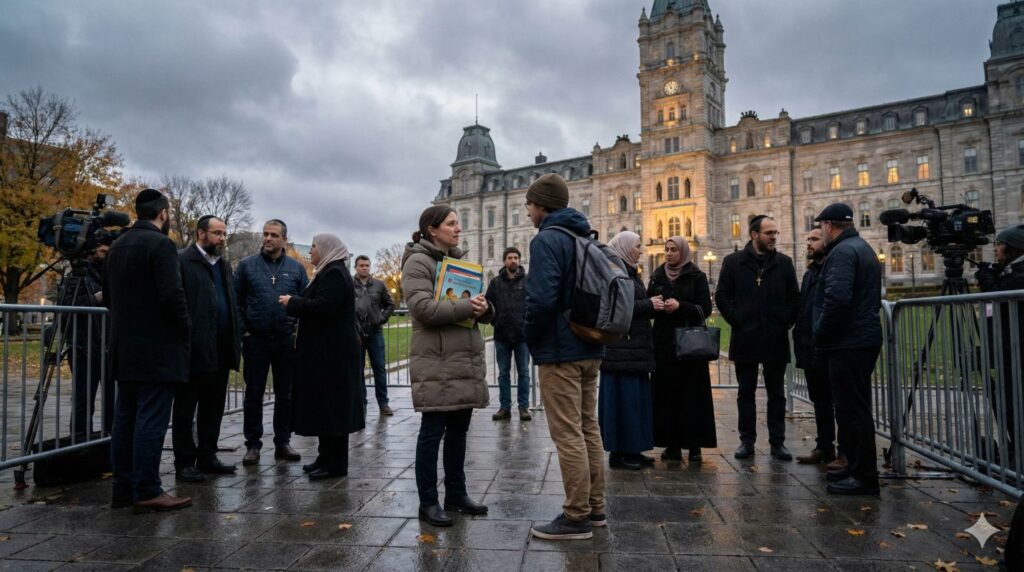
Quebec’s latest move to tighten its approach to religion in public life pushes the long-running debate over the Quebec secularism law into a new and more contentious phase. The Legault government’s new bill, tabled on November 27, 2025, goes well beyond the original 2019 framework and directly targets daycares, CEGEPs, universities, and even prayer rooms on campus. Supporters describe it as “Secularism 2.0.” Opponents call it a direct assault on religious freedom that disproportionately harms minorities.
As the rest of Canada watches closely, the new Quebec secularism law has become a test case for how far a democratic government can go in enforcing state neutrality before it crosses into discrimination.
Overview of the new bill — Quebec secularism law
The new bill, often referred to as Bill 9, sits on top of the existing 2019 Act respecting the laicity of the State, commonly known as Bill 21. That earlier Quebec secularism law already barred many public officials in positions of authority, including teachers, police officers, judges, and certain civil servants, from wearing visible religious symbols such as hijabs, turbans, kippahs, or large crosses while on duty. CCLA+1
Bill 9 significantly widens that framework. According to reporting by The Canadian Press, the new Quebec secularism law would ban religious symbols for people working in daycares, colleges, universities, and many private schools that receive public subsidies. It would also prohibit full face coverings, including the niqab, for staff and students in those institutions. Similar rules were already imposed on elementary and high schools in a separate bill earlier in 2025. Lethbridge News Now+2Winnipeg Free Press+2
The bill also bans prayer rooms in public institutions, especially colleges and universities, and places tighter conditions on public funding for roughly 50 subsidized private religious schools. Those schools would be barred from teaching religion during regular classroom hours if they want to keep their funding. Lethbridge News Now+2CityNews Halifax+2
Quebec’s secularism minister, Jean-François Roberge, has framed the bill as a natural extension of the province’s longstanding push for laïcité, saying that “Quebecers have advanced since 2019” and that it is now necessary to “strengthen our model of secularism.” CityNews Halifax+1
How we got here: from Bill 21 to “Secularism 2.0”
To understand why the new Quebec secularism law is so divisive, you have to go back to Bill 21 in 2019. That law, passed by the Coalition Avenir Québec government, declared Quebec a secular state and barred many newly hired public employees in positions of authority from wearing religious symbols at work. It also required some people receiving public services to uncover their faces for identification purposes. CCLA+2Concordia University+2
Bill 21 used Canada’s constitutional “notwithstanding clause” to override key Charter rights, including freedom of religion and equality protections. That meant courts could recognize that the Quebec secularism law violated rights but still be forced to let it stand. Multiple civil liberties organizations and religious groups challenged the law anyway, and in early 2025 the Supreme Court of Canada agreed to hear the case, with the federal government pledging to intervene against Bill 21. The Guardian+2NCCM+2
Even before Bill 9, research showed that Bill 21 had concrete social costs. A 2022 survey on Law 21’s impact found high levels of reported discrimination, alienation, and fear among Sikh and Muslim respondents in Quebec. Many reported increased exposure to hate incidents and a weaker sense of belonging since the Quebec secularism law came into force. ACS Metropolis+2Cult MTL+2
Bill 9 arrives in that context: on top of a contested legal foundation, with evidence of real harms to minority communities already on the table, but with the government still arguing that more secularism is the answer.
Supporters’ view: neutrality, cohesion, and “how we live in Quebec”
Supporters of the new Quebec secularism law say the province is simply finishing the job it started in 2019. For them, state neutrality is not just an abstract principle; it is part of Quebec’s modern identity. They argue that visible religious symbols on authority figures can create an impression of bias and that banning them in more institutions is a reasonable limit in a secular democracy. Lethbridge News Now+2CityNews Halifax+2
Roberge and his allies insist the law is universal and does not single out any one faith. From their perspective, a ban on hijabs, turbans, kippahs, and large crosses in certain public roles treats all religions equally and protects citizens from feeling pressured or judged on religious grounds when they interact with the state. Lethbridge News Now+2The Catholic Register+2
They also describe the clampdown on prayer rooms and public prayers as a response to growing social tensions, including street prayers at pro-Palestinian demonstrations in Montreal. In that framing, the Quebec secularism law is a way to prevent religion from spilling into political protest and public services, keeping a clear boundary between personal belief and shared civic spaces. The Guardian+1
Arguments about integration and shared rules
Another recurring argument from supporters is that a consistent Quebec secularism law actually helps integration. They say that clear, firm rules about what is and is not allowed in public institutions reduce ambiguity, make expectations transparent for immigrants and newcomers, and help avoid case-by-case fights that can fuel resentment on all sides. Lethbridge News Now+1
In this view, restrictions on religious symbols at work are just one more condition of public employment, no different from dress codes or conflict-of-interest rules. If someone does not want to follow those conditions, they are free to choose a different job. That is the line many secularism advocates have drawn since Bill 21 and are now extending under Bill 9.
Critics’ view: discrimination hidden behind the Quebec secularism law
Civil rights groups, many religious organizations, and a significant portion of the wider Canadian public see the new Quebec secularism law very differently. The Canadian Civil Liberties Association has denounced Bill 9 as “yet another assault on religious freedoms, equality, and basic human dignity,” arguing that it masks discrimination as secularism. CCLA+2CCLA+2
Organizations representing Muslims, Sikhs, and Jews say the law in practice targets minorities with visible religious practices, especially Muslim women who wear the hijab or niqab, Sikh men and women who wear turbans, and observant Jews who wear kippahs. They stress that the choice to bar such people from daycare jobs, teaching, or public-sector work is not neutral; it forces them to choose between their faith and their careers. NCCM+2ACS Metropolis+2
Daycares, campuses, and the message to children
The new focus on daycares and higher education adds another layer of controversy. Banning religious symbols and face coverings for daycare workers sends a sharp message about whose identities are considered acceptable around very young children. Critics argue that the Quebec secularism law implicitly tells kids that certain forms of religious expression are incompatible with public life, baking stigma into the earliest educational environments. Winnipeg Free Press+1
On college and university campuses, shutting down prayer rooms and banning full face coverings affects not just workers but students who are legally adults. Civil liberties advocates warn that this undermines freedom of religion, expression, and association in spaces that are supposed to be dedicated to open inquiry and debate. The Canadian Jewish News+2The Guardian+2
Legal and constitutional stakes for the Quebec secularism law
Legally, Bill 9 lands on a landscape already shaped by the notwithstanding clause. Bill 21 was crafted to pre-empt many Charter challenges by shielding itself from certain rights-based claims for a renewable five-year period. That shield does not apply to everything, and the Supreme Court’s decision to hear challenges to Bill 21 in 2025 shows that even a fortified Quebec secularism law can still face serious scrutiny at the national level. The Guardian+2CCLA+2
Early commentary from legal experts and civil liberties groups suggests Bill 9 will almost certainly be challenged as well. The Canadian Civil Liberties Association and the National Council of Canadian Muslims are already signalling that the new measures—including bans on prayer rooms and face coverings in daycares—raise fresh constitutional questions, especially around freedom of religion, expression, and equality under sections 2 and 15 of the Charter. CCLA+2Yahoo News+2
If Quebec again invokes the notwithstanding clause to protect Bill 9, the political cost could rise even if courts are constrained. Each time the clause is used to lock in a Quebec secularism law that acknowledges rights violations, it reinforces the impression that minority protections are negotiable when they collide with a majority’s sense of cultural security.
Everyday impacts of the new rules
Beyond courtrooms and press conferences, the Quebec secularism law will show up in ordinary lives. A daycare educator who wears a hijab or turban may now have to remove that symbol or leave the job. A university student who wears a niqab might be told that full participation on campus is incompatible with covering her face. Campus chaplains could find themselves pushed to the margins if prayer rooms disappear from public buildings. Lethbridge News Now+2Winnipeg Free Press+2
Studies on Bill 21 already documented spikes in reported discrimination, increased fear, and reduced civic participation among affected communities. Adding more restrictions under the new Quebec secularism law risks deepening that alienation. People who feel singled out by state policy are less likely to trust institutions, pursue public-facing careers, or see themselves as full partners in the province’s future. ACS Metropolis+2Angus Reid Institute+2
At the same time, it is not clear that the law will deliver the cohesion its supporters promise. Teachers and childcare workers from minority backgrounds were already leaving or avoiding Quebec’s public systems under Bill 21. Extending bans to more sectors could intensify staffing shortages and reduce the diversity of role models available to children and young adults.
Quebec secularism law in global context
Quebec is not operating in a vacuum. France, which has strongly influenced Quebec’s vision of laïcité, bans conspicuous religious symbols in public schools and has prohibited full face coverings in public spaces since 2010. Those laws have generated years of social tension, legal challenges, and complaints from rights groups that Muslim communities are being singled out. The Guardian+1
Other parts of Canada have taken a different path. Most provinces allow public employees to wear religious symbols and treat that as part of a broader multicultural commitment. National polling shows that while many Canadians worry about discrimination against Muslims and other minorities, they are divided on whether laws like the Quebec secularism law are an appropriate response. Angus Reid Institute+1
That contrast makes Quebec something of a laboratory—and a warning. If the new measures become normalized, they could embolden similar proposals elsewhere. If they backfire, they may harden opposition to any future attempts to legislate secularism in Canada.
Bottom line
Quebec’s new secularism bill is not just a technical update; it is a political statement about identity, power, and who gets to feel fully at home in public institutions. Supporters see the Quebec secularism law as the logical next step in securing a neutral state and defending a distinct model of laicity. Critics see it as another round of exclusion aimed at religious minorities who already bear the brunt of discrimination.
How this plays out will depend on court challenges, federal–provincial politics, and everyday choices by Quebecers themselves. For now, one thing is clear: the Quebec secularism law has moved from a single statute to an expanding architecture of rules that will shape rights, careers, and belonging for years to come.
Further Reading
Winnipeg Free Press / Canadian Press: “Five things to know about the Quebec government’s new secularism bill”
https://www.winnipegfreepress.com/arts-and-life/life/faith/2025/11/27/five-things-to-know-about-the-quebec-governments-new-secularism-bill Winnipeg Free Press
Global News: “Quebec to extend religious symbols ban, outlaw university prayer rooms in new bill”
https://globalnews.ca/news/11543747/quebec-religious-symbols-ban-university-prayer-rooms/ Global News+1
Canadian Civil Liberties Association: “Quebec’s Bill 9 Masks Discrimination as Secularism”
https://ccla.org/press-release/quebecs-bill-9-masks-discrimination-as-secularism/ CCLA
Canadian Civil Liberties Association: “Bill 21 – Our Fight to Protect Religious Freedom and Equality”
https://ccla.org/major-cases-and-reports/bill-21/ CCLA
National Council of Canadian Muslims: “Bill 21 – Hijab Ban”
https://nccm.ca/bill-21/ NCCM
Guardian: “Canada’s top court to hear challenge to controversial Quebec secularism law”
https://www.theguardian.com/world/2025/jan/23/canada-quebec-secularism-law-supreme-court The Guardian
Law 21 Survey (ACS–Metropolis): “Law 21 Discourse, Perceptions & Impacts” (PDF)
https://acs-metropolis.ca/wp-content/uploads/2022/08/Report_Survey-Law-21_ACS_Leger-4.pdf ACS Metropolis
Angus Reid Institute: “Islamophobia in Canada: Four mindsets indicate negativity toward Muslims”
https://angusreid.org/islamophobia-canada-quebec/ Angus Reid Institute
Connect with the Author
Curious about the inspiration behind The Unmaking of America or want to follow the latest news and insights from J.T. Mercer? Dive deeper and stay connected through the links below—then explore Vera2 for sharp, timely reporting.
About the Author
Discover more about J.T. Mercer’s background, writing journey, and the real-world events that inspired The Unmaking of America. Learn what drives the storytelling and how this trilogy came to life.
[Learn more about J.T. Mercer]
NRP Dispatch Blog
Stay informed with the NRP Dispatch blog, where you’ll find author updates, behind-the-scenes commentary, and thought-provoking articles on current events, democracy, and the writing process.
[Read the NRP Dispatch]
Vera2 — News & Analysis
Looking for the latest reporting, explainers, and investigative pieces? Visit Vera2, North River Publications’ news and analysis hub. Vera2 covers politics, civil society, global affairs, courts, technology, and more—curated with context and built for readers who want clarity over noise.
[Explore Vera2]
Whether you’re interested in the creative process, want to engage with fellow readers, or simply want the latest updates, these resources are the best way to stay in touch with the world of The Unmaking of America—and with the broader news ecosystem at Vera2.
Free Chapter
Begin reading The Unmaking of America today and experience a story that asks: What remains when the rules are gone, and who will stand up when it matters most? Join the Fall of America mailing list below to receive the first chapter of The Unmaking of America for free and stay connected for updates, bonus material, and author news.
