
Vera2, Global Affairs
Venezuela’s Response to Trump Airspace Closure Warning Raises Fears of Regional Escalation
Dec
Trump Airspace Closure Warning: Venezuela’s Response and Regional Fallout
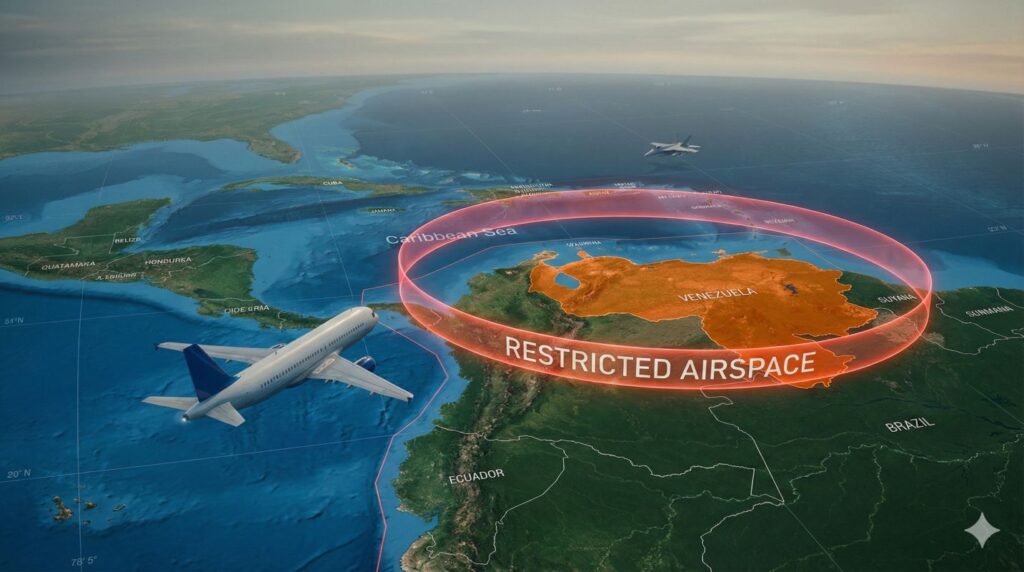
When Donald Trump stood before cameras on November 29, 2025 and declared that the airspace around Venezuela should be treated as “closed in its entirety,” he turned an already volatile standoff into a direct test of power and law. The Trump airspace closure warning landing on top of existing U.S. flight advisories and sanctions raised immediate questions: Is this a legally binding closure or a political threat? Does it signal an air blockade, an imminent strike, or an attempt to scare airlines and allies into compliance? And how will Venezuela and the rest of the region respond to a move many see as a throwback to gunboat diplomacy.
Within hours of the Trump airspace closure warning, Caracas denounced the declaration as a “colonial threat” and a violation of Venezuelan sovereignty. Maduro’s government, already battered by sanctions and an economic collapse, seized the moment to rally domestic opinion and appeal for international solidarity against what it framed as U.S. imperialism.
Trump’s Airspace Declaration — Trump airspace closure warning
Trump’s statement did not come out of nowhere. The United States had already restricted its own airlines from operating in Venezuelan airspace under a 2019 order and was issuing new security notices as tensions climbed in late 2025. A fresh Notice to Air Missions (NOTAM) reiterated that U.S. operators should avoid Venezuela’s airspace due to deteriorating security and the risk of miscalculation amid increased military activity.
The Trump airspace closure warning, however, went further. In remarks amplified on social media and at a White House press event, Trump urged all airlines and aviation partners to treat Venezuelan skies as effectively off limits. He framed the move as essential to protect U.S. interests and citizens, hinting that hostile actors and Iranian-linked forces were using Venezuelan airspace and ports as staging grounds.
Legal experts were quick to note that the president can strongly advise foreign carriers and allies, but he cannot unilaterally “close” another sovereign state’s airspace under international law. The Chicago Convention, which underpins global civil aviation, recognizes every state’s “complete and exclusive sovereignty over the airspace above its territory.” Even ABC’s explainer on the crisis stressed that while the U.S. can regulate its own airlines and military operations, the Trump airspace closure warning has no automatic force over third countries unless they choose to comply.
Still, in practice, the line between legal and practical power is blurry. When Washington issues strong security advisories and hints at military activity, many airlines will suspend flights rather than test the risk. Several carriers had already halted service after the latest FAA warning. A Reuters report on Iberia extending its suspension of flights to Caracas underlined how the rhetoric and the security environment were combining to strangle Venezuela’s air links even without a formal international air blockade.
Venezuela’s Response: Colonial Threat and Rallying Cry
Venezuela’s reaction to the Trump airspace closure warning was immediate and furious. President Nicolás Maduro branded the move a “colonialist threat,” accusing the U.S. of trying to impose a de facto siege and pave the way for regime change. State media hammered the message that Washington was weaponizing airspace rules in the same way it had weaponized sanctions, aiming to break Venezuela’s resistance and seize its oil.
Foreign Minister Jorge Arreaza and other officials framed the declaration as just the latest chapter in a long history of U.S. intervention in Latin America. They pointed to years of escalating sanctions, Washington’s refusal to recognize Maduro’s reelection, and the earlier recognition of opposition leader Juan Guaidó as interim president as proof that the United States had abandoned any pretense of neutrality. U.S. sanctions policy documents show that both the first Trump administration and its successors steadily widened measures against Venezuelan officials, economic sectors, and state-owned companies.
Caracas moved to retaliate symbolically. Authorities revoked operating rights for several foreign airlines already scaling back service under the security advisories, accusing them of acting as instruments of “state terrorism” at Washington’s behest. At the same time, Venezuela appealed to allies like Iran and Russia, and to organizations such as OPEC, calling for coordinated resistance to U.S. threats against its airspace and oil infrastructure.
International Law, Airspace Sovereignty, and the Trump Airspace Closure Warning
The Trump airspace closure warning has pushed a technical issue—who controls airspace and how flight advisories work—into the center of geopolitical conflict. Under the Chicago Convention, Venezuela retains sovereign control over its skies, including the right to close them to foreign flights if it chooses. The United States, by contrast, can only control its own carriers and military aircraft, or use secondary pressure on allies and partners.
The United States has used similar tools before, most notably when its Department of Transportation and FAA have restricted operations in conflict zones ranging from eastern Ukraine to parts of the Middle East. The difference here is the political framing. Critics argue that wrapping routine-but-serious security advisories in the language of total closure and confrontation risks undermining the credibility of future warnings. If every NOTAM becomes a battlefield for messaging, airlines may struggle to distinguish genuine safety alerts from political posturing.
Human rights advocates also warn that the Trump airspace closure warning could complicate humanitarian flights, migrant repatriation efforts, and medical evacuations. Recent reporting notes that U.S.-led deportation flights have returned tens of thousands of Venezuelans in 2025; any escalation that jeopardizes those corridors risks trapping vulnerable people in limbo or pushing them onto more dangerous routes by land and sea.
Regional Reactions: Fear of Spillover
The regional response to the Trump airspace closure warning has been wary. Colombia, which shares a more than 2,000 kilometer border with Venezuela and already hosts millions of Venezuelan refugees, has the most to lose from miscalculation. President Gustavo Petro has repeatedly warned that a conflict triggered by U.S.–Venezuela escalation would inevitably spill over into Colombian territory and strain a society already coping with displacement and inequality.
Petro has proposed multilateral talks involving not just regional neighbors but also global powers such as China, arguing that a broader diplomatic table is the only way to cap the risks created by the Trump airspace closure warning and related military moves. Reports in regional and international outlets describe Colombia as pushing for de-escalation even as U.S. naval deployments and anti-drug operations near Venezuelan waters raise fears of an accidental clash.
Other Latin American governments, including Brazil and Mexico, have echoed concerns about militarization and called for renewed dialogue. Within the Organization of American States, which has previously condemned human rights abuses under Maduro, there is growing tension between those who favor maximum pressure and those who want to avoid any step that could slide into open war. Recent OAS statements on Venezuela have emphasized accountability for crimes against humanity, but the institution is now being pressed to speak out just as clearly against actions that risk igniting a wider conflict.
Domestic Politics in Washington and Caracas
Inside the United States, the Trump airspace closure warning plays directly into a familiar campaign script: the image of a tough leader willing to confront “hostile regimes” in America’s near abroad. Supporters argue that tightening the screws on Maduro, including through aggressive aviation pressure, is necessary to curb narcotrafficking, curb migration, and prevent Russia, Iran, and China from consolidating influence in the hemisphere. The Council on Foreign Relations’ conflict tracker notes that instability in Venezuela has long been treated as a strategic threat by U.S. planners.
Critics, including many in Latin America, counter that the real driver is oil. Petro and others have openly accused Washington of using sanctions, pressure campaigns, and now the Trump airspace closure warning to gain leverage over Venezuela’s vast reserves rather than to defend democracy or fight drugs. An analysis by Anadolu Agency quotes Petro arguing that U.S. policy is aimed at securing fossil fuels, not promoting genuine reform.
In Venezuela, Maduro is using the crisis to tighten his grip. By framing the Trump airspace closure warning as proof that the United States wants to strangle the country, the government can justify new emergency powers, rally its core supporters, and paint domestic critics as tools of foreign interests. Yet the economic reality is brutal: years of hyperinflation, shortages, and mass emigration mean that many Venezuelans are skeptical of both Washington and their own leaders. For them, the prospect of further isolation—whether through sanctions, airspace restrictions, or military escalation—is a nightmare, not a rallying cry.
What Comes Next After the Trump Airspace Closure Warning
Even if no missile is fired, the Trump airspace closure warning has already had tangible effects. Airlines are suspending more routes, insurers are reassessing risk premiums, and ship and air operators are redrawing routes to avoid possible flashpoints. A patchwork of advisories and retaliatory measures is turning the skies and seas around Venezuela into a gray zone where misunderstanding could have deadly consequences.
At the same time, diplomatic channels are still open. Mediation initiatives involving Brazil, Qatar, Turkey, and others are reportedly exploring off-ramps, from confidence-building measures on air and naval operations to broader talks about political transition in Caracas. Global conflict trackers emphasize that both sides face strong incentives to avoid outright war: the U.S. risks another costly entanglement, while Venezuela’s already shattered economy could not withstand a direct confrontation.
In the end, the trajectory of the crisis will depend on whether leaders treat the Trump airspace closure warning as a ceiling or a floor. If it becomes a starting point for negotiating clear rules, deconfliction hotlines, and phased de-escalation, it may be remembered as a dangerously phrased but ultimately contained escalation. If instead it is followed by more maximalist demands, military brinkmanship, or misinterpreted maneuvers, the region could find itself edging toward a conflict nobody claims to want.
Bottom Line
The Trump airspace closure warning has crystallized a long-simmering confrontation between Washington and Caracas into a single, combustible symbol. For Venezuela, it is proof of colonial arrogance and an assault on sovereignty. For Trump and his allies, it is a necessary show of resolve against a regime they portray as criminal and dangerous. For the rest of the hemisphere, it is a red flag that the margin for error is disappearing.
What happens next will hinge less on rhetorical flourishes than on concrete choices: whether airlines and allies follow Washington’s lead, whether Venezuela and the United States can agree on practical safety measures, and whether regional actors can push both sides back from the brink. Until then, the Trump airspace closure warning will hang over the Caribbean not just as a statement, but as a risk—one more sign of how fragile security in the Americas has become.
Further Reading
ABC News explainer on Trump’s declaration and the limits of international law over foreign airspace:
https://www.abc.net.au/news/trump-venezuela-airspace-explainer/106086368
New York Post summary of Maduro’s response, calling the move a “colonial threat” and denouncing U.S. overreach:
https://nypost.com/2025/11/30/world-news/venezuelan-president-maduro-slams-trumps-airspace-shutdown-as-colonial-threat/
Milwaukee Independent analysis of the declaration’s legality and its implications for possible conflict:
https://www.milwaukeeindependent.com/newswire/trumps-unlawful-declaration-close-venezuelan-airspace-draws-scrutiny-implications-war/
Newsweek overview of U.S. flight warnings and maps of affected airspace amid growing military tensions:
https://www.newsweek.com/map-us-flight-warnings-venezuela-military-tensions-11103726
FAA and DOT order outlining the 2019 restrictions on U.S. flights in Venezuelan airspace:
https://www.faa.gov/air_traffic/publications/media/2019-5-5_DOT-Order-on-Venezuela.pdf
Congressional Research Service brief on U.S. sanctions policy toward Venezuela:
https://www.congress.gov/crs-product/IF10715
Council on Foreign Relations Global Conflict Tracker entry on instability and U.S.–Venezuela confrontation:
https://www.cfr.org/global-conflict-tracker/conflict/instability-venezuela
Al Jazeera reporting on Petro’s warnings and regional concerns over a potential U.S. strike on Venezuela:
https://www.aljazeera.com/news/2025/11/30/is-us-president-donald-trump-preparing-to-strike-venezuela
Connect with the Author
Curious about the inspiration behind The Unmaking of America or want to follow the latest news and insights from J.T. Mercer? Dive deeper and stay connected through the links below—then explore Vera2 for sharp, timely reporting.
About the Author
Discover more about J.T. Mercer’s background, writing journey, and the real-world events that inspired The Unmaking of America. Learn what drives the storytelling and how this trilogy came to life.
[Learn more about J.T. Mercer]
NRP Dispatch Blog
Stay informed with the NRP Dispatch blog, where you’ll find author updates, behind-the-scenes commentary, and thought-provoking articles on current events, democracy, and the writing process.
[Read the NRP Dispatch]
Vera2 — News & Analysis
Looking for the latest reporting, explainers, and investigative pieces? Visit Vera2, North River Publications’ news and analysis hub. Vera2 covers politics, civil society, global affairs, courts, technology, and more—curated with context and built for readers who want clarity over noise.
[Explore Vera2]
Whether you’re interested in the creative process, want to engage with fellow readers, or simply want the latest updates, these resources are the best way to stay in touch with the world of The Unmaking of America—and with the broader news ecosystem at Vera2.
Free Chapter
Begin reading The Unmaking of America today and experience a story that asks: What remains when the rules are gone, and who will stand up when it matters most? Join the Fall of America mailing list below to receive the first chapter of The Unmaking of America for free and stay connected for updates, bonus material, and author news.
