
Vera2, Civil Rights and Society
College Student Deported During Thanksgiving Trip Raises Alarms Over Immigration Enforcement
Dec
College Student Deported During Thanksgiving Travel
The case of a college student deported while trying to fly home for Thanksgiving has become a flashpoint in the debate over immigration enforcement, due process, and the rights of young people who grew up in the United States. Nineteen-year-old Any Lucia López Belloza, a Babson College freshman who has lived in the U.S. since childhood, expected a routine trip from Boston to Texas to surprise her family for the holiday. Instead, she was detained at Boston Logan International Airport and rapidly removed to Honduras, despite a federal judge’s order temporarily blocking her deportation. News that a college student deported under these circumstances had been sent out of the country in less than forty-eight hours has sparked outrage far beyond the campus gates.
Incident Overview — college student deported
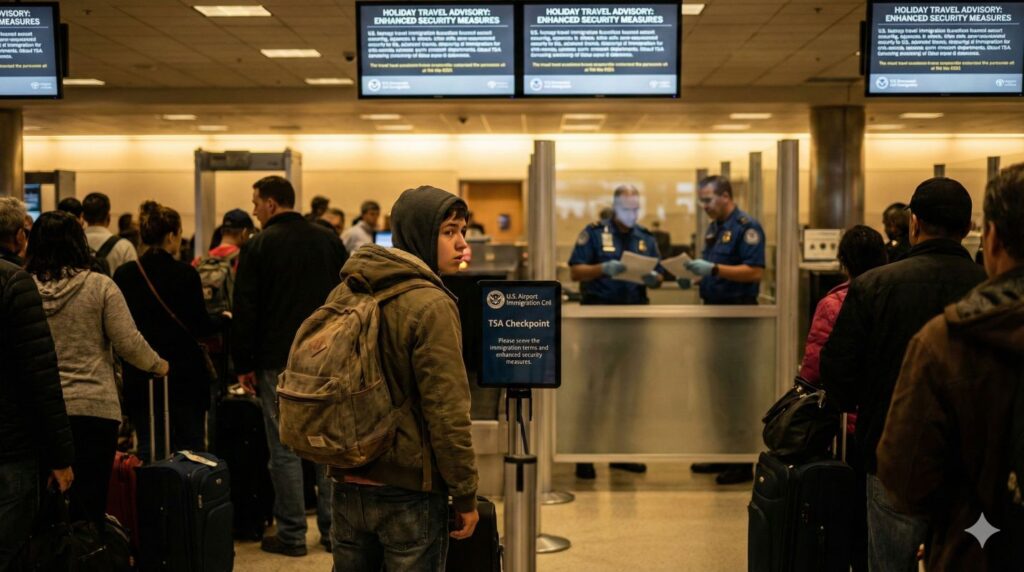
According to court documents and multiple news reports, López Belloza had already cleared security at Boston Logan on November 20 when airline staff and federal personnel told her there was an issue with her boarding pass. She was then taken aside, questioned by immigration officials, and informed that she was subject to a years-old removal order tied to an earlier asylum case that her family believed had been closed. Within two days, the young woman was transferred from Massachusetts to a Texas detention facility and then placed on a flight to Honduras, the country she left as a child.
What makes this case particularly explosive is the timing. The day after her arrest, a federal judge issued an emergency order instructing the government not to remove her from Massachusetts or from the United States for at least seventy-two hours. Despite that order, the college student deported from Boston was already out of the country by the time lawyers could fully challenge the government’s actions. Her attorney has described the episode as a violation of the court’s authority and of her constitutional rights, noting that she had no meaningful opportunity to be heard before being expelled.
López Belloza had just begun her first semester at Babson on a scholarship, studying business and hoping to help her family start a small tailoring business. Friends and professors describe her as a hardworking and ambitious student who had quickly become part of campus life. Instead of planning finals and winter break, she is now living with extended family in Honduras, trying to understand how someone deported so quickly can fight for a chance to return and resume her education.
Legal and Policy Implications of the Case
The deportation has raised serious questions about how immigration enforcement is being carried out, especially in high-security environments like airports. Immigration and Customs Enforcement (ICE) officials say López Belloza was subject to a removal order dating back almost a decade, citing records from an earlier proceeding. Her legal team disputes how that order was handled, whether she ever received proper notice, and why it suddenly became a priority after years in which she had traveled without incident.
At the center of the controversy is the fact that the college student deported in this case was removed despite an active federal court order that should have prevented any transfer or deportation for at least three days. Legal experts warn that ignoring such an order undermines the basic checks and balances between the executive and judicial branches. If immigration agencies can have a college student deported in apparent defiance of a judge’s directive, many ask what is to stop them from doing the same to other vulnerable migrants before courts can intervene.
The episode also highlights how fragile immigration status can be for young people who arrived as children. Many depend on parents, overworked attorneys, or community advocates to navigate a maze of paperwork and hearings. A single missed notice, clerical error, or miscommunication can leave a final removal order sitting in a file for years. When a college student deported under those circumstances has no clear memory of the legal process that sealed their fate, the system starts to look arbitrary rather than orderly.
Human Impact on Students and Families
Behind the legal arguments is a straightforward human story. López Belloza left Honduras when she was young, grew up in the United States, and built an academic record strong enough to win admission and financial aid at a competitive college. For her relatives, the picture of a college student deported while trying to come home for Thanksgiving is a nightmare scenario that cuts against everything they believed about hard work and opportunity.
Her parents and younger sisters in Texas had expected a joyful surprise visit. Instead, they received calls from lawyers and advocates describing how the college student deported from Boston had been moved from facility to facility with little chance to speak directly to her family. By the time the public learned the details, she was already thousands of miles away, trying to make sense of a country she barely remembers.
The psychological damage in cases like this goes far beyond one holiday or one semester. Students who see a fellow college student deported so swiftly may begin to second-guess ordinary decisions: Can they safely fly to see family? Apply for internships in other states? Consider study-abroad programs? Even those with temporary protections or pending cases may retreat from public life, fearing that any routine interaction with authorities could trigger detention.
Campus, Community, and National Reactions
On campus, classmates and faculty have organized vigils, issued statements of support, and circulated petitions demanding that Babson and other institutions do more to protect vulnerable students. For many, the removal of a college student deported in direct conflict with a judge’s order is a test of whether universities will truly stand behind the young people they recruit and highlight in their marketing.
Immigrant rights organizations have seized on the case to argue that airport enforcement has become too aggressive and opaque. They say that treating a college student deported while trying to board a domestic flight as if she were a high-risk security threat sends a chilling message to entire communities who rely on air travel for family and work. Lawyers and advocates are now pushing for a full investigation into how ICE and the Department of Homeland Security handled the judge’s emergency order, and whether any internal accountability will follow.
Nationally, the story has fed into a broader debate over deportations in the second Trump administration. Civil liberties groups argue that this case fits a pattern in which people with longstanding community ties are removed in ways that sidestep court protections or humanitarian considerations. Supporters of strict enforcement counter that a valid removal order is a valid order, regardless of a person’s age or academic success. Yet even some security-focused policymakers are uneasy with the optics of a college student deported while a federal judge’s stay was still in effect.
A Broader Pattern in Immigration Enforcement
While the facts of this case are striking, immigration lawyers note that they are not entirely unique. In recent years there have been several reports of migrants deported in violation of court orders or before lawyers could fully present their arguments. In that context, the story of a college student deported during routine holiday travel looks less like an isolated mistake and more like a symptom of a system that prioritizes speed over careful review.
Airports have become pressure points where federal databases, airline procedures, and security protocols collide. A student might pass through checkpoints many times without issue, only to be suddenly flagged when an old record surfaces or when enforcement priorities shift. Because the process happens behind secure doors, it is difficult for journalists, watchdogs, or even family members to understand exactly what transpired in real time.
For undocumented and mixed-status families, the message is stark. Even those who seem to be doing everything “right” — studying, working, paying taxes, staying out of trouble — can see a loved one, including a college student deported while pursuing a degree, taken away with little warning. That uncertainty undermines trust not only in immigration agencies but in the broader promise that effort and achievement can offset early disadvantages.
What Reform Could Look Like
The outrage over this college student deported at the airport has sparked a fresh round of policy ideas, some incremental and some far-reaching. Legal scholars point to several immediate steps that could reduce the risk of similar incidents. One is a stricter internal compliance system to ensure that emergency court orders are communicated instantly to all relevant agencies and contractors, with real consequences when they are ignored. Another is requiring that individuals with old or disputed removal orders receive timely notice and access to counsel before any attempt at deportation.
Advocates also argue for stronger protections for students who have lived in the U.S. for many years, especially those who arrived as children and have built deep ties to their communities. Expanding pathways to legal status, streamlining humanitarian waivers, or restoring and strengthening programs like DACA would all reduce the likelihood that another college student deported under similar conditions will lose a once-in-a-lifetime opportunity to attend college.
More fundamentally, the case is fueling arguments that immigration policy must be guided by proportionality and common sense, not just raw enforcement numbers. The question many people are asking is simple: What public interest is served when a high-achieving college student deported in haste is ripped away from her family, campus, and future?
Bottom Line
The story of Any Lucia López Belloza has become shorthand for the human cost of aggressive immigration enforcement. A college student deported while trying to fly home for Thanksgiving is now living in a country she barely knows, while her lawyers attempt to untangle years of paperwork and search for a path back. Whether or not she ultimately returns, her case has already altered the national conversation.
For students in similar situations, it is a warning that even academic success and community support may not be enough to shield them from abrupt, life-changing decisions made far from the public eye. For policymakers, the case poses a stark choice: accept a system in which a college student deported despite a judge’s order is considered an acceptable outcome, or push for reforms that align enforcement with basic fairness and respect for the rule of law.
Until that choice is made, stories like this will continue to emerge, each one a reminder that behind every statistic is a human being — in this instance, a college student deported at the exact moment she was trying to come home.
Further Reading
Associated Press coverage of the deportation of Any Lucia López Belloza and the emergency court order that sought to block her removal: https://apnews.com/article/babson-student-deported-thanksgiving-467393d8d9b9ae6351f99de7b9cbfb98
ABC News reporting on how a 19-year-old college student was deported despite a federal judge’s order: https://abcnews.go.com/US/19-year-college-student-deported-despite-judges-order/story?id=127914941
NBC Boston and local coverage detailing the timeline of events at Boston Logan International Airport and the student’s ties to Babson College: https://www.nbcboston.com/news/local/college-freshman-deported-flying-home-from-boston-for-thanksgiving-despite-court-order/3852170/
People magazine’s summary of the case and the legal challenges surrounding López Belloza’s deportation: https://people.com/college-student-deported-to-honduras-despite-judges-order-11858465
Background on deportations carried out during the second Trump administration and documented instances where removals proceeded despite legal challenges: https://en.wikipedia.org/wiki/Deportation_in_the_second_Trump_administration
Connect with the Author
Curious about the inspiration behind The Unmaking of America or want to follow the latest news and insights from J.T. Mercer? Dive deeper and stay connected through the links below—then explore Vera2 for sharp, timely reporting.
About the Author
Discover more about J.T. Mercer’s background, writing journey, and the real-world events that inspired The Unmaking of America. Learn what drives the storytelling and how this trilogy came to life.
[Learn more about J.T. Mercer]
NRP Dispatch Blog
Stay informed with the NRP Dispatch blog, where you’ll find author updates, behind-the-scenes commentary, and thought-provoking articles on current events, democracy, and the writing process.
[Read the NRP Dispatch]
Vera2 — News & Analysis
Looking for the latest reporting, explainers, and investigative pieces? Visit Vera2, North River Publications’ news and analysis hub. Vera2 covers politics, civil society, global affairs, courts, technology, and more—curated with context and built for readers who want clarity over noise.
[Explore Vera2]
Whether you’re interested in the creative process, want to engage with fellow readers, or simply want the latest updates, these resources are the best way to stay in touch with the world of The Unmaking of America—and with the broader news ecosystem at Vera2.
Free Chapter
Begin reading The Unmaking of America today and experience a story that asks: What remains when the rules are gone, and who will stand up when it matters most? Join the Fall of America mailing list below to receive the first chapter of The Unmaking of America for free and stay connected for updates, bonus material, and author news.
