
Vera2, Courts and Justice
Alina Habba Disqualified as U.S. Attorney: What the Appeals Court Ruling Really Means
Dec
Alina Habba Disqualified as U.S. Attorney: What the Appeals Court Ruling Really Means
When the Third U.S. Circuit Court of Appeals ruled that Alina Habba had been unlawfully appointed as New Jersey’s top federal prosecutor, it didn’t just end one controversial tenure. It exposed how aggressively the Trump Administration pushed the boundaries of the law to install loyalists in positions that are supposed to be insulated from raw politics.
The decision disqualifying Alina Habba as acting U.S. attorney for the District of New Jersey upheld a lower court’s finding and concluded that the administration violated federal law, including the Federal Vacancies Reform Act, when it maneuvered to keep her in power without Senate confirmation. For Vera2 readers tracking threats to institutional checks and balances, the case against Alina Habba is another warning sign that the guardrails are weaker than they look.
Who Is Alina Habba and How Did She Reach This Role?
From Trump’s Personal Lawyer to New Jersey’s Top Federal Prosecutor
For years, Alina Habba was best known as one of Donald Trump’s most aggressive defenders on television and in the courts. She represented him in civil cases, publicly attacked his opponents, and built a reputation as a loyal political ally as much as a lawyer.
In early 2025, the Trump Administration elevated Alina Habba from political ally to a powerful government role, installing her first as interim and then as acting U.S. attorney for the District of New Jersey. She had no prior experience as a federal prosecutor, yet overnight Alina Habba became the chief federal law enforcement officer in a state of nearly 9 million people.
According to public records and court reporting, Alina Habba was controversial long before she stepped into the federal role. She had been sanctioned in court for frivolous lawsuits and accused of politicized conduct in her private practice on Trump’s behalf. Bringing that record into the Justice Department was never going to be quiet or neutral.
Once in office, Alina Habba quickly sent a message about how she intended to use her power. She launched investigations into Democratic Governor Phil Murphy and Attorney General Matt Platkin and pursued cases involving Newark Mayor Ras Baraka and Rep. LaMonica McIver, all Democrats. Critics said the pattern showed that Alina Habba was approaching the U.S. attorney’s office as a partisan weapon rather than a neutral enforcer of federal law.
Federal judges in New Jersey had already signaled discomfort with Alina Habba’s standing. In mid-2025, they tried to replace her by appointing her first assistant, Desiree Leigh Grace, as the lawful U.S. attorney. That move was quickly undermined when Attorney General Pam Bondi fired Grace just days later — a maneuver that became central to the legal fight over who actually controlled the office and whether Alina Habba could lawfully remain in charge.
Why the Appeals Court Said Alina Habba Was Unlawfully Appointed
The Federal Vacancies Reform Act at the Center of the Case
The case that toppled Alina Habba’s tenure started the way many structural challenges do: with criminal defendants asking whether the person claiming to be U.S. attorney was legally allowed to hold the job.
Defendants in drug and gun cases argued that Alina Habba’s authority was invalid because the administration had blown past the rules governing temporary appointments, especially the Federal Vacancies Reform Act (FVRA). That statute limits how long someone can serve in an acting role and sets strict conditions once a president formally nominates that person to the permanent position.
A federal district judge ruled in August 2025 that Alina Habba’s appointment became void as of July 1, 2025, and that the attempt to “re-appoint” her after that date violated vacancies law and succession rules. The judge’s decision, initially stayed on appeal, laid out a simple logic: the administration could not treat those statutory limits as optional just because it wanted Alina Habba in the job.
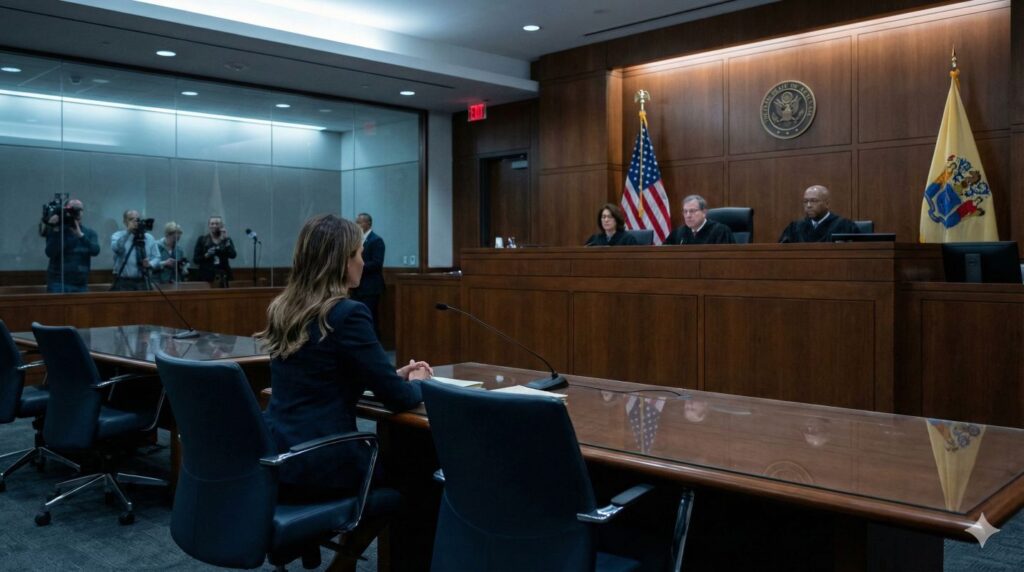
On December 1, 2025, a three-judge panel of the Third Circuit affirmed that conclusion. The appeals court held that the Trump Justice Department had violated the FVRA and related succession statutes in its effort to keep Alina Habba in place, particularly after Trump nominated her for the permanent role and then withdrew the nomination — a sequence that triggered restrictions on further acting service. The panel concluded that Alina Habba could not lawfully continue as acting U.S. attorney and formally disqualified her from the position.
One judge noted that it was “apparent that the current administration has been frustrated by some of the legal and political barriers to getting its appointees in place,” but stressed that those frustrations did not justify ignoring the law. In other words, the court treated Alina Habba’s case as a clear example of political impatience running headfirst into statutory limits.
Consequences for Cases Handled Under Alina Habba
The immediate practical question is what happens to the cases and investigations that moved forward while Alina Habba was in charge of the office. If the top federal prosecutor was unlawfully appointed, does that invalidate everything done on her watch?
So far, courts have mostly refused to toss out criminal cases solely because Alina Habba signed off on them. Judges have emphasized that day-to-day prosecutions were run by career assistant U.S. attorneys, not by Alina Habba personally, and that dismissing entire dockets could cause chaos for victims, witnesses, and defendants who have already accepted plea agreements.
Still, the disqualification ruling is not harmless. Defense attorneys will examine politically sensitive cases that Alina Habba prioritized, especially those involving New Jersey Democrats, for any sign that her lack of lawful authority or her openly partisan posture tainted decisions. At a minimum, every major indictment that bore Alina Habba’s signature now comes with an asterisk: it was overseen by a U.S. attorney whom a federal appeals court says never had valid authority to hold the job.
The stigma matters even if convictions stand. Inside the Justice Department, line prosecutors now have to explain to juries, witnesses, and future employers that they served under an unlawfully appointed boss. For communities already skeptical of federal power, learning that Alina Habba was never legally in office will reinforce the idea that the justice system is being bent to political will.
Political Fallout and the Battle Over Prosecutorial Power
From the moment she emerged as a Trump surrogate, Alina Habba was a political lightning rod. To Trump’s base, she was a fearless loyalist who would go on offense against Democrats and “the deep state.” To critics, Alina Habba personified the dangers of turning federal law enforcement into a partisan tool.
The appeals court ruling gives each side new ammunition. Trump allies are already framing Alina Habba as another victim of a hostile establishment that targets anyone willing to fight for the former president. Expect fundraising appeals, talk-show rants, and social-media posts casting Alina Habba’s disqualification as proof that the justice system is out to crush Trump-aligned lawyers.
Institutionalists see something very different. For them, the disqualification of Alina Habba is a case study in how a White House can try to stretch vacancies law and exploit gray zones to keep loyalists in charge of powerful offices. The fact that Alina Habba had little prosecutorial background, a history of court sanctions, and a public record of partisan commentary makes the episode even more troubling for people who care about prosecutorial independence.
The Biden-era Justice Department also has decisions to make. The department inherits the litigation posture of the government, even when the underlying choices were made under Trump. If DOJ were to seek Supreme Court review of the Third Circuit decision, it could look as if the current administration is defending the same aggressive tactics that put Alina Habba in office. If it lets the ruling stand, it quietly accepts that the courts have narrowed the room for future presidents to run similar experiments with vacancies law.
Implications for Future U.S. Attorney Appointments
The fallout from the Alina Habba ruling will not be confined to New Jersey. Defense lawyers and watchdog groups are already scrutinizing other Trump-era U.S. attorney appointments that followed similar patterns of extended acting service, skipped confirmations, and heavy reliance on personal loyalty.
If one federal appeals court is willing to say that the installation of Alina Habba plainly violated the FVRA, other courts will be more willing to ask hard questions in parallel cases. Presidents of both parties may now hesitate before pushing “acting” U.S. attorneys beyond the statute’s time limits or playing nomination games that reset the clock.
For future administrations, the lesson is blunt. If you want a particular person — whether another Alina Habba or a very different figure — to run a powerful U.S. attorney’s office, you have to respect the legal process. That means acceptable succession plans when vacancies open, plausible acting appointments for limited periods, and timely, serious nominations that the Senate can actually vet.
It also means accepting that courts and, in some cases, local federal judges have a say. In New Jersey, those judges tried to steer the office away from Alina Habba by naming Desiree Leigh Grace. The attempt to fire Grace and slide Alina Habba back into control is exactly the kind of maneuver this ruling rejects. Going forward, administrations that treat judicial input as an obstacle rather than a constraint may find themselves facing the same kind of embarrassing legal defeat.
Why the Alina Habba Disqualification Matters Beyond One Name
It would be easy to file the Alina Habba story under “just another Trump-era controversy” and move on. That would miss the larger stakes.
U.S. attorneys control what kinds of cases get brought, how aggressively federal power is used, and which investigations are prioritized or quietly dropped. When a figure like Alina Habba is installed despite serious questions about legal authority and professional judgment, the damage goes beyond one office. It signals that the rules meant to keep federal prosecutors independent can be bent until they nearly break.
The disqualification of Alina Habba shows that those rules still have teeth — but only when someone with the resources, motivation, and courage to sue forces the courts to act. Until criminal defendants challenged her authority, Alina Habba remained in place, making decisions that affected people’s freedom, reputations, and political futures.
For a justice system already struggling with legitimacy, that is a brutal reality. Large parts of the public already believe that law is applied differently depending on wealth, race, or political alignment. Learning that the top federal prosecutor in New Jersey — Alina Habba — was unlawfully appointed will deepen that distrust for many.
The question now is whether anyone learns from what happened to Alina Habba. Will future administrations treat vacancies statutes as real constraints, or as hurdles to be gamed until a court steps in again? Will Congress tighten the law to prevent similar end-runs, or silently accept that these battles will be fought case by case?
The appeals court has done its job by saying clearly that Alina Habba should never have been in that role. Whether that turns into lasting reform — or just another scandal in an already long list — depends on what elected officials, the Justice Department, and voters choose to do next.
Further Reading
Appeals court disqualifies Trump ally Habba as top New Jersey federal prosecutor — Reuters
https://www.reuters.com/world/us-appeals-court-disqualifies-trump-ally-habba-us-attorney-2025-12-01/ Reuters
Ex-Trump lawyer Alina Habba disqualified as N.J. prosecutor, U.S. appeals court rules — NBC New York
https://www.nbcnewyork.com/new-jersey/alina-habba-disqualified-trump-prosecutor/6424490/ NBC New York
Alina Habba, Trump’s former lawyer, disqualified as New Jersey prosecutor — PBS / Associated Press
https://www.pbs.org/newshour/politics/alina-habba-trumps-former-lawyer-disqualified-as-new-jersey-prosecutor PBS
Appeals Court Disqualifies former Trump Lawyer Alina Habba as New Jersey U.S. Attorney — Democracy Docket
https://www.democracydocket.com/news-alerts/trump-lawyer-alina-habba-appeals-court-disqualified-new-jersey-us-attorney/ Democracy Docket
Appeals court rules Trump prosecutor appointment violates law — Washington Post
https://www.washingtonpost.com/national-security/2025/12/01/trump-habba-us-attorney-ruling/ The Washington Post
Connect with the Author
Curious about the inspiration behind The Unmaking of America or want to follow the latest news and insights from J.T. Mercer? Dive deeper and stay connected through the links below—then explore Vera2 for sharp, timely reporting.
About the Author
Discover more about J.T. Mercer’s background, writing journey, and the real-world events that inspired The Unmaking of America. Learn what drives the storytelling and how this trilogy came to life.
[Learn more about J.T. Mercer]
NRP Dispatch Blog
Stay informed with the NRP Dispatch blog, where you’ll find author updates, behind-the-scenes commentary, and thought-provoking articles on current events, democracy, and the writing process.
[Read the NRP Dispatch]
Vera2 — News & Analysis
Looking for the latest reporting, explainers, and investigative pieces? Visit Vera2, North River Publications’ news and analysis hub. Vera2 covers politics, civil society, global affairs, courts, technology, and more—curated with context and built for readers who want clarity over noise.
[Explore Vera2]
Whether you’re interested in the creative process, want to engage with fellow readers, or simply want the latest updates, these resources are the best way to stay in touch with the world of The Unmaking of America—and with the broader news ecosystem at Vera2.
Free Chapter
Begin reading The Unmaking of America today and experience a story that asks: What remains when the rules are gone, and who will stand up when it matters most? Join the Fall of America mailing list below to receive the first chapter of The Unmaking of America for free and stay connected for updates, bonus material, and author news.
