
Vera2, Global Affairs
Hegseth Boat Attack | Hegseth Says He Did Not See Survivors
Dec
-
Hegseth’s Controversial Statements on Boat Attack Survivors
Overview — Hegseth boat attack
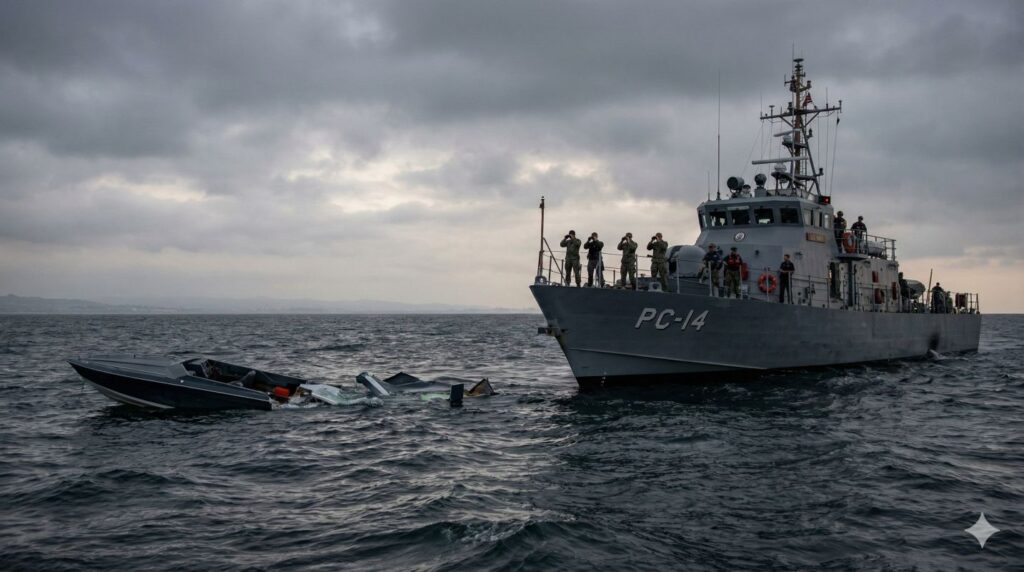
The Hegseth boat attack controversy sits at the intersection of military power, drug interdiction policy, and the hard legal limits on the use of force at sea. On 2 September 2025, U.S. forces struck a small vessel off the coast of Venezuela that officials said was involved in drug smuggling. The mission was part of a broader campaign of strikes on suspected narcotics traffickers in Caribbean and Latin American waters, operations that the Trump administration has framed as essential to national security.
According to administration officials, the initial strike disabled the vessel. What has made the Hegseth boat attack truly explosive, however, is the reported second strike against people in the water who appeared to be survivors of the first explosion. Reporting from Reuters, human rights experts at the United Nations, and subsequent investigative pieces have raised the possibility that incapacitated individuals were targeted after the immediate threat had passed, a scenario that international law treats as potentially unlawful.
Defense Secretary Pete Hegseth has publicly backed the admiral in command, insisting that the operation was lawful and consistent with the law of armed conflict. The White House has echoed that line, even as lawmakers in both parties have demanded answers about who ordered the second strike and under what authority it was carried out.
Context of the Boat Attack — Hegseth boat attack
In official briefings, the administration has portrayed the Hegseth boat attack as part of an aggressive push to choke off maritime drug routes. Since early September, U.S. forces have launched a series of similar operations against suspected smuggling vessels, with dozens of reported deaths at sea. The government argues that these missions disrupt cartels, protect U.S. communities from narcotics, and send a deterrent signal to traffickers.
Critics counter that the legal basis for treating drug smuggling as a kind of armed conflict is shaky at best. Legal scholars have warned that relabeling counternarcotics work as a war on “narco-terrorists” does not grant the United States broader authority to use lethal force, especially when people are already shipwrecked or otherwise incapacitated. Under long-standing law of the sea norms, as well as the San Remo Manual on conflicts at sea, shipwrecked persons are entitled to protection, not deliberate targeting.
The Hegseth boat attack also sits uncomfortably alongside newer Pentagon guidance on civilian harm. In recent years, the Defense Department has adopted a Civilian Harm Mitigation and Response framework that is meant to push commanders to anticipate and reduce the risk to civilians, and to investigate and respond when harm occurs. If survivors were visible in the water and still struck, that raises obvious questions about how rigorously those standards were applied.
Hegseth’s Statements and the Question of Survivors
In public comments, Hegseth has insisted that he did not see evidence of survivors clinging to wreckage from the targeted boat. He has suggested that the intelligence picture was confused and that the admiral on scene acted appropriately based on the information available at the time. Administration officials have floated phrases like “fog of war” to frame the episode as a tragic but lawful incident rather than a deliberate attack on defenseless people.
Those statements clash with accounts from human rights investigators, survivors from other attacks in the same campaign, and at least one complaint to the Inter-American human rights system, which accuses the United States of unlawful killings at sea. If future investigations show that the operational picture was clearer than Hegseth has claimed, his defense of the Hegseth boat attack will look less like loyal support for commanders and more like an effort to shield senior officials from accountability.
At the center of the dispute is a basic question: once a vessel is disabled and its occupants are in the water, under what conditions can they still be treated as lawful targets? International humanitarian law, including rules governing naval warfare, is explicit that shipwrecked persons who are hors de combat must be spared and collected, not attacked, unless they are actively hostile. If the people hit in the second strike were simply trying to stay afloat, the legal justification for the Hegseth boat attack becomes very thin.
Transparency, Oversight, and the Hegseth boat attack
The controversy is not just about one incident. Human rights experts and some in Congress say the Hegseth boat attack exposes a structural problem with how the United States conducts and reviews lethal operations at sea. The Pentagon has pledged repeatedly to improve how it investigates civilian harm, but external reviews continue to find gaps, from poor evidence collection to narrow definitions of who counts as a civilian casualty.
In this case, lawmakers have requested classified briefings, logs, and video footage to determine what commanders knew and when. The administration so far has offered partial narratives through press briefings, without releasing full strike assessments or opening a transparent, independent inquiry. That feeds suspicions that the investigation is designed more to protect the chain of command than to uncover the full truth about the Hegseth boat attack and its casualties.
Observers also note the political backdrop. The administration has been leaning on hard-line counternarcotics rhetoric and highlighting body counts as evidence of “success” at sea. That creates an obvious incentive problem: if the metric that matters in Washington is the number of traffickers killed or boats destroyed, there will always be pressure to interpret ambiguous situations in ways that justify pulling the trigger.
Legal and Ethical Frameworks at Sea
To understand why the Hegseth boat attack has drawn such intense scrutiny, it helps to look at the underlying legal framework. Maritime security law, including the UN Convention on the Law of the Sea and various counter-drug agreements, gives states authority to interdict stateless or suspect vessels and to arrest those on board. But that is law enforcement authority, not carte blanche to use lethal force.
When states use military assets and weapons, they also trigger the body of rules governing armed conflict at sea. Those rules allow attacks on legitimate military objectives, but they are constrained by principles of distinction, proportionality, and precautions in attack. Shipwrecked persons, medical personnel, and others hors de combat are specifically protected. Attacking them can amount to a grave breach of the laws of war.
Ethically, even when the law arguably allows lethal force, commanders face the harder question of whether they should use it. A growing body of doctrine inside the Pentagon emphasizes that civilian harm mitigation is not just a legal box-check; it is central to strategic legitimacy and to the moral well-being of service members who have to live with the consequences of their actions. The Hegseth boat attack tests whether that rhetoric actually constrains behavior when there is pressure from above to “show results.”
Public and Political Reactions
Public reaction to the Hegseth boat attack has been polarized. Supporters of the operation argue that drug traffickers knowingly assume the risk of violent interdiction, that the intelligence picture is never perfect, and that critics underestimate the danger armed smugglers pose to U.S. forces. They point to the sheer volume of narcotics moving by sea and the increasing sophistication of semi-submersible vessels as evidence that only decisive action will make a dent in the trade.
Opponents, including human rights organizations, international law experts, and some veterans, see the incident as part of a pattern in which lethal force has become the default tool for problems that should be handled through better policing, financial enforcement, and regional cooperation. They warn that normalizing strikes like the Hegseth boat attack risks eroding long-standing protections for civilians at sea and invites other states to adopt similarly expansive interpretations of self-defense.
In Congress, lawmakers have called for hearings, document production, and potentially an independent commission to examine not only this incident but the entire campaign of maritime strikes. Whether those efforts lead to real accountability will be a key test of how serious Washington is about its own stated commitment to civilian protection.
Bottom Line — Why the Hegseth boat attack matters
The Hegseth boat attack is more than a single tragic episode in a distant sea lane. It is a stress test for the rules that are supposed to govern how powerful states use force far from home. If a campaign the United States insists is about law enforcement and drug interdiction ends up looking, in practice, like a shadow naval war with a relaxed attitude toward shipwrecked survivors, then the gap between rhetoric and reality becomes impossible to ignore.
For now, the administration is betting that careful legal language and limited disclosures will contain the damage. But the underlying questions are not going away. Who counts as a combatant when the enemy is a drug courier rather than a soldier? What duties does a state owe to people who are no longer a threat but still within its power? And what message does it send—to allies, rivals, and its own sailors—if the answer to those questions is buried under classified annexes and talking points about the “fog of war”?
The answers that emerge from the investigations into the Hegseth boat attack will shape not just this administration’s legacy, but the future of maritime security operations more broadly. If there is no meaningful accountability, future commanders may assume that firing a second missile at a crippled boat is simply part of the job. If there is a clear, public reckoning, the episode could instead mark a turning point toward more restrained and accountable uses of force at sea.
Further Reading
For readers who want to go deeper into the legal, ethical, and policy questions raised by the Hegseth boat attack and similar operations, the following sources provide detailed reporting and expert analysis:
White House defends US attack on boat from Venezuela as lawful — Reuters
https://www.reuters.com/world/americas/white-house-admiral-approved-second-strike-boat-venezuela-was-well-within-legal-2025-12-01/Trump administration is ‘selling out’ admiral to shield Hegseth over boat strikes — The Guardian
https://www.theguardian.com/us-news/2025/dec/02/us-admiral-to-brief-lawmakers-as-bipartisan-scrutiny-grows-over-boat-strikeFamily of Colombian man killed in U.S. boat strikes files formal complaint — The Washington Post
https://www.washingtonpost.com/world/2025/12/03/venezuela-colombia-hegseth-boat-strikes-human-rights/Unprovoked lethal strikes by the United States against vessels at sea may amount to extrajudicial killings — UN Office of the High Commissioner for Human Rights
https://www.ohchr.org/en/press-releases/2025/11/unprovoked-lethal-strikes-united-states-against-vessels-sea-may-amountLabels, Not Law, to Justify Lethal Force: Venezuela Boat Strike — Just Security
https://www.justsecurity.org/119985/labels-ustify-lethal-force-venezuelan-boat-strike/The Humanity Compass: Navigating the Protection of Civilians in Naval Warfare — ICRC Law & Policy
https://blogs.icrc.org/law-and-policy/2025/10/28/the-humanity-compass-navigating-the-protection-of-civilians-in-naval-warfare/Here’s What You Need to Know About the Pentagon’s New Civilian Harm Policy — Just Security
https://www.justsecurity.org/92068/heres-what-you-need-to-know-about-the-pentagons-new-civilian-harm-policy/DoD Issues Civilian Harm Mitigation, Response Instruction — U.S. Department of Defense
at-strikes.html)
https://www.war.gov/News/News-Stories/Article/Article/3624268/dod-issues-civilian-harm-mitigation-response-instruction/
Connect with the Author
Curious about the inspiration behind The Unmaking of America or want to follow the latest news and insights from J.T. Mercer? Dive deeper and stay connected through the links below—then explore Vera2 for sharp, timely reporting.
About the Author
Discover more about J.T. Mercer’s background, writing journey, and the real-world events that inspired The Unmaking of America. Learn what drives the storytelling and how this trilogy came to life.
[Learn more about J.T. Mercer]
NRP Dispatch Blog
Stay informed with the NRP Dispatch blog, where you’ll find author updates, behind-the-scenes commentary, and thought-provoking articles on current events, democracy, and the writing process.
[Read the NRP Dispatch]
Vera2 — News & Analysis
Looking for the latest reporting, explainers, and investigative pieces? Visit Vera2, North River Publications’ news and analysis hub. Vera2 covers politics, civil society, global affairs, courts, technology, and more—curated with context and built for readers who want clarity over noise.
[Explore Vera2]
Whether you’re interested in the creative process, want to engage with fellow readers, or simply want the latest updates, these resources are the best way to stay in touch with the world of The Unmaking of America—and with the broader news ecosystem at Vera2.
Free Chapter
Begin reading The Unmaking of America today and experience a story that asks: What remains when the rules are gone, and who will stand up when it matters most? Join the Fall of America mailing list below to receive the first chapter of The Unmaking of America for free and stay connected for updates, bonus material, and author news.
