
Behind the Fiction, NRP Dispatch
Venezuela Boat Strikes: Missiles Down, Accountability Missing
Dec
By J.T. Mercer
I write near-future political fiction for a living. Lately, the future keeps showing up ahead of schedule.
Take the Venezuela boat strikes. If I had put this storyline in The Fall of America a few years ago—U.S. warships running live-fire missions on small boats, a second missile fired at survivors in the water, and the political system shrugging because the president is wrapped in a new layer of immunity—an editor would have told me to dial it back. Too on-the-nose. Too cynical. Too much like a conspiracy theorist’s blog post about Venezuela boat strikes rather than something that would actually happen.
Now it is just the news cycle. The phrase “Venezuela boat strikes” has become another branded campaign, like Operation This or Freedom That, except this one is being sold as a clever new way to fight drugs while quietly testing just how far presidential impunity can stretch.
What is really happening with the Venezuela boat strikes
Let’s strip off the patriotic polish and call the Venezuela boat strikes what they are.
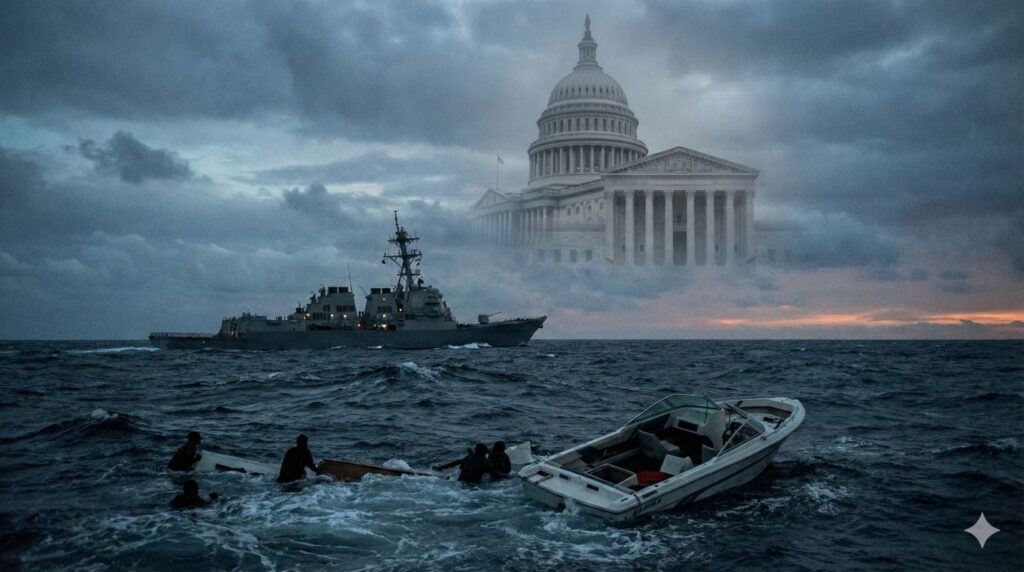
Since early September, the United States has been running live-fire operations in the Caribbean and eastern Pacific, focusing on small vessels Washington says are Venezuelan drug-smuggling or “narco-terrorist” boats. The Pentagon has admitted to more than twenty Venezuela boat strikes and upward of eighty deaths so far, most of them near Venezuela and Colombia. The phrase “Venezuela boat strikes” sounds abstract until you realize it means people in fiberglass hulls being hit by precision weapons launched from billion-dollar platforms.
One particular incident on September 2 blew through the talking points. A U.S. asset hit a suspected smuggling boat and destroyed it. Survivors were left clinging to the wreckage. Then a second strike was ordered, killing at least two of those survivors in the water. That second volley has become the defining image of the Venezuela boat strikes: not some clean cinematic intercept, but a “double tap” on human beings who were no longer a threat.
Defense Secretary Pete Hegseth says he watched the first Venezuela boat strike live and somehow did not learn about the second one for “a couple of hours,” blaming the “fog of war” and insisting the admiral on scene had full authority. In the same breath he praises the admiral as a hero, defends the legality of the Venezuela boat strikes, and denies ever giving a “no survivors” order that multiple reports say was at least implied.
Meanwhile, legal and military experts who have actually read the Pentagon’s Law of War manual point out something awkward: deliberately targeting shipwrecked survivors is illegal in war and in peace. United Nations human-rights experts have already said the Venezuela boat strikes violate the right to life and may amount to unlawful killings, not some heroic new front in a “war on narco-terrorism.” From their perspective, the phrase “Venezuela boat strikes” is just a euphemism for extrajudicial executions at sea.
Yet inside the Beltway, the Venezuela boat strikes are being marketed as a bold innovation. The president announced one of the early Venezuela boat strikes as an attack on “positively identified Tren de Aragua narco-terrorists” aboard a vessel in international waters. He bragged that the U.S. could have intercepted the boat but chose to destroy it instead “to deter traffickers,” and that one made-for-TV moment has now been expanded into an ongoing campaign of Venezuela boat strikes.
In plain language: the United States is blowing people out of the water on the theory that they are drug couriers and therefore legitimate military targets. No trials. No public evidence. No meaningful accountability at the top. Just more Venezuela boat strikes and more insistence that everything about them is lawful and necessary.
How crime becomes war in three words
The Venezuela boat strikes only make sense politically if you play a naming game. “Drug smugglers” sounds like a job for law enforcement and boring courtrooms. “Narco-terrorists” sounds like a job for missiles.
So the administration does what administrations do when it wants Venezuela boat strikes instead of extradition requests. It designates a Venezuelan gang like Tren de Aragua as a foreign terrorist organization. It declares that cocaine routes out of Venezuela are a national-security threat. It labels the whole thing a “non-international armed conflict” and suddenly the Venezuela boat strikes slide from the criminal-justice column into the war column.
Once you make that move, everything around the Venezuela boat strikes starts to feel familiar. Target decks are built. Rules of engagement are drafted. Lawyers bless the framework from inside secure rooms. The small vessels in the Caribbean are no longer evidence in a drug case; they are enemy platforms in a conflict. The people on them are no longer suspects; they are “fighters” who can be killed on sight as part of the Venezuela boat strikes campaign.
That is how you launder something that would look like an extrajudicial execution if a police department did it. Put uniforms on the shooters, classify the memos, call it the Venezuela boat strikes, and hope the public never notices that the legal logic is built on sand.
UN experts, again, are not impressed. They have already said the U.S. “war on ‘narco-terrorists’” is violating the right to life, and that terrorist designations are being used as a pretext to justify otherwise illegal use of force. In their view, the Venezuela boat strikes are not a lawful use of self-defense; they are an escalation that blurs the line between policing and war so thoroughly that almost anything can be justified after the fact.
But UN experts do not command carrier groups. Presidents do. Which brings us to the most dangerous part of the Venezuela boat strikes saga: the way domestic law has been quietly rewritten to turn the commander in chief into the least accountable player in the entire drama.
The Supreme Court blesses presidential impunity
On July 1, 2024, the Supreme Court decided Trump v. United States. In a 6–3 ruling, the Court held that a former president has absolute immunity from criminal prosecution for “core” official acts, and at least presumptive immunity for other official acts within the outer perimeter of presidential responsibility.
What counts as a core official act? Using the military. Directing foreign policy. Making decisions that look very much like green-lighting Venezuela boat strikes.
Civil-rights groups and legal analysts did not hold back. The ACLU called it broad immunity for official acts that risks placing presidents effectively “above the law” for a wide swath of conduct, including the kind that might emerge from operations like the Venezuela boat strikes. Legal scholars warned that the Court had created incentives for presidents to push the envelope in exactly the kinds of shadowy conflicts where Venezuela boat strikes fit neatly.
In practice, this means any future prosecutor who wanted to bring a case over the Venezuela boat strikes would have to get past two massive barricades. First, persuade a court that decisions about Venezuela boat strikes were not “official acts” at all, but somehow private behavior. Second, overcome the presumption that even many official acts are immune from prosecution. Ordering or approving a series of Venezuela boat strikes in international waters, dressed up as national security, is almost the textbook example of an official act.
So when you ask whether Trump will ever face criminal consequences for green-lighting a campaign that includes a second strike killing survivors in the context of Venezuela boat strikes, you are not just bumping into political reality. You are colliding with a Supreme Court that has pre-emptively wrapped large parts of presidential war-making, including things like Venezuela boat strikes, in a legal force field.
For a novelist trying to write a plausible slide from constitutional republic to something more imperial, this is the chapter where the margin notes read: “Do not change a word. Reality has already outpaced the outline.”
Pardons as the safety net under Venezuela boat strikes
Just in case the immunity shield were not enough, there is still the old fail-safe: pardons.
We already know how Trump views military crimes. In 2019 he granted clemency to Army 1st Lt. Clint Lorance, convicted of murdering two unarmed Afghan villagers; to Maj. Mathew Golsteyn, accused of killing a suspected bomb-maker; and he reversed the demotion of Navy SEAL Eddie Gallagher after a high-profile war-crimes case. Those decisions signaled that, in his world, certain forms of unlawful killing are negotiable, especially if they fit a political narrative of toughness.
Now map that mentality onto the Venezuela boat strikes. If some mid-ranking officer eventually gets charged over a second missile that killed survivors during one of the Venezuela boat strikes, the president has a ready-made story: a brave patriot went too far while trying to protect Americans from “narco-terrorists.” That is the kind of story that ends with a Rose Garden ceremony and a pardon, not a prison term.
From the perspective of someone in the chain of command, the Venezuela boat strikes come with a very specific message. Aggressive action in support of the narrative might be risky, but there is political cover and, if all else fails, the possibility of clemency. Caution that makes the president look weak in the middle of the Venezuela boat strikes campaign, on the other hand, has no such insurance policy.
The scapegoat ladder beneath the Venezuela boat strikes
The choreography of blame around the Venezuela boat strikes is almost as revealing as the strikes themselves.
At the bottom sits the operator: the pilot, the weapons tech, the sailor at the console. They are told the Venezuela boat strikes are lawful, that the targets are narco-terrorists, that command and lawyers have cleared the shots. They are trained to refuse manifestly unlawful orders, but in the moment, the entire structure around the Venezuela boat strikes is telling them this is legitimate force.
Above them sits the mission commander, perhaps an admiral in a dim operations center. In the current episode, Vice Adm. Frank “Mitch” Bradley has become the face of the decision to execute the second strike during one of the Venezuela boat strikes. Public accounts frame it as his authority, his call, his judgment at that moment.
Above him stands Hegseth, the Defense Secretary, weaving a line careful enough to make any political consultant proud. He insists he did not order anyone to kill survivors in the Venezuela boat strikes, claims ignorance of the second missile for hours, and simultaneously asserts that the mission was lawful and successful. He praises Bradley as a hero even as the admiral is pushed closer to the spotlight that no cabinet secretary wants to stand in.
And above them all sits the president, orchestrator of the broader Venezuela boat strikes narrative, who wanted to show strength against narco-terrorists, approve deterrent action, and send a message to Venezuela. Thanks to the Supreme Court, much of what he did to set the Venezuela boat strikes in motion now lives inside a zone of official-act immunity. Even if the entire campaign is later seen as a moral and legal disaster, the odds of real consequences landing on his desk are vanishingly small.
When the music stops, who is most likely to be left without a chair? Not the man with immunity. Not the cabinet official with a friendly media chorus. The most logical candidate is someone lower down the Venezuela boat strikes ladder who executed one order on one bad day and can be offered up as evidence that “the system takes violations seriously,” preferably right before a quiet pardon a few years later.
Why the Venezuela boat strikes are a warning flare, not a footnote
It would be comforting to treat the Venezuela boat strikes as a nasty little episode that will fade away. I do not think that is what they are.
The Venezuela boat strikes look, to me, like a template. You start with a messy, real-world problem that should live in courtrooms and intelligence files—drug trafficking, migration, cybercrime. You inflate it into “terrorism.” You declare an armed conflict against a category of people. You move from subpoenas to missiles. And you rely on a Supreme Court immunity ruling and the pardon power to ensure that the architects of operations like the Venezuela boat strikes never have to answer for what they have done.
International law objects. UN experts issue stern statements about the right to life and warning shots about the dangers of unprovoked lethal force at sea. Congress grumbles about war powers and oversight. Maybe there are hearings that mention the Venezuela boat strikes by name. But unless there is a real political price to be paid at home, the underlying pattern remains intact.
As a writer, I have spent years imagining how a superpower slides from a rule-bound republic into something more arbitrary, one exception at a time. Watching the Venezuela boat strikes unfold, watching the Supreme Court hand presidents a thicker shield, watching war-crimes pardons normalize impunity, I have the uncomfortable sense that the fiction is struggling to keep up.
Missiles are cheap. Small boats are cheap. Human lives at sea are apparently cheap. The one commodity Washington seems determined to keep priceless, especially in the era of Venezuela boat strikes, is senior-level accountability.
Connect with the Author
Curious about the inspiration behind The Unmaking of America or want to follow the latest news and insights from J.T. Mercer? Dive deeper and stay connected through the links below—then explore Vera2 for sharp, timely reporting.
About the Author
Discover more about J.T. Mercer’s background, writing journey, and the real-world events that inspired The Unmaking of America. Learn what drives the storytelling and how this trilogy came to life.
[Learn more about J.T. Mercer]
NRP Dispatch Blog
Stay informed with the NRP Dispatch blog, where you’ll find author updates, behind-the-scenes commentary, and thought-provoking articles on current events, democracy, and the writing process.
[Read the NRP Dispatch]
Vera2 — News & Analysis
Looking for the latest reporting, explainers, and investigative pieces? Visit Vera2, North River Publications’ news and analysis hub. Vera2 covers politics, civil society, global affairs, courts, technology, and more—curated with context and built for readers who want clarity over noise.
[Explore Vera2]
Whether you’re interested in the creative process, want to engage with fellow readers, or simply want the latest updates, these resources are the best way to stay in touch with the world of The Unmaking of America—and with the broader news ecosystem at Vera2.
Free Chapter
Begin reading The Unmaking of America today and experience a story that asks: What remains when the rules are gone, and who will stand up when it matters most? Join the Fall of America mailing list below to receive the first chapter of The Unmaking of America for free and stay connected for updates, bonus material, and author news.
