
Vera2, Global Affairs
U.S. Military’s Boat Strikes Planning Under Scrutiny
Dec
U.S. Military’s Boat Strikes Planning Under Scrutiny
The September 2 operation in the Caribbean was supposed to be just another mission in Washington’s expanding campaign against suspected drug traffickers at sea. Instead, a pair of U.S. military boat strikes near Venezuela has become the centerpiece of a fierce debate about command responsibility, the law of armed conflict, and whether the United States crossed a line when it chose how and when to apply lethal force.
Reports that a follow-up attack was ordered even after survivors were seen in the water have pushed these boat strikes from the defense pages into the center of a wider argument: who is accountable when U.S. forces conduct lethal maritime operations that may violate both U.S. and international law?
Context of the Strikes — boat strikes
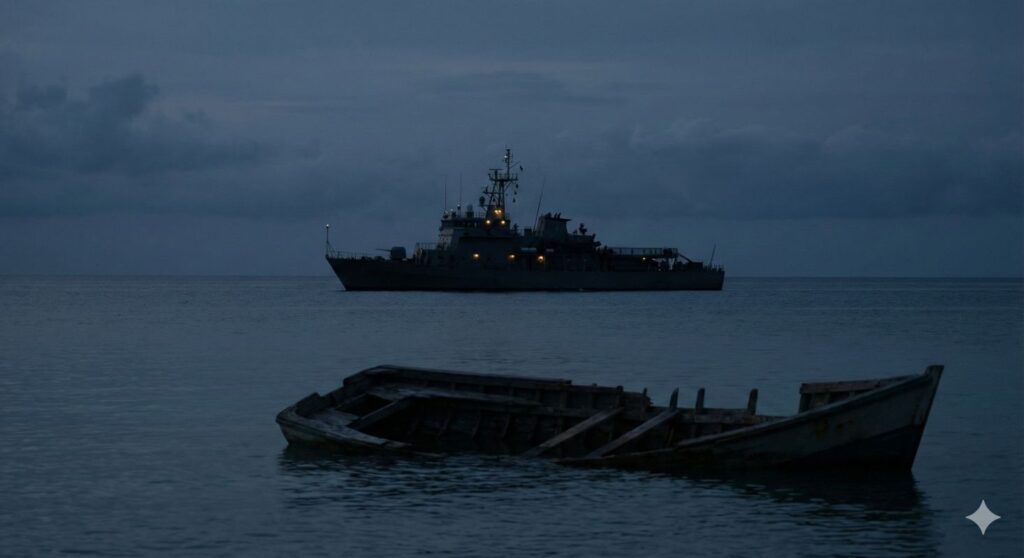
According to multiple investigations, the September 2 mission began when U.S. forces targeted a small vessel in the Caribbean Sea, in waters near Venezuela, on suspicion that it was carrying drugs. An initial round of boat strikes disabled the vessel, leaving debris and people in the water. Subsequent reporting from outlets including Reuters, the Guardian, and AP has alleged that a second strike was then ordered to destroy what remained of the boat and, in the process, to kill surviving passengers.
The administration initially framed these boat strikes as part of a broader maritime campaign against so-called “narco-terrorists” supported by the Venezuelan government. Officials described an ongoing effort involving more than twenty separate actions against suspected drug-running boats, resulting in at least eighty deaths in a series of escalating boat strikes at sea. That narrative cast the operations as a kind of low-level armed conflict, with U.S. forces acting under wartime authorities rather than ordinary law-enforcement rules.
Legal experts and human-rights advocates immediately challenged that framing. They noted that Congress has never authorized the use of military force against cartels and that there is no recognized armed conflict between the United States and drug-trafficking organizations. Under that view, the boat strikes look less like naval warfare and more like extrajudicial killings carried out on the high seas under a legally dubious theory of self-defense.
The controversy deepened when sources inside the Pentagon told reporters that commanders knew there were survivors in the water after the first strike, yet proceeded with a follow-on attack anyway. That detail has turned the September 2 boat strikes into a potential test case for whether senior leaders can be held to account for decisions that appear to target individuals who are already clearly hors de combat.
Command Responsibility And The Chain Of Decision
At the center of the storm are two key figures: Defense Secretary Pete Hegseth and Navy Admiral Frank “Mitch” Bradley. Public reporting suggests that Hegseth authorized a particularly aggressive posture for the maritime campaign and that Bradley, then leading Joint Special Operations Command, transmitted or reinforced orders for the second wave of boat strikes on the September 2 target.
The White House has tried to narrow the focus to Bradley, insisting that the admiral acted “within his authority and the law” when he directed the follow-up engagement to ensure the boat was fully destroyed. At the same time, Hegseth has publicly defended the operation, describing decisions made in the “fog of war,” even as former military lawyers argue that any order to use boat strikes against shipwreck survivors would be blatantly unlawful.
Traditional principles of command responsibility collide here with the modern reality of precision boat strikes executed in real time. Under long-standing international law, commanders can be held criminally responsible not only for unlawful orders they issue directly, but also for failing to prevent or punish violations committed by subordinates when they knew or should have known about them. The classic Yamashita case after World War II remains a touchstone for this doctrine.
If investigators confirm that senior leaders knew survivors were in the water and nonetheless pressed ahead with lethal boat strikes, the legal exposure will not stop at the tactical level. It could extend up the chain of command, including to the secretary who helped set the rules and the posture under which these boat strikes were conducted.
From Targeted Engagement To “Double-Tap” boat strikes
The most explosive allegation is that the September 2 mission amounted to a “double-tap” strike: a pattern in which an initial attack is followed by a second strike aimed at rescuers or survivors. Congressional critics and former judge advocates have warned that this pattern of boat strikes—if substantiated—would place the operation squarely in the category of potential war crimes.
The U.S. Defense Department’s own Law of War Manual explicitly protects shipwrecked persons and survivors from attack, recognizing them as hors de combat and therefore no longer lawful targets. Reuters, PBS, and AP reporting all note that directing boat strikes against clearly incapacitated survivors would violate both U.S. doctrine and international humanitarian law.
In other words, the same rules the United States has invoked for decades to criticize other states’ behavior at sea may now apply uncomfortably to its own use of boat strikes in the Caribbean.
Legal And Ethical Questions Around The boat strikes
Beyond the specifics of one mission, the entire legal basis for the Caribbean boat strikes campaign is being questioned. An in-depth expert Q&A at Just Security concluded that all twenty-one lethal actions against suspected drug-trafficking boats to date were unlawful, mainly because there is no recognized armed conflict with cartels and because peacetime law-enforcement limits still apply on the high seas.
Under the law of armed conflict, concepts like distinction, proportionality, and precautions in attack shape what is permitted, including in naval warfare. Scholars such as James Kraska have emphasized that even at sea, commanders must distinguish between military objectives and civilians, avoid excessive incidental harm, and take feasible steps to verify targets. In the September 2 case, critics argue that once the vessel was disabled and individuals were visibly struggling in the water, the military objective had effectively been neutralized. Continuing to apply boat strikes at that point, they say, can no longer be justified as necessary.
There is also the question of what body of law applies if the boat strikes are framed not as war but as counter-drug enforcement. In that scenario, lethal force is governed by human-rights standards requiring that it be strictly necessary to protect life and proportionate to an imminent threat. Legal experts interviewed by PBS NewsHour and AP have stated bluntly that using boat strikes to kill survivors under those conditions would be a crime.
The administration, for its part, has tried to straddle both frameworks—talking about an “armed conflict” with “narco-terrorists” while also asserting law-enforcement-style justifications for the boat strikes. That hybrid approach may play well in briefings, but it sits uneasily with the clear categories that law actually recognizes.
Political Reactions And Oversight
Congress has reacted with unusual speed and rare bipartisanship. The House and Senate Armed Services Committees have both opened investigations into the Caribbean boat strikes, with special attention to the September 2 follow-on attack. Lawmakers have requested full strike footage, the rules of engagement, the legal opinions underpinning the campaign, and any executive orders authorizing the use of boat strikes against cartels.
Admiral Bradley is now appearing on Capitol Hill to provide classified briefings for key members, even as public pressure mounts for open testimony about the boat strikes program. Meanwhile, Secretary Hegseth faces growing scrutiny over both his role in green-lighting the operations and his broader pattern of handling sensitive military matters, including a separate watchdog finding that he discussed strike planning on the encrypted messaging app Signal.
Politically, the administration is trying to contain the damage by insisting that the boat strikes were vetted by “the best military and civilian lawyers” and conducted in compliance with the law of armed conflict. Yet that line is now directly contradicted by outside experts, former JAGs, and even some U.S. allies, who worry that Washington is eroding norms it once championed.
For Congress, the stakes go beyond a single scandal. If lawmakers fail to assert meaningful oversight here, they will effectively signal that future presidents can launch lethal campaigns of boat strikes—with ambiguous legal foundations and opaque planning—without serious accountability for how those operations are conducted.
Public Sentiment, Media Coverage, And Trust
Public reaction to the controversy reflects a broader fatigue with unaccountable uses of force, whether from drone campaigns or boat strikes. Many Americans are only dimly aware of the maritime campaign itself; what catches their attention is the idea of U.S. forces firing on survivors clinging to wreckage in the open sea.
Media coverage has focused on two core themes: the legality of the second strike and the honesty of the government’s shifting explanations. Outlets like CBS News and Time have documented how the official account of the September 2 boat strikes has evolved over time, raising questions about whether political damage control has replaced a straightforward presentation of facts.
Social media has become a noisy forum where veterans, lawyers, and ordinary citizens argue over whether refusing an unlawful order is realistic in the heat of operations, what “fog of war” really means in a carefully planned mission, and how the U.S. would respond if another state carried out similar boat strikes against its own alleged enemies.
In that environment, every new leak, memo, or investigative piece either restores a bit of trust—or erodes it further. The more the story centers on who gave which order and who is trying to shift blame for the boat strikes, the more it confirms public suspicions that accountability is something senior officials talk about, not something they actually accept.
Lessons For Future Operations
Regardless of how the investigations into the Caribbean boat strikes end, the episode has already become a case study in what happens when legal thresholds are pushed and oversight lags behind. A few hard lessons stand out.
First, clarity matters. Commanders and operators need unambiguous guidance about when boat strikes are authorized, under which legal framework, and what happens when circumstances change—such as when a target is disabled and survivors are plainly visible. Blending the rhetoric of war with the reality of law-enforcement operations is an invitation to confusion and abuse.
Second, documentation and transparency are no longer optional. High-resolution sensors, real-time communications, and near-instant media leaks mean that every set of boat strikes can and will be dissected after the fact. If the justification for a second strike is weak or fabricated, that will come out, and the damage to U.S. credibility will be far greater than any short-term operational gain.
Third, command responsibility is not an abstract doctrine. The careers—and possibly the legal exposure—of Hegseth, Bradley, and others now hang on how they exercised their authority over these boat strikes. That reality should serve as a warning to future leaders who are tempted to sign off on aggressive operations while assuming someone else will bear the risk.
Ultimately, the question is not whether the United States has the capability to carry out precise boat strikes against suspected drug-running vessels at sea. It clearly does. The question is whether it can conduct such operations in a way that respects the law, preserves public trust, and avoids turning boat strikes into another symbol of unrestrained power.
Bottom Line
The scrutiny surrounding the U.S. military’s boat strikes is not going away. The September 2 operation in the Caribbean, especially the alleged decision to fire on survivors after the initial attack, has forced a reckoning over how lethal force is planned, approved, and reviewed at the highest levels. As Congress digs deeper and legal experts continue to challenge the administration’s narrative, the outcome will shape not only the careers of the officials involved, but also the future rules that govern U.S. operations at sea.
If the United States wants to retain any moral authority when it criticizes others for unlawful violence on the high seas, it will have to show that its own boat strikes are subject to real law, real oversight, and real accountability—not just talking points about the fog of war.
Further Reading
Reuters – “Did the U.S. military commit a war crime in boat attack off Venezuela?”
https://www.reuters.com/world/americas/are-deadly-us-strikes-alleged-drug-vessels-legal-2025-10-31/ Reuters
The Guardian – “Killing of survivors sparks outrage – but entire U.S. ‘drug boat’ war is legally shaky”
https://www.theguardian.com/us-news/2025/dec/04/venezuela-boat-strikes-legality-hegseth The Guardian
AP News – “This is what the law says about killing survivors of a boat strike”
https://apnews.com/article/boat-strikes-survivors-hegseth-72b0a498ca08615b2589c772a1d9e642 AP News
PBS NewsHour – “What the law says about killing survivors of a boat strike, according to experts”
https://www.pbs.org/newshour/politics/what-the-law-says-about-killing-survivors-of-a-boat-strike-according-to-experts PBS
Just Security – “Expert Q&A on the U.S. Boat Strikes”
https://www.justsecurity.org/126156/expert-qa-on-the-u-s-boat-strikes/ justsecurity.org
Defense One – “Congress to probe U.S. strikes on boats in Caribbean”
https://www.defenseone.com/policy/2025/12/congress-probe-us-strikes-boats-caribbean/409853/ Defense One
Military Times – “Former JAGs say Hegseth, others may have committed war crimes”
https://www.militarytimes.com/news/your-military/2025/12/01/former-jags-say-hegseth-others-may-have-committed-war-crimes/ Military Times
TIME – “Could Hegseth Face Prosecution for Alleged Boat Strike?”
https://time.com/7337735/pete-hegseth-boat-strike-caribbean/
Connect with the Author
Curious about the inspiration behind The Unmaking of America or want to follow the latest news and insights from J.T. Mercer? Dive deeper and stay connected through the links below—then explore Vera2 for sharp, timely reporting.
About the Author
Discover more about J.T. Mercer’s background, writing journey, and the real-world events that inspired The Unmaking of America. Learn what drives the storytelling and how this trilogy came to life.
[Learn more about J.T. Mercer]
NRP Dispatch Blog
Stay informed with the NRP Dispatch blog, where you’ll find author updates, behind-the-scenes commentary, and thought-provoking articles on current events, democracy, and the writing process.
[Read the NRP Dispatch]
Vera2 — News & Analysis
Looking for the latest reporting, explainers, and investigative pieces? Visit Vera2, North River Publications’ news and analysis hub. Vera2 covers politics, civil society, global affairs, courts, technology, and more—curated with context and built for readers who want clarity over noise.
[Explore Vera2]
Whether you’re interested in the creative process, want to engage with fellow readers, or simply want the latest updates, these resources are the best way to stay in touch with the world of The Unmaking of America—and with the broader news ecosystem at Vera2.
Free Chapter
Begin reading The Unmaking of America today and experience a story that asks: What remains when the rules are gone, and who will stand up when it matters most? Join the Fall of America mailing list below to receive the first chapter of The Unmaking of America for free and stay connected for updates, bonus material, and author news.
