
Vera2, Global Affairs
Benin Coup Thwarted by Loyalist Troops
Dec
Benin coup: Benin’s Thwarted Coup: A Show of Loyalty and Control
On 7 December 2025, the West African nation of Benin woke up to gunfire, explosions and an unexpected power struggle in its economic capital, Cotonou. A small group of soldiers appeared on state television to announce that they had seized power, suspended the constitution and removed President Patrice Talon from office. By the end of the day, Talon went on air himself to declare the Benin coup a failure and insist that the situation was “totally under control.” The episode was brief, but it exposed deep tensions inside Benin’s security forces and raised new questions about the health of its democracy.
Details of the Coup Attempt — Benin coup
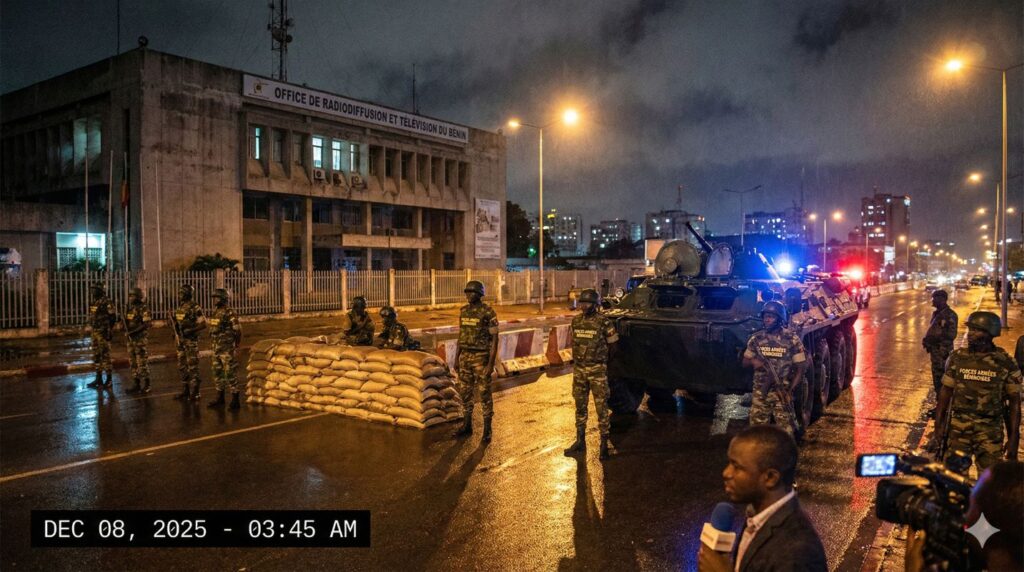
According to Benin’s interior minister Alassane Seidou and multiple international reports, the Benin coup began in the early hours of 7 December when elements of the National Guard attacked the president’s residence in Cotonou and moved to seize key state institutions. A group of eight soldiers stormed the national broadcaster and appeared on air, identifying themselves as the “Military Committee for Refoundation” and declaring that Talon had been removed as president. They announced the suspension of the constitution and state institutions and claimed to have closed the country’s borders and airspace.
Who led the soldiers
The soldiers, reportedly led by Lieutenant Colonel Pascal Tigri, said they were acting in response to mismanagement of the country, favoritism within the armed forces and what they described as the neglect of soldiers killed in northern counterinsurgency operations. They also cited rising insecurity in northern Benin, where armed groups linked to jihadist organizations operating in the Sahel have expanded attacks in recent years, as well as complaints over taxation, cuts to public services and restrictions on political activity.
Witnesses in Cotonou reported gunfire and explosions near military installations and around Camp Guezo, close to the presidential residence. The French and U.S. embassies issued alerts warning their nationals to avoid certain neighborhoods as armored vehicles and helicopters were seen in the streets and airspace over the city. For several hours, the signal of state television and public radio was interrupted after the initial announcement by the putschists.
By late morning, government officials were already insisting that loyalist forces were regaining control. Seidou said the attempted Benin coup had been “thwarted” and that most of the army and National Guard remained loyal to the constitutional authorities. Troops loyal to the government moved to retake the broadcaster and key military sites; by afternoon, authorities said traffic in Cotonou was largely back to normal, even as security checkpoints remained in place.
Government Response and Regional Role in the Benin coup
President Talon addressed the nation later that day on state television. He praised the “commitment and mobilization” of soldiers who remained loyal and argued that their actions had prevented “the worst” for the country. Talon pledged that the perpetrators of the Benin coup would be punished and described the putsch as a “senseless adventure” that would not go unaddressed. As of Sunday afternoon, officials reported at least 14 arrests, mostly active-duty soldiers accused of taking part in the attack on the broadcaster and other facilities.
Loyalist forces did not act alone. At the request of Benin’s government, neighboring Nigeria deployed air force jets to secure Benin’s airspace and carried out precision strikes on positions held by the mutineers, including a military camp west of Cotonou. Nigerian ground troops were also sent across the border to support Beninese forces in retaking the national television headquarters and stabilizing key sites.
The Economic Community of West African States (ECOWAS) and the African Union quickly condemned the Benin coup. ECOWAS leaders ordered the deployment of elements of the bloc’s standby force, including troops from Nigeria, Ghana, Côte d’Ivoire and Sierra Leone, to support Benin’s authorities and deter any renewed attempt to seize power by force. This rapid regional response stands in contrast to earlier coups in Mali, Burkina Faso and Niger, where regional mediation and sanctions struggled to reverse military takeovers.
By the evening of 7 December, Talon insisted that the situation was “completely” or “totally under control.” However, key questions remained unresolved. Reports indicated that Pascal Tigri was still at large, and local and international outlets noted that some senior officers and journalists had been held hostage during the day, with their status not immediately clarified. The government’s emphasis on control and loyalty reflected both a desire to reassure citizens and an awareness that the attempted Benin coup exposed fissures within the security services.
Political Context: Why the Benin coup Matters
The Benin coup did not occur in a vacuum. For years, Benin was widely described as one of Africa’s most stable democracies, especially after its transition to multiparty rule in 1991. More recently, however, observers have documented what they call significant “democratic backsliding” under Talon, who was first elected president in 2016.
Human rights organizations and research groups such as Freedom House and academic analysts have pointed to new electoral rules that effectively excluded much of the opposition from the 2019 parliamentary elections, arrests and prosecutions of opposition leaders, and the use of special courts to try political rivals. Deadly police violence at protests and restrictions on civil liberties have further undermined Benin’s earlier reputation as a democratic success story.
These trends matter for interpreting the Benin coup. On one side, Talon’s government and its regional partners frame the events of 7 December as an unacceptable attempt by a small faction of soldiers to overthrow an elected president and dismantle constitutional order. On the other, critics argue that closing off peaceful political competition and weakening democratic institutions can increase the risk that frustrated actors, including parts of the security forces, turn to force. None of these criticisms justifies a military takeover, but they help explain why a country long seen as stable has suddenly joined the list of states facing coup attempts.
The timing of the Benin coup is also significant. Talon is constitutionally barred from seeking another term and has said he will leave office after the April 2026 presidential election. Media reports note that he has endorsed his finance minister, Romuald Wadagni, as his preferred successor, while at least one prominent opposition figure has already been disqualified from running. That combination of managed succession and restricted competition has raised concerns that the transition may preserve Talon’s political project without addressing grievances that fueled both street protests and, now, mutiny within the ranks.
Regional Pattern and What the Benin coup Reveals
The Benin coup fits into a broader pattern of military interventions and attempted power grabs across West Africa since 2020. Coups in Mali, Burkina Faso, Niger and Guinea-Bissau, along with attempted putsches in other states, have led analysts to speak of a “coup belt” stretching from the Atlantic to the Red Sea. In many of these cases, militaries justified their actions by citing jihadist violence, corruption and frustration with civilian leaders, even as their own rule has brought new rights abuses and uncertainties.
What makes the Benin coup stand out is that it occurred in a country still formally on a democratic path, with elections scheduled and a president publicly preparing to step down. It underscores that democratic decline can coexist with regular elections and constitutional language. When institutions are hollowed out, opposition voices sidelined and security challenges allowed to fester, loyalty inside the armed forces can erode even without a complete breakdown of civilian rule.
The Benin coup also highlights the evolving role of regional security mechanisms. ECOWAS has struggled to reverse successful coups, especially when juntas have consolidated control over territory and key institutions. In Benin, by contrast, regional support for the elected government came while the outcome was still in doubt. Nigerian air power and the deployment of a standby force sent a clear signal that neighboring states were prepared to defend constitutional order in this case, though questions remain about whether similar resolve will be shown elsewhere.
For Beninese citizens, the failed putsch is both a warning and a test. It demonstrates that their country is not immune to the instability affecting much of the region. It also presents an opportunity for political leaders to address grievances that the mutineers exploited, from perceptions of unfair treatment within the military to anger over political exclusion and economic pressures. How authorities handle investigations, trials and broader reforms after the Benin coup will shape whether this episode becomes a turning point away from democratic erosion or simply another step in a worrying trend.
Bottom Line
The failed Benin coup of 7 December 2025 was short-lived, but its implications are long-term. Loyalist troops, backed by Nigeria and ECOWAS, restored control and allowed President Patrice Talon to project strength and continuity. At the same time, the attempt revealed fractures inside the security forces and drew attention to years of democratic backsliding and rising insecurity. Whether Benin can rebuild trust in its institutions, manage the 2026 election transparently and avoid further shocks will determine if this thwarted coup remains an isolated crisis or the prelude to deeper instability.
Further Reading
-
Al Jazeera coverage of soldiers’ televised announcement and President Talon’s response to the Benin coup:
https://www.aljazeera.com/news/2025/12/7/soldiers-appear-on-benin-state-television-announcing-apparent-coup -
Reuters report detailing the Benin coup attempt, the mutineers’ grievances and the government’s claim that loyalist forces thwarted the takeover:
https://www.reuters.com/world/africa/soldiers-benins-national-television-claim-have-seized-power-2025-12-07/ -
The Guardian analysis of troop deployments, Nigerian airstrikes and ECOWAS’s decision to send a standby force after the failed Benin coup:
https://www.theguardian.com/world/2025/dec/07/troops-and-warplanes-deployed-in-benin-after-failed-coup-attempt -
ABC News / Reuters overview of the events in Cotonou and President Talon’s assurance that the situation was “completely under control” after the Benin coup attempt:
https://www.abc.net.au/news/2025-12-08/benin-coup-attempt-thwarted/106114130 -
Freedom House 2024 country report on Benin, documenting democratic backsliding and restrictions on political opposition under President Talon:
https://freedomhouse.org/country/benin/freedom-world/2024 -
Democracy in Africa analysis of how electoral rules and institutional changes have weakened competitive politics in Benin in the years leading up to the Benin coup:
https://democracyinafrica.org/democracy-on-the-line-in-benin/
Connect with the Author
Curious about the inspiration behind The Unmaking of America or want to follow the latest news and insights from J.T. Mercer? Dive deeper and stay connected through the links below—then explore Vera2 for sharp, timely reporting.
About the Author
Discover more about J.T. Mercer’s background, writing journey, and the real-world events that inspired The Unmaking of America. Learn what drives the storytelling and how this trilogy came to life.
[Learn more about J.T. Mercer]
NRP Dispatch Blog
Stay informed with the NRP Dispatch blog, where you’ll find author updates, behind-the-scenes commentary, and thought-provoking articles on current events, democracy, and the writing process.
[Read the NRP Dispatch]
Vera2 — News & Analysis
Looking for the latest reporting, explainers, and investigative pieces? Visit Vera2, North River Publications’ news and analysis hub. Vera2 covers politics, civil society, global affairs, courts, technology, and more—curated with context and built for readers who want clarity over noise.
[Explore Vera2]
Whether you’re interested in the creative process, want to engage with fellow readers, or simply want the latest updates, these resources are the best way to stay in touch with the world of The Unmaking of America—and with the broader news ecosystem at Vera2.
Free Chapter
Begin reading The Unmaking of America today and experience a story that asks: What remains when the rules are gone, and who will stand up when it matters most? Join the Fall of America mailing list below to receive the first chapter of The Unmaking of America for free and stay connected for updates, bonus material, and author news.
