
Vera2, Global Affairs
US Influence Undermines Global Environmental Agreements
Dec
US Influence Undermines Global Environmental Agreements
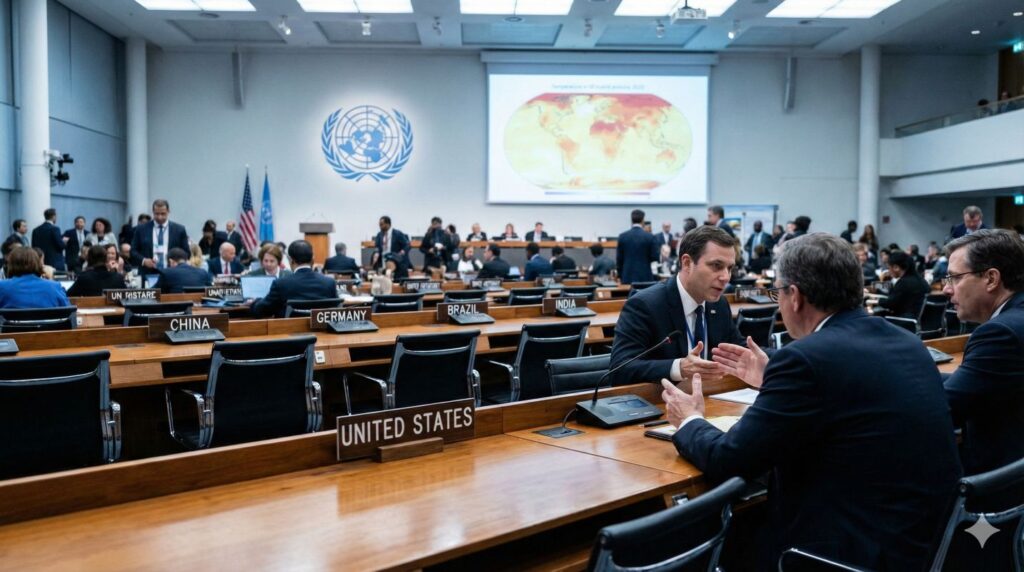
US influence over United Nations environment negotiations is under intense scrutiny after a major UN assessment on the state of the planet was published without its usual political summary. Senior scientists and negotiators say US influence, combined with pressure from other fossil fuel–aligned states, helped derail consensus language on phasing out coal, oil and gas, weakening the message to governments at a critical moment for climate action. The Guardian+1
Background on the UN Environment Report and US influence
The controversy centers on the latest Global Environment Outlook (GEO), the flagship assessment of the UN Environment Programme (UNEP). The 2025 GEO report, running to more than 1,100 pages, brings together the work of around 200 researchers and concludes that unsustainable food and fossil fuel production is causing about $5 billion in environmental damage every hour, or roughly $45 trillion per year. The Guardian
The GEO report warns that escalating climate change, biodiversity loss and pollution are undermining food security, water security, public health and even national and global security. It argues that a rapid transformation of energy, food and financial systems is needed “before collapse becomes inevitable,” including ending harmful subsidies, pricing environmental damage into fossil fuels and food, and investing heavily in renewable energy and nature protection. The Guardian
Under long-standing UN practice, major scientific reports such as GEO are accompanied by a shorter “summary for policymakers,” negotiated line by line and adopted by consensus. That summary distils the science into political language that ministers can use in national decision-making. For the first time in the history of the GEO series, however, governments failed to agree on such a summary. UNEP confirmed that no consensus text could be adopted, even though the underlying science remains unchanged. NonStop Local Tri-Cities/Yakima
According to reporting based on meeting minutes seen by Agence France-Presse (AFP), major oil producers Saudi Arabia and the United States opposed references to phasing out fossil fuels in the draft summary, contributing to the breakdown in talks. NonStop Local Tri-Cities/Yakima Senior scientist Robert Watson, a former chair of UN climate and biodiversity panels and co-chair of the GEO assessment, has said publicly that political resistance – including from the US under Donald Trump and other governments – is blocking or reversing environmental action despite clear scientific warnings. The Guardian These episodes have intensified concerns about how US influence is shaping the final form of international environmental agreements.
What the GEO assessment says about environmental harm
The GEO report quantifies environmental harm at an unprecedented scale. It estimates that combined damage from climate change, nature loss and pollution amounts to about $45 trillion a year, driven heavily by fossil fuel combustion and industrial agriculture. The food system alone is responsible for roughly $20 trillion of that damage, transport for about $13 trillion, and fossil fuel–powered electricity for around $12 trillion. The Guardian+1
The report argues that these “externalities” need to be reflected in real prices through measures such as removing environmentally harmful subsidies and potentially taxing emissions-intensive products like meat. It also notes that existing fossil fuel, food and mining subsidies total about $1.5 trillion per year, encouraging overconsumption and locking in polluting infrastructure. The Guardian
Crucially, the GEO authors stress that the costs of action are lower than the costs of inaction. They estimate the benefits of ambitious climate action alone could reach about $20 trillion a year by 2070 and as much as $100 trillion annually by 2100, through avoided damage and new economic opportunities. The Guardian From their perspective, resisting these changes because of short-term political or commercial interests – including US influence aligned with fossil fuel producers – is economically irrational as well as environmentally dangerous.
How US influence helped block the GEO summary
The dispute over the GEO summary played out in late October at a five-day meeting at UNEP headquarters in Nairobi. Under UN rules, the summary for policymakers must be approved by consensus because it represents a collective political understanding of the science. AFP reporting indicates that sharp divisions emerged over language on fossil fuel phase-out, plastics, harmful subsidies, gender and conflict. NonStop Local Tri-Cities/Yakima
Minutes of the meeting seen by AFP say Saudi Arabia and the United States opposed references to phasing out fossil fuels, which are both the primary driver of climate change when burned and the feedstock for most plastics. NonStop Local Tri-Cities/Yakima Other governments objected to sections on gender and conflict. With US influence and petrostate resistance aligned on core fossil fuel language, consensus became impossible.
UNEP executive director Inger Andersen described the failure to reach agreement as “regrettable,” while emphasizing that the scientific integrity of the 1,200-page report itself remained intact. She also noted that the United States participated relatively little in the debate and expressed its opposition at the end, but that was enough, under consensus rules, to prevent adoption. NonStop Local Tri-Cities/Yakima
For critics, this episode is a clear example of US influence weakening international environmental governance. They argue that when US influence is used to strip or block fossil fuel language in a summary document, it makes it harder for other countries’ ministers to argue for ambitious policies at home, even when the science is unequivocal.
US influence beyond the GEO report: shipping, plastics and COP30
The fight over the GEO summary is not occurring in isolation. The same AFP report notes that in October, pressure from the United States contributed to delaying a vote on a global emissions price for shipping, an initiative seen as a key step for decarbonizing international trade. NonStop Local Tri-Cities/Yakima In August, negotiations for what was hoped to be the world’s first global plastics treaty collapsed under opposition from oil-producing nations, which feared limits on plastic production would undercut fossil fuel demand. NonStop Local Tri-Cities/Yakima
At the UN’s COP30 climate summit in Belém, Brazil, negotiations over a roadmap to “transition away from fossil fuels” were deeply contentious. Draft text that mentioned a fossil fuel phase-out roadmap was later watered down, and the final compromise did not include a clear commitment to phase out coal, oil and gas. Petrostates such as Saudi Arabia and coal-dependent India were prominent in opposing stronger language, and the United States did not play a leading role in pushing for a firm phase-out commitment. Reuters+3The Guardian+3Financial Times+3
UN Secretary-General António Guterres has warned that multilateralism “remains effective” but is being tested by a combination of US absence from some processes and active fossil fuel industry opposition to stronger climate action. Reuters This creates a pattern in which US influence, whether through direct opposition to specific measures or through limited engagement in critical negotiations, contributes to weaker outcomes at a time when scientists say rapid cuts in emissions are urgently needed.
How US influence interacts with other powerful interests
It would be misleading to suggest that US influence is the only reason global environmental agreements are struggling. The GEO negotiations show that a cluster of governments, including Saudi Arabia, Iran, Russia, Turkey and Argentina, resisted references to fossil fuels, plastics, reduced meat consumption and harmful subsidies. The Guardian+1 At COP30, large fossil fuel producers and some major emerging economies opposed a strong phase-out roadmap. The Guardian+2Financial Times+2
However, analysts note that US influence is uniquely important because of the country’s economic weight, diplomatic power and cumulative emissions. When US influence aligns with petrostate positions to weaken or remove fossil fuel language, it gives political cover to other governments and makes it harder for ambitious coalitions to prevail.
Past investigations into climate negotiations have shown how governments, including big fossil fuel producers, have lobbied UN scientific bodies to soften language around fossil fuel phase-out and meat consumption. Leaked documents published in 2021 showed countries such as Saudi Arabia, Japan and Australia seeking to water down IPCC language on the need to move rapidly away from fossil fuels. Unearthed+2Mining Technology+2 While those leaks did not focus on the United States, they illustrate how intensive lobbying and political pressure can alter scientific summary texts – a pattern now echoed in debates over US influence in the GEO process.
Scientific and civil society responses to US influence
Scientists involved in the GEO assessment and other UN processes have been explicit that politics, not science, explains the failure to agree on the summary. Watson has emphasized that “the science is good, the solutions are known,” but that implementing them requires political courage that many governments currently lack. The Guardian+1
Researchers and environmental groups argue that US influence should be used to strengthen, not weaken, global agreements. From their perspective, a major emitter that has the financial and technological capacity to act quickly ought to be leading efforts to phase out fossil fuels and reform harmful subsidies. Instead, when US influence is deployed to oppose language on fossil fuel phase-out or delay votes on sector-specific measures like shipping emissions, it undercuts the credibility of US climate diplomacy and emboldens other countries to stall. NonStop Local Tri-Cities/Yakima+2Reuters+2
Civil society organizations are calling for greater transparency around how national delegations, including that of the United States, intervene in line-by-line negotiations on UN texts. They argue that recording and publishing countries’ positions more systematically could help voters, journalists and parliaments scrutinize how US influence is wielded in international forums and whether it aligns with public commitments on climate and biodiversity.
Implications for future global environmental agreements
The breakdown over the GEO summary matters because these documents shape how governments and financial institutions interpret scientific findings. Without an agreed political summary, the risk is that ministers and negotiators cherry-pick from the 1,100-plus pages, while those opposed to strong action point to the lack of consensus as a reason to move slowly.
If US influence continues to align with petrostates to resist explicit references to fossil fuel phase-out, future agreements on shipping, aviation, plastics and climate finance could face similar obstacles. The AFP story highlights that US pressure helped delay a vote on shipping emissions pricing, and plastics treaty talks broke down amid opposition from oil-producing nations. NonStop Local Tri-Cities/Yakima Together with a watered-down COP30 outcome that lacks a robust fossil fuel roadmap, this suggests that current multilateral structures can be vulnerable when US influence is not pushing firmly in the direction of stronger environmental protections. Reuters+2The Energy Mix+2
At the same time, the GEO report’s core message remains: the cost of inaction far exceeds the cost of action, and pathways exist to transform energy, food and finance in ways that improve welfare and reduce risk. The Guardian+1 Whether global institutions seize those pathways will depend in large part on how US influence is exercised in coming years – and on whether other countries, especially in Europe, Latin America and climate-vulnerable regions, can build coalitions strong enough to counterbalance opposition from fossil fuel-aligned actors.
Bottom Line
The latest UN environment assessment shows that the world is rapidly exhausting its environmental safety margins, yet political negotiations around that science remain fragile. The failure to agree a GEO summary for policymakers, in part due to opposition from Saudi Arabia and the United States to fossil fuel phase-out language, has become a symbol of how US influence and petrostate resistance can weaken global environmental agreements at exactly the moment when strong, coordinated action is needed. The Guardian+2NonStop Local Tri-Cities/Yakima+2
How US influence is deployed in upcoming negotiations on shipping, plastics, climate finance and future COPs will help determine whether multilateralism delivers the rapid transition scientists say is essential – or whether the gap between scientific warnings and political outcomes continues to widen.
Further Reading
BBC News – “UN environment report ‘hijacked’ by US and others over fossil fuels, top scientist says”:
https://www.bbc.com/news/articles/c1w9ge93w9po
The Guardian – “‘Food and fossil fuel production causing $5bn of environmental damage an hour’”:
https://www.theguardian.com/environment/2025/dec/09/food-fossil-fuel-production-5bn-environmental-damage-an-hour-un-geo-report- The Guardian
AFP via NBC Right Now – “Fight over fossil fuels nixes key text of UN environment report”:
https://www.nbcrightnow.com/national/fight-over-fossil-fuels-nixes-key-text-of-un-environment-report/article_c8198c0f-f6a6-53fa-bcaf-09ad270c811b.html NonStop Local Tri-Cities/Yakima
Reuters – “Multilateralism works even as US and fossil fuel industry oppose climate action, UN chief says”:
https://www.reuters.com/sustainability/climate-energy/multilateralism-still-works-even-us-oil-industry-abandon-climate-action-un-chief-2025-12-03/ Reuters
The Guardian – “Cop30 draft text omits mention of fossil fuel phase-out roadmap”:
https://www.theguardian.com/environment/2025/nov/21/cop30-countries-threaten-block-resolution-unless-roadmap-to-fossil-fuel-phase-out The Guardian
The Energy Mix – “‘Empty Deal’ at COP30 as Petrostates Block Progress on Fossil Fuel Phaseout”:
https://www.theenergymix.com/breaking-empty-deal-at-cop30-as-petrostates-block-progress-on-fossil-fuel-phaseout/ The Energy Mix
Greenpeace Unearthed – “Leaked documents reveal the fossil fuel and meat lobbies trying to weaken UN climate report”:
https://unearthed.greenpeace.org/2021/10/21/leaked-climate-lobbying-ipcc-glasgow/ Unearthed+1
UNEP – “Global Environment Outlook (GEO) – A Future We Choose”:
https://www.unep.org/resources/global-environment-outlook-7
Connect with the Author
Curious about the inspiration behind The Unmaking of America or want to follow the latest news and insights from J.T. Mercer? Dive deeper and stay connected through the links below—then explore Vera2 for sharp, timely reporting.
About the Author
Discover more about J.T. Mercer’s background, writing journey, and the real-world events that inspired The Unmaking of America. Learn what drives the storytelling and how this trilogy came to life.
[Learn more about J.T. Mercer]
NRP Dispatch Blog
Stay informed with the NRP Dispatch blog, where you’ll find author updates, behind-the-scenes commentary, and thought-provoking articles on current events, democracy, and the writing process.
[Read the NRP Dispatch]
Vera2 — News & Analysis
Looking for the latest reporting, explainers, and investigative pieces? Visit Vera2, North River Publications’ news and analysis hub. Vera2 covers politics, civil society, global affairs, courts, technology, and more—curated with context and built for readers who want clarity over noise.
[Explore Vera2]
Whether you’re interested in the creative process, want to engage with fellow readers, or simply want the latest updates, these resources are the best way to stay in touch with the world of The Unmaking of America—and with the broader news ecosystem at Vera2.
Free Chapter
Begin reading The Unmaking of America today and experience a story that asks: What remains when the rules are gone, and who will stand up when it matters most? Join the Fall of America mailing list below to receive the first chapter of The Unmaking of America for free and stay connected for updates, bonus material, and author news.
