
Vera2, Global Affairs, Investigations & Corruption
Hegseth briefing: Congress Presses Pentagon on Drug Boat Strike Video and War Powers
Dec
Hegseth briefing: Congressional Scrutiny of US Drug Boat Strikes
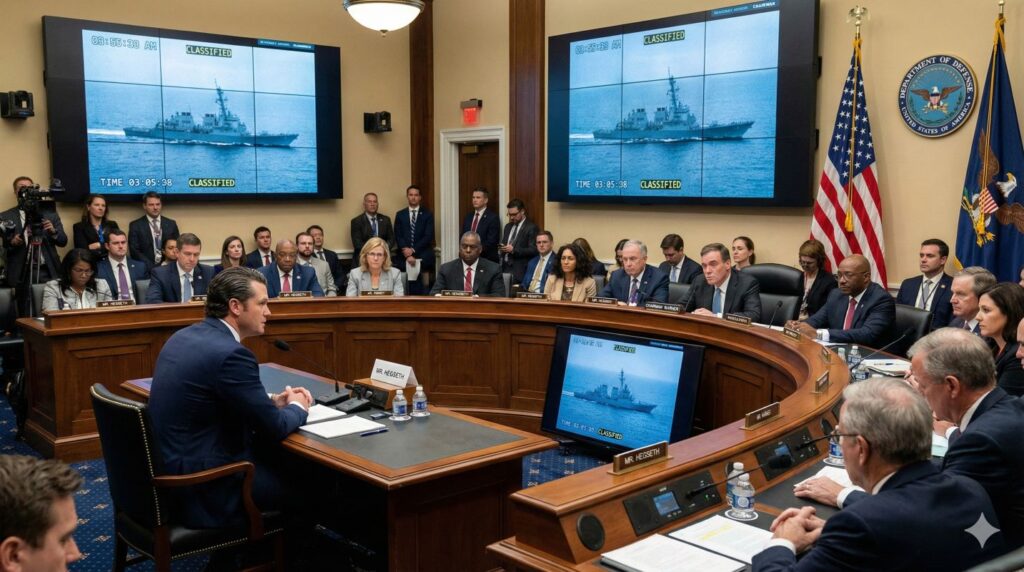
Defense Secretary Pete Hegseth’s recent classified update to lawmakers has become known simply as the Hegseth briefing. It focused on a controversial U.S. military strike on a suspected drug-smuggling boat in the Caribbean, and on the wider campaign of air and naval operations against alleged traffickers. The Hegseth briefing has intensified debate over how far the United States can go in using military force in the name of counternarcotics, and how transparent the Pentagon must be with Congress and the public.
At the center of the Hegseth briefing is video of a September 2, 2025 strike that killed all eleven people on a small vessel the administration says was tied to drug cartels. According to detailed reporting, nine men died in an initial missile strike; two survivors clung to debris before a second “double tap” strike killed them as well. Lawmakers from both parties say they need to see the full, unedited footage and the underlying orders to determine whether U.S. forces complied with the law of armed conflict.
Context: Operation Southern Spear and the anti-drug campaign
The Hegseth briefing cannot be understood without the broader context of Operation Southern Spear, a Trump administration campaign that combines surveillance, drones, and naval assets to target alleged narcotraffickers in the Western Hemisphere. Publicly available information indicates that the campaign began in mid-August 2025, after the administration deployed additional Navy assets to waters near Venezuela and other transit routes for cocaine and other drugs.
According to open-source reporting and government statements, at least 15 vessels had been struck by late October 2025, leaving more than 60 people dead and only a handful of survivors. Officials say the targets are operated by groups that Washington has labeled “narcoterrorists,” including Venezuela’s Tren de Aragua criminal network and Colombia’s National Liberation Army. However, the administration has not publicly released evidence tying individual boats to these organizations, which has fuelled criticism from legal experts and human rights advocates who argue that lethal force is being used without transparent standards of proof.
The September 2 strike at the center of the Hegseth briefing occurred shortly after President Donald Trump publicly announced the first such operation, releasing video of an earlier attack on a Venezuelan boat. He framed the campaign as a necessary escalation in the “war on cartels,” describing Venezuelan president Nicolás Maduro as a leading narcotrafficker and offering a multimillion-dollar bounty for information leading to Maduro’s arrest.
The September 2 double-tap strike
The Hegseth briefing was called after weeks of mounting concern over what happened during the September 2 operation. Press accounts, citing U.S. officials and leaked documents, report that the first missile strike tore apart a small vessel and killed most of the people on board. Two survivors were seen clinging to wreckage when a second strike destroyed the remaining debris and killed them.
According to a Washington Post investigation and subsequent summaries of Admiral Frank Bradley’s closed-door testimony, there is a dispute over who ordered that second strike and why. Some anonymous sources claimed Defense Secretary Hegseth had given a “no survivors” directive, a charge he and Pentagon spokespeople reject as “false” and “fabricated.” Bradley, the naval commander who oversaw the mission, has reportedly told lawmakers that he ordered the follow-up strike because he believed the floating debris still contained a large quantity of cocaine that could be recovered and trafficked if the survivors were rescued with it.
The Pentagon’s own Law of War Manual emphasizes that shipwrecked or otherwise incapacitated individuals who are out of combat and pose no immediate threat should not be targeted. Legal experts note that if the survivors were unarmed, unable to communicate, and presented no imminent danger, intentionally striking them could violate international humanitarian law and potentially constitute a war crime. These concerns were a major reason why lawmakers insisted on the Hegseth briefing and on reviewing the full video.
Inside the Hegseth briefing to Congress
During the Hegseth briefing on Capitol Hill, the defense secretary was joined by Secretary of State Marco Rubio, CIA Director John Ratcliffe, and senior military officers including Admiral Bradley. According to multiple accounts, including Associated Press and PBS reporting, lawmakers in both parties emerged dissatisfied, saying the session left key questions unanswered.
A central dispute in the Hegseth briefing was over access to evidence. Legislators pressed Hegseth to release the unedited video of the strike and the written or verbal orders that governed the mission. Administration officials have allowed a select group of lawmakers to see portions of the footage in secure settings, but they have so far resisted making it more widely available or declassifying it for public release.
Democrats argued that, without full access to the video and targeting intelligence, Congress cannot properly assess whether the strikes comply with U.S. and international law. Several Republicans, including some who normally align with the Trump administration, echoed concerns about transparency and the clarity of the rules of engagement. Hegseth has said he is “weighing” whether to release more of the footage, citing operational security and the need to protect tactics and intelligence capabilities.
Questions about legality and rules of engagement
Much of the closed-door discussion in the Hegseth briefing reportedly focused on whether the United States is, in legal terms, “at war” with drug cartels, and what that means for targeting rules. Public comments from Hegseth and other officials have compared cartel members to terrorists and suggested that they may be attacked wherever they operate if they are part of designated organizations.
Critics counter that the United States has not passed a specific authorization for the use of military force (AUMF) against cartels, and that standard law enforcement frameworks should apply unless Congress explicitly approves a war-like posture. Legal scholars and former military lawyers have warned that stretching existing terrorism-related authorities to justify open-ended lethal operations against suspected traffickers risks setting a precedent for bypassing normal judicial processes.
These issues came to the surface in the Hegseth briefing as lawmakers pressed for clarity on who can be targeted, under what evidence standard, and with what safeguards to prevent the killing of noncombatants or shipwrecked survivors.
Congressional oversight and political fallout
The political consequences of the Hegseth briefing are unfolding on several fronts. On the House side, Armed Services Committee chair Mike Rogers has indicated that he plans to wind down his panel’s formal investigation after receiving classified briefings, saying he believes he has enough information. That decision has drawn criticism from Democrats and some Republicans who argue that Congress should not close the book while serious legal questions remain unresolved.
In the Senate, Republican Roger Wicker and other lawmakers are pursuing parallel inquiries and pushing for continued access to witnesses and documents referenced in the Hegseth briefing. Some members of both parties have floated the idea of a war powers resolution aimed at limiting President Trump’s authority to use force in or around Venezuela without explicit congressional authorization, particularly if operations are framed as part of a broader confrontation with the Maduro government rather than as discrete counternarcotics missions.
Separately, human rights groups and legal experts have called for independent investigations into the September 2 strike and the wider campaign, arguing that internal Pentagon reviews and the Hegseth briefing are not enough to guarantee accountability. Commentators note that more than twenty senior officers have been removed or pushed out during Trump’s current term, raising questions about whether dissenting voices inside the military feel able to challenge aggressive directives.
Impact on public debate
News of the Hegseth briefing has filtered into broader public debate about the Trump administration’s national security strategy. At the Reagan National Defense Forum, Hegseth argued that previous decades of what he called “utopian idealism” are over, and that his priority is securing the Western Hemisphere, including more assertive military roles in border security and anti-drug operations.
Media coverage from outlets such as the Associated Press, Reuters, The Washington Post, The Guardian, and others has highlighted how the Hegseth briefing underscores tensions between this more hard-edged approach and traditional legal and ethical constraints on the use of force.
Why the Hegseth briefing matters beyond one mission
The Hegseth briefing is not only about a single tragic incident at sea. It raises fundamental questions about how the United States defines threats, authorizes force, and balances secrecy with democratic oversight.
First, the case illustrates how new technologies and missions—such as drone strikes on small boats far from declared battlefields—can outpace existing legal frameworks. If cartels and criminal networks are effectively treated as wartime enemies, the lines between war and law enforcement may blur in ways that Congress never explicitly debated. Second, by keeping key evidence classified or tightly restricted, the executive branch can make it harder for legislators, courts, and the public to evaluate whether the rules are being followed.
Finally, the Hegseth briefing highlights the personal accountability of senior leaders in shaping and overseeing lethal operations. Even if Admiral Bradley, rather than Hegseth, ordered the second strike, civilian leaders are responsible for the overall design of campaigns such as Operation Southern Spear and for ensuring that subordinates act within the law.
Bottom line
The Hegseth briefing has become a focal point for larger arguments about transparency, legality, and the militarization of counternarcotics policy. It has drawn attention to a lethal campaign of strikes on alleged drug traffickers, the opaque standards used to select targets, and the unresolved questions about a deadly double-tap strike that killed survivors in the water.
Whether the administration ultimately releases the full strike video and related orders, and whether Congress chooses to assert its authority through new legislation or war powers measures, will shape how future presidents conduct similar operations. In that sense, the Hegseth briefing is likely to remain a reference point in debates over how far the United States should go in using military force to confront criminal networks, and how accountable those decisions must be to elected representatives and the public.
Further Reading
Associated Press. “Hegseth tells congressional leaders he is weighing release of boat strike video.” AP News. 10 December 2025. https://apnews.com/article/9f46a5f074b5b3c979ee41082949b196
House Armed Services Committee probe coverage. “House panel plans to end its boat strike probe, GOP chair says.” The Washington Post. 9 December 2025. https://www.washingtonpost.com/national-security/2025/12/09/alvin-holsey-hegseth-boat-strikes/
Reuters. “Hegseth says he would have ordered second strike on Caribbean vessel.” 6 December 2025. https://www.reuters.com/world/americas/hegseth-says-he-would-have-ordered-second-strike-caribbean-vessel-2025-12-06/
The Guardian. “Hegseth gives defiant speech defending ‘drug boat’ strikes amid scrutiny.” 6 December 2025. https://www.theguardian.com/us-news/2025/dec/06/hegseth-boat-strikes
Politico. “Hegseth declares end of US ‘utopian idealism’ with new military strategy.” 6 December 2025. https://www.politico.com/news/2025/12/06/hegseth-reagan-forum-defense-strategy-00679736
Wikipedia. “2025 United States military strikes on alleged drug traffickers.” https://en.wikipedia.org/wiki/2025_United_States_military_strikes_on_alleged_drug_traffickers
Wikipedia. “Operation Southern Spear.” https://en.wikipedia.org/wiki/Operation_Southern_Spear
Connect with the Author
Curious about the inspiration behind The Unmaking of America or want to follow the latest news and insights from J.T. Mercer? Dive deeper and stay connected through the links below—then explore Vera2 for sharp, timely reporting.
About the Author
Discover more about J.T. Mercer’s background, writing journey, and the real-world events that inspired The Unmaking of America. Learn what drives the storytelling and how this trilogy came to life.
[Learn more about J.T. Mercer]
NRP Dispatch Blog
Stay informed with the NRP Dispatch blog, where you’ll find author updates, behind-the-scenes commentary, and thought-provoking articles on current events, democracy, and the writing process.
[Read the NRP Dispatch]
Vera2 — News & Analysis
Looking for the latest reporting, explainers, and investigative pieces? Visit Vera2, North River Publications’ news and analysis hub. Vera2 covers politics, civil society, global affairs, courts, technology, and more—curated with context and built for readers who want clarity over noise.
[Explore Vera2]
Whether you’re interested in the creative process, want to engage with fellow readers, or simply want the latest updates, these resources are the best way to stay in touch with the world of The Unmaking of America—and with the broader news ecosystem at Vera2.
Free Chapter
Begin reading The Unmaking of America today and experience a story that asks: What remains when the rules are gone, and who will stand up when it matters most? Join the Fall of America mailing list below to receive the first chapter of The Unmaking of America for free and stay connected for updates, bonus material, and author news.
