
Vera2, Civil Rights and Society
TSA passenger data and ICE: What the Reported Data-Sharing Means for Privacy, Travel, and Enforcement
Dec
TSA passenger data and ICE: What the Reported Data-Sharing Means for Privacy, Travel, and Enforcement
Reporting in December 2025 said the Transportation Security Administration (TSA) is providing lists of air traveler names to Immigration and Customs Enforcement (ICE), a development that has reignited debate over how far aviation-security systems can be repurposed for domestic immigration enforcement. The controversy is not that the federal government collects traveler information. It already does, largely through screening and watchlist-matching programs that depend on identifying details provided by airlines. The controversy is the reported operational use of TSA passenger data to help ICE identify and detain people at airports, and what that means for privacy, due process, and day-to-day travel.
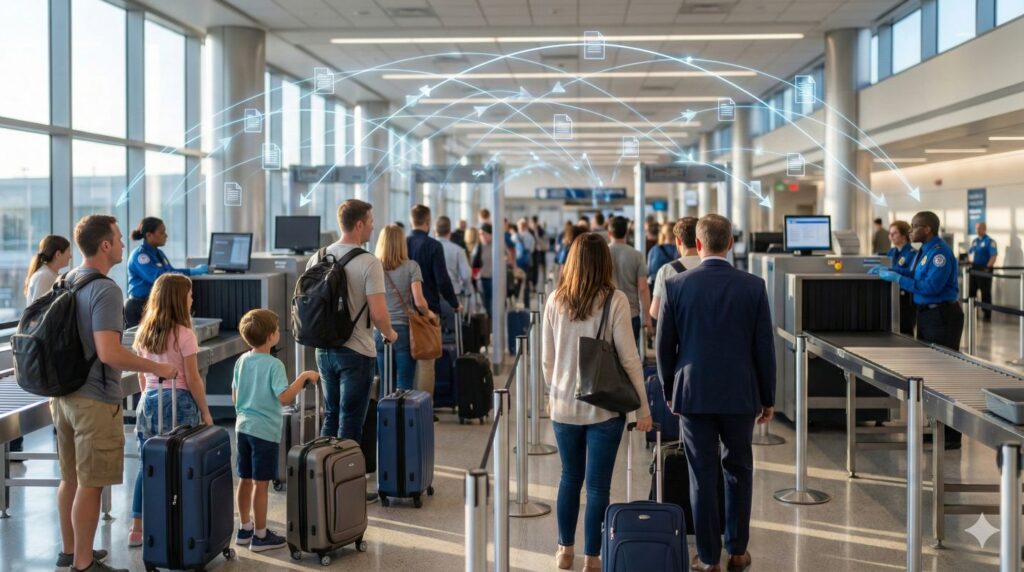
Because TSA passenger data sits inside a high-volume system that touches nearly every commercial passenger, even a narrow enforcement use can feel broad in practice. The practical question for most travelers is not the legal jargon in a notice, but the real-world consequence: whether routine airline travel can become a moment where TSA passenger data is used to trigger enforcement action at a gate, at a checkpoint, or in a terminal.
This is why the story has drawn rapid attention from immigrant-rights groups, civil-liberties advocates, and travelers who worry that flying within the United States could increasingly function as an immigration checkpoint powered by TSA passenger data. The public argument, in other words, is not only about what TSA passenger data exists, but about how TSA passenger data is used once it is in government hands.
Overview of the reported TSA passenger data sharing with ICE
A People report summarizing New York Times reporting described a Trump administration directive instructing TSA to provide ICE with the names of every air passenger. According to that reporting, TSA began sending passenger-name lists to ICE multiple times per week starting in March 2025. The stated purpose was to allow ICE to compare those names against immigration databases and identify people the agency says are subject to deportation or detention.
That description matters because it implies a routine pipeline: TSA passenger data is shared at a recurring cadence, not only in isolated, case-by-case circumstances. Even if ICE’s operational goal is limited to a subset of individuals, the mechanism begins with broad lists, and that is the pivot point for many privacy critiques of TSA passenger data use.
The reporting also emphasized a structural reality: TSA and ICE sit within the Department of Homeland Security (DHS). When TSA passenger data moves between DHS components, it can occur under internal-sharing practices that are less visible to the public than a cross-department handoff, even if the downstream effect is substantial. This is one reason opponents focus on transparency: the public may see the consequences of TSA passenger data sharing before it sees the operational rules behind TSA passenger data sharing.
A DHS spokesperson, in comments quoted by People, characterized the cooperation as “nothing new” while also framing it as a reversal of Biden-era practices, arguing that people in the country unlawfully should not be able to fly domestically without identification. That framing suggests the administration is presenting TSA passenger data sharing as a “core mission” enforcement alignment rather than a novel surveillance program.
What remains less clear from public reporting is the full scope of what TSA passenger data includes in these transfers beyond names, whether itinerary details or additional identifiers are involved, how often database matches occur, how frequently ICE acts on those matches at airports, and what auditing steps exist to reduce mistaken identity or stale-record errors when a match leads to detention mid-travel. The unanswered questions here are central because the privacy impact of TSA passenger data often depends on details: which fields, which matching logic, what human verification, and what error-correction exists after a TSA passenger data match triggers action.
What the public reporting does and does not establish about TSA passenger data
The core factual claims in the public reporting are about frequency, the starting timeframe in March 2025, and the use of name matching that can lead to airport enforcement actions. The public reporting does not provide a single, comprehensive, official technical specification of TSA passenger data elements shared, nor does it provide a full set of published safeguards in one canonical release that a traveler can easily read and understand.
That gap between what the public can see and what the system can do is a major reason TSA passenger data becomes politically volatile: the consequences are concrete, while the operational details can remain opaque. When a traveler hears “TSA passenger data,” the phrase can sound abstract. But when TSA passenger data is used to help locate a person in an airport, TSA passenger data becomes an operational tool with immediate real-world stakes.
What TSA already collects and why TSA passenger data is not “new”
To understand the dispute, it helps to be specific about what TSA already does. For years, airlines have provided passenger biographic information for watchlist matching and security screening, and TSA’s Secure Flight program exists to screen passengers before they enter sterile areas or board aircraft. The public-facing issue is not that TSA passenger data suddenly appeared; it is that existing pipelines may be used more directly for civil immigration enforcement.
Secure Flight operates under published legal and privacy frameworks that describe how information is handled and when disclosures may occur. Secure Flight regulations include privacy notice language stating that TSA may share information with law enforcement or intelligence agencies or others under its published system-of-records notice. That legal backdrop is central to arguments that TSA passenger data sharing can be lawful under certain conditions.
Separately, Secure Flight records have been described through system-of-records notices (SORNs) under the Privacy Act framework. Those notices provide the structure for what categories of records exist, how the government says they are used, and what “routine uses” may allow sharing. In practical terms, these notices are part of the reason TSA can say TSA passenger data is governed by existing documentation rather than invented from scratch.
But documentation is not the whole story. A “may share” clause does not automatically answer whether sharing should occur at a particular scale, in a particular operational pattern, for a particular enforcement goal. The public debate is about the real-world application of TSA passenger data: using aviation-security infrastructure to assist airport detentions tied to civil immigration enforcement. Put plainly, the controversy is not the existence of TSA passenger data, but the operational repurposing of TSA passenger data.
Why the “repurposing” argument persists
Even where legal notice exists, many travelers still experience airport screening as “aviation security,” not “immigration enforcement.” When TSA passenger data becomes an operational tool for ICE activity in airports, critics argue that this is a repurposing of a security-screening system into an enforcement locator system, at least in effect.
That repurposing concern is amplified by the scale of air travel: a system designed for throughput and standardized processing can produce datasets that are large enough to make TSA passenger data uniquely powerful when combined with other databases. In that sense, TSA passenger data is not merely “information,” but an index into movement and presence at specific times and places.
Why privacy and civil-liberties concerns focus on TSA passenger data notice, scale, and error
Privacy concerns around TSA passenger data and ICE generally cluster around three practical issues: whether travelers have meaningful notice, whether the approach is proportionate, and how errors are handled when the stakes include detention and removal.
Notice is the first flashpoint because many travelers do not experience domestic flying as an immigration-screening encounter. Even if a privacy notice allows certain disclosures, travelers often do not understand the downstream uses in plain terms when they book a ticket. TSA maintains public privacy policies, but critics argue those documents do not necessarily translate into a clear expectation that TSA passenger data could be routinely shared with immigration agents multiple times per week for interior enforcement operations. A policy can be technically published while still leaving ordinary people with a misleading mental model of how TSA passenger data can be used.
Scale is the second flashpoint. The reported approach is described as providing ICE the names of all air travelers. Even if ICE claims it is searching for a narrower subset of people, the mechanism still begins with broad collection. In many privacy debates, that is the hallmark of dragnet architecture: you start with large sets of TSA passenger data, then filter for targets later. Critics argue that this structure inevitably exposes many uninvolved travelers to scrutiny because TSA passenger data is processed in bulk before any individualized determination is made.
Error is the third flashpoint, and it is not theoretical. Reporting summarized by People described arrests and removals linked to the program, highlighting the risk that database information can be outdated, incomplete, contested, or tied to a person with a similar name. When TSA passenger data is used to trigger an airport enforcement response, it raises immediate questions about verification, escalation protocols, and what happens to a traveler who is flagged incorrectly mid-journey.
Airports add another layer of risk. They are time-sensitive, public, and often chaotic. A detention at a gate or checkpoint can cause missed flights and cascading disruptions even for people who are not detained, while also creating high-stress confrontations that can escalate quickly. In that environment, even a small error rate tied to TSA passenger data matching can have outsized personal and operational consequences.
The broader travel-data ecosystem and why TSA passenger data is only one channel
The TSA passenger data debate is happening in a wider context: travel information can circulate through multiple channels, not all of them direct government collection at a checkpoint.
In July 2025, the Electronic Frontier Foundation (EFF) warned that data brokers can sell flight and travel-related information to government entities including Customs and Border Protection and ICE, arguing that U.S. privacy gaps allow sensitive movement data to be monetized and accessed without the transparency that normally comes with direct government collection. That broader ecosystem fuels skepticism that any single pathway of access will remain narrow over time.
This matters because the policy question is not only “What is TSA sharing?” It is also “What can be paired with it?” If TSA passenger data becomes a routine input for immigration operations, critics argue it may normalize a broader interior-enforcement model where travel itself is treated as an enforcement opportunity, with multiple data sources reinforcing each other. From that perspective, TSA passenger data can become one of several cross-referenced signals that collectively increase the risk of mistaken matches, expanded targeting, or mission creep.
Legal framework: authority to share TSA passenger data versus limits on how it is used
The legal debate is not about whether TSA can ever share information. Secure Flight regulations include privacy notice language that contemplates sharing under published system-of-records notices, and the Secure Flight SORN framework is part of how the program has long been structured.
The harder question is about implementation. Even if disclosures are permitted under a system-of-records “routine use,” opponents may argue that routine-use reasoning can be stretched beyond what the public reasonably expects, especially if TSA passenger data is transmitted repeatedly and systematically for the operational purpose of enabling airport detentions and arrests. In disputes like this, the legal fight often turns on practical questions about the TSA passenger data workflow: what triggers sharing, who approves it, what is logged, and what safeguards constrain how TSA passenger data is acted upon.
If legal challenges emerge, the most likely pressure points would be fact-specific: what exactly is being shared, under what written policy, how matches are verified, what redress exists for errors, and whether the government can justify the scale as necessary and proportionate. Those questions typically require documentation, and documentation often becomes public only through investigative reporting, congressional oversight, inspector general reviews, or litigation and FOIA disclosures. In other words, the legal controversy tends to turn on details about TSA passenger data operations, not just broad statements about TSA passenger data authority.
Operational and political implications of TSA passenger data use at airports
On the operational side, the reported approach could change how some communities experience travel even if the number of detentions remains limited. The fear of mistaken detention can have a chilling effect in mixed-status families and immigrant communities, including lawful residents who worry about database confusion, name similarity, or administrative errors tied to TSA passenger data matching.
Airports also rely on predictability. If airport detentions expand, it could create friction between passenger throughput and enforcement actions unfolding in public spaces. That is not sensationalism; it is a practical observation about what happens when you combine high-volume passenger processing with enforcement actions triggered by TSA passenger data matches. When enforcement actions occur at scale in terminals, the impact does not fall only on the person targeted; it can affect everyone caught in the delay, the confusion, or the disruption caused by TSA passenger data-driven interventions.
On the political side, DHS’s public framing suggests the administration views the use of TSA passenger data as consistent with a more aggressive enforcement posture. Critics view it as a step toward embedding immigration enforcement into daily life and domestic movement, with air travel functioning as an interior checkpoint.
What to watch next on TSA passenger data and ICE
The next phase of the story will be shaped by transparency and oversight.
One thing to watch is whether DHS or TSA releases clearer public documentation describing what fields TSA passenger data includes in these transfers, what safeguards apply, and what auditing occurs after ICE action at an airport. Another is whether Congress requests briefings, documents, or audits to assess compliance with privacy frameworks and to quantify error rates. Another is whether litigation forces disclosures that turn reported operational details into a clearer public record.
It is also worth watching how other travel-data channels evolve. If government entities can access travel records through multiple pathways, pressure will grow for a policy framework that is clear to ordinary travelers, not just legible to lawyers and privacy specialists. The more normalized TSA passenger data sharing becomes, the more likely policymakers will be forced to answer, in plain language, what domestic travel should and should not be used for, and where TSA passenger data fits in those boundaries.
Bottom line
The reported practice of TSA providing passenger-name lists to ICE shows how quickly the boundary between security screening and domestic enforcement can blur. The key reported facts are the routine transmission of names, the start date in March 2025, and the stated goal of enabling database matching that can lead to airport detentions. Those facts, combined with the scale of U.S. air travel, are why TSA passenger data has become a privacy and civil-liberties flashpoint.
Whether this remains a narrow tactic or becomes a durable feature of domestic travel will depend on how transparently the program is defined, how errors and redress are handled, and whether policymakers accept airports as a normalized venue for immigration enforcement powered by TSA passenger data. However the policy debate resolves, the practical reality is that TSA passenger data is now at the center of a national argument about what air travel is for, and what TSA passenger data should be allowed to do.
Further Reading
People report summarizing the New York Times findings on TSA providing ICE the names of every air passenger, including the reported start in March 2025 and “multiple times a week” transmission: https://people.com/trump-administration-instructs-tsa-to-give-ice-the-name-of-every-passenger-11868539
The Guardian live coverage referencing the reported TSA-to-ICE passenger-name sharing and DHS comments: https://www.theguardian.com/us-news/live/2025/dec/12/obamacare-health-premiums-donald-trump-redistricting-aid-venezuela-latest-news-updates
49 CFR Part 1560 (Secure Flight Program) text on eCFR, including the privacy notice language on sharing under published system-of-records notices: https://www.ecfr.gov/current/title-49/subtitle-B/chapter-XII/subchapter-C/part-1560
49 CFR § 1560.103 (Privacy notice) as reproduced by Cornell Law School for easy section-level reference: https://www.law.cornell.edu/cfr/text/49/1560.103
Federal Register notice describing the Secure Flight Records system-of-records framework (DHS/TSA-019) and its Privacy Act context: https://www.federalregister.gov/documents/2012/11/19/2012-28058/privacy-act-of-1974-system-of-records-secure-flight-records
DHS privacy impact assessment page for TSA Secure Flight (program purpose and privacy documentation hub): https://www.dhs.gov/publication/dhstsapia-018-tsa-secure-flight
DHS System of Records Notices index page listing DHS/TSA-019 Secure Flight Records and related notices: https://www.dhs.gov/system-records-notices-sorns
EFF analysis on travel-record data ecosystems and government access concerns (context beyond TSA systems): https://www.eff.org/deeplinks/2025/07/data-brokers-are-selling-your-flight-information-cbp-and-ice
Connect with the Author
Curious about the inspiration behind The Unmaking of America or want to follow the latest news and insights from J.T. Mercer? Dive deeper and stay connected through the links below—then explore Vera2 for sharp, timely reporting.
About the Author
Discover more about J.T. Mercer’s background, writing journey, and the real-world events that inspired The Unmaking of America. Learn what drives the storytelling and how this trilogy came to life.
[Learn more about J.T. Mercer]
NRP Dispatch Blog
Stay informed with the NRP Dispatch blog, where you’ll find author updates, behind-the-scenes commentary, and thought-provoking articles on current events, democracy, and the writing process.
[Read the NRP Dispatch]
Vera2 — News & Analysis
Looking for the latest reporting, explainers, and investigative pieces? Visit Vera2, North River Publications’ news and analysis hub. Vera2 covers politics, civil society, global affairs, courts, technology, and more—curated with context and built for readers who want clarity over noise.
[Explore Vera2]
Whether you’re interested in the creative process, want to engage with fellow readers, or simply want the latest updates, these resources are the best way to stay in touch with the world of The Unmaking of America—and with the broader news ecosystem at Vera2.
Free Chapter
Begin reading The Unmaking of America today and experience a story that asks: What remains when the rules are gone, and who will stand up when it matters most? Join the Fall of America mailing list below to receive the first chapter of The Unmaking of America for free and stay connected for updates, bonus material, and author news.
