
Vera2, Investigations & Corruption
ICE inspections: Judge Blocks ICE Rules Limiting Unannounced Lawmaker Visits
Dec
ICE inspections: Federal Judge Blocks ICE Limits on Lawmaker Visits, Strengthening Oversight
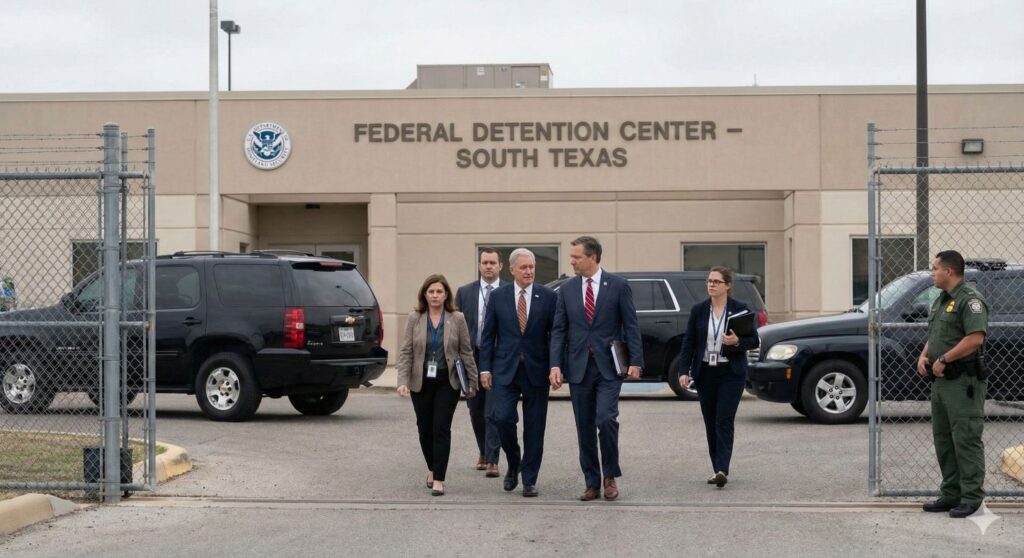
A federal judge has ruled that Immigration and Customs Enforcement cannot enforce policies that restrict members of Congress from making unannounced oversight visits to immigration detention facilities. The decision targets ICE policies adopted in mid-2025 that required advance notice for visits and sought to limit which ICE locations lawmakers could access. For supporters of transparency, the ruling is a significant expansion of congressional oversight tools. For ICE and the Department of Homeland Security, it is a legal setback that forces a return to broader access while the case continues in court. ICE inspections.
The case matters because ICE inspections are one of the few direct ways lawmakers can verify conditions inside facilities that hold noncitizens in civil immigration detention. Oversight visits can document sanitation, medical access, overcrowding, and basic living conditions in a way that secondhand briefings and written reports cannot. The court’s order reinforces the idea that Congress’s oversight role is not optional or subject to agency convenience, particularly when lawmakers say they are acting under legal authority designed to ensure transparency. ICE inspections.
Background of the Ruling — ICE inspections
On December 17, 2025, U.S. District Judge Jia M. Cobb issued a ruling that blocks DHS and ICE from enforcing June 2025 policies that required lawmakers to give advance notice before visiting. Those policies effectively imposed a seven-day notice requirement for certain visits and attempted to narrow what ICE and DHS considered accessible for congressional oversight. The lawsuit was brought by Democratic members of the House who argued that the restrictions interfered with their statutory ability to conduct ICE inspections without prior notice.
In practical terms, the ruling means lawmakers can again attempt ICE inspections without being forced into a waiting period that could limit what they observe. The judge’s analysis emphasized that the core point of an unannounced visit is that it is unannounced. When a facility has time to prepare, the inspection no longer captures routine conditions and becomes less useful as an accountability mechanism. ICE inspections.
This was not a debate about whether Congress can ever be asked to coordinate logistics. It was a debate about whether the government can impose broad rules that make oversight access contingent on an agency’s preferred timeline. The court’s decision rejects that approach at this stage of the case and restores a more immediate form of oversight access. ICE inspections.
The Policies at Issue and Why They Triggered Litigation
The challenged policies were introduced in June 2025. Reporting on the dispute described a system in which congressional offices would be required to provide advance notice—often described as seven days—before visiting certain ICE detention facilities. The policies also drew criticism for treating some ICE locations as outside the scope of oversight access, including certain field offices and related sites where immigration enforcement functions occur. For lawmakers attempting ICE inspections, those restrictions created real-world barriers: a visit delayed is often a visit diluted.
The lawmakers who sued argued that the policies were not neutral administrative adjustments. They said the rules functioned as a barrier to the kind of oversight Congress is supposed to conduct, especially when facilities face allegations of poor conditions or when lawmakers believe urgent inspection is necessary. ICE inspections.
The government’s position, as described in coverage, included arguments that lawmakers did not have a legal basis to sue or that the consequences they claimed were speculative. Judge Cobb rejected key parts of those arguments when granting relief that prevents enforcement of the policies while litigation proceeds. In short, the judge accepted that delays can undermine oversight, and that conditions in detention settings can change quickly enough that a waiting period matters. ICE inspections.
Why Unannounced ICE inspections Matter in Detention Oversight
Unannounced ICE inspections serve a different purpose than scheduled tours. A scheduled visit often shows what an agency wants to show. An unannounced visit is designed to show what exists when no one is performing. That distinction is central to the fight.
Immigration detention facilities are not static environments. Detainee populations can fluctuate, staffing levels can shift, and health conditions can change rapidly. A facility that is overcrowded or struggling with medical care today may not look the same after a week of preparation, transfers, or operational adjustments. When Congress is trying to understand baseline conditions, the timing of ICE inspections can be the difference between meaningful oversight and curated exposure.
The court’s reasoning, as reported, aligns with this common-sense point. If Congress has a legally protected ability to enter facilities for oversight, an agency cannot neutralize that authority by turning unannounced visits into scheduled appointments. ICE inspections.
Congressional Oversight Authority and the Checks-and-Balances Argument
Congressional oversight is not decorative. It is a core feature of checks and balances, particularly for federal agencies that operate with substantial discretion and significant budgets. ICE is a powerful enforcement agency. Its detention operations involve vulnerable populations, intense public scrutiny, and routine decisions that affect health, liberty, and due process outcomes. ICE inspections are one way Congress tests whether the agency’s practices align with law, policy, and basic standards of humane treatment.
Oversight visits also affect appropriations and legislation. When lawmakers return from ICE inspections and report conditions, that firsthand information can shape committee hearings, funding restrictions, and legislative proposals. Without access, Congress has less leverage to enforce accountability beyond paper requests and public statements.
Judge Cobb’s decision reinforces the idea that Congress’s authority must be workable. Oversight that cannot be exercised quickly becomes oversight that cannot be exercised at all in urgent situations. ICE inspections.
What the Ruling Does and Does Not Do
The ruling blocks DHS and ICE from enforcing the challenged policies while the lawsuit moves forward. That’s an important point: this is not necessarily the final word on the legality of every procedural step surrounding visits. It is, however, an immediate and practical change for ICE inspections.
The decision does not mean every lawmaker can enter every location under any condition with no coordination. Facilities may still apply reasonable safety rules, confirm identity, and manage operational realities. But the key principle the ruling reinforces is that DHS cannot impose broad notice requirements or categorical access restrictions that effectively defeat Congress’s oversight rights.
The ruling also puts pressure on DHS to justify any future rules. If DHS wants to regulate the process for ICE inspections, it will likely need to do so in a way that respects the statutory framework Congress has enacted and the court’s interpretation of what oversight access is supposed to look like.
Reactions From Lawmakers and Advocacy Groups
Lawmakers who brought the case and their allies framed the decision as a victory for transparency, arguing that ICE inspections are necessary to ensure detention conditions meet legal and humanitarian standards. Advocacy organizations that focus on immigration detention and civil rights also praised the ruling, saying that oversight access is essential for accountability.
On the other side, DHS and ICE have defended the need for operational procedures around visits, including coordination and clarity about what facilities are covered. The court’s order requires DHS to change course for now, regardless of those arguments, and that change will likely intensify the political conflict around detention policy and the agency’s broader enforcement strategy. ICE inspections.
The Practical Impact on Detention Monitoring
The most immediate impact is operational. Members of Congress and their staff can attempt ICE inspections without being automatically turned away for failing to provide a week of notice. That change could increase the frequency of visits, particularly from lawmakers who have been active on detention oversight.
The ruling may also affect how quickly concerns become public. When lawmakers can enter facilities on short notice, they can document conditions sooner and with fewer opportunities for the agency to pre-stage improvements. That can shape public narratives, media coverage, and legislative attention.
The decision may also encourage oversight beyond the plaintiffs. Even lawmakers who have not historically focused on detention issues may interpret the ruling as a signal that oversight access is protected and enforceable. That could expand the universe of officials conducting ICE inspections and increase pressure for standardized conditions across facilities.
Potential Legislative Effects and Policy Pressure
Court rulings do not write legislation, but they can shift momentum. This decision may encourage lawmakers to pursue clearer statutory language, stronger enforcement mechanisms, or more routine reporting requirements tied to detention operations. ICE inspections can also generate the factual record that fuels legislative proposals, including measures aimed at detention standards, medical oversight, facility contracting, and transparency.
At the same time, the ruling could become part of a broader political debate over immigration enforcement. Supporters of aggressive enforcement often argue that detention is necessary to ensure compliance with immigration proceedings. Critics argue detention is overused, poorly monitored, and vulnerable to abuse. Wider access for ICE inspections increases the likelihood that conditions inside facilities will be publicly documented and debated.
What Happens Next
The lawsuit continues. DHS may seek to narrow the order, appeal it, or defend the policies on the merits as the case develops. For now, the practical rule is simple: ICE inspections by members of Congress cannot be blocked solely because DHS wants advance notice or wants to treat certain ICE locations as categorically exempt from oversight access.
That is the key takeaway. The court’s order preserves Congress’s ability to conduct oversight in the way it is designed to function: promptly, directly, and without agency-controlled delay.
Bottom Line — ICE inspections
Judge Jia M. Cobb’s ruling is a significant win for lawmakers seeking stronger oversight of immigration detention. It blocks ICE restrictions that required advance notice and limited what sites Congress could access, restoring the ability to conduct unannounced ICE inspections while litigation proceeds. The ruling reinforces a basic principle: oversight only works when it can be exercised in real time, not on an agency’s preferred schedule. ICE inspections.
Further Reading
Reuters. “US judge says Trump can’t ban lawmakers’ surprise visits to ICE facilities.”
https://www.reuters.com/legal/government/us-judge-says-trump-cant-ban-lawmakers-surprise-visits-ice-facilities-2025-12-17/
Associated Press. “Judge temporarily blocks Trump administration policies limiting lawmakers’ access to ICE facilities.”
https://apnews.com/article/dc5e44ea66cac4047a0359fd13abbe06
The Washington Post. “Trump officials ordered to lift limits on lawmakers’ visits to ICE facilities.”
https://www.washingtonpost.com/politics/2025/12/18/trump-democrats-lawsuit-access-immigration-detention/
CBS News. “Judge blocks ICE from requiring members of Congress to provide prior notice before detention center visits.”
https://www.cbsnews.com/news/judge-blocks-ice-congress-prior-notice-detention-center-visits/
Roll Call. “Judge halts DHS policy on oversight visits to ICE detention facilities.”
https://rollcall.com/2025/12/17/judge-halts-dhs-policy-on-oversight-visits-to-ice-detention-facilities/
Connect with the Author
Curious about the inspiration behind The Unmaking of America or want to follow the latest news and insights from J.T. Mercer? Dive deeper and stay connected through the links below—then explore Vera2 for sharp, timely reporting.
About the Author
Discover more about J.T. Mercer’s background, writing journey, and the real-world events that inspired The Unmaking of America. Learn what drives the storytelling and how this trilogy came to life.
[Learn more about J.T. Mercer]
NRP Dispatch Blog
Stay informed with the NRP Dispatch blog, where you’ll find author updates, behind-the-scenes commentary, and thought-provoking articles on current events, democracy, and the writing process.
[Read the NRP Dispatch]
Vera2 — News & Analysis
Looking for the latest reporting, explainers, and investigative pieces? Visit Vera2, North River Publications’ news and analysis hub. Vera2 covers politics, civil society, global affairs, courts, technology, and more—curated with context and built for readers who want clarity over noise.
[Explore Vera2]
Whether you’re interested in the creative process, want to engage with fellow readers, or simply want the latest updates, these resources are the best way to stay in touch with the world of The Unmaking of America—and with the broader news ecosystem at Vera2.
Free Chapter
Begin reading The Unmaking of America today and experience a story that asks: What remains when the rules are gone, and who will stand up when it matters most? Join the Fall of America mailing list below to receive the first chapter of The Unmaking of America for free and stay connected for updates, bonus material, and author news.
