
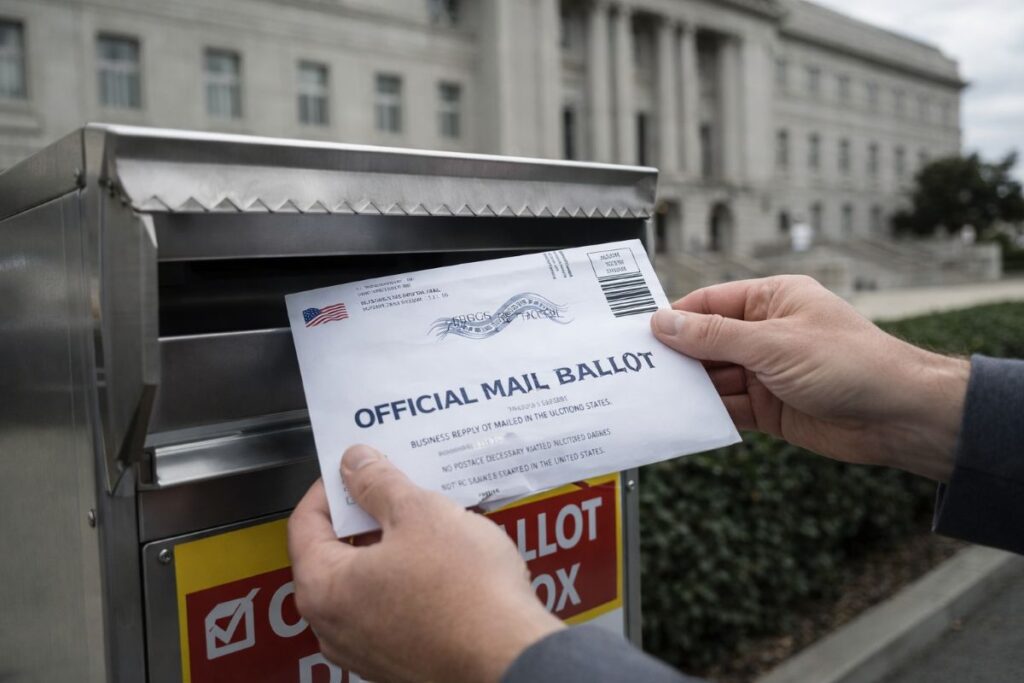
Supreme Court’s Mail-In Ballot Ruling: Implications for Voters
The Supreme Court mail-in ballot ruling now headed to the U.S. Supreme Court could reshape a basic question of election administration: whether states may count mail ballots that are postmarked by Election Day but arrive afterward. The case, Watson v. Republican National Committee, arises from Mississippi’s rule allowing certain absentee ballots to be counted if they are postmarked on or before Election Day and received within five business days. NCSL+2The Guardian+2
Supporters of Mississippi’s approach argue that voters should not lose their votes because of mail delays they cannot control. Opponents argue that federal statutes setting “Election Day” establish a single national deadline by which ballots must be received, not merely mailed. The Supreme Court mail-in ballot ruling matters because it is not limited to one state. Many jurisdictions use some form of postmark-by-Election-Day rule for at least some categories of voters, and the Court’s answer could push states toward receipt-by-Election-Day rules, expand litigation, and accelerate a trend already visible in some legislatures. The Washington Post+2The Guardian+2
The outcome is also time-sensitive. The Supreme Court mail-in ballot ruling is expected on the Court’s normal timetable for cases accepted for full review, which places the decision before the 2026 midterm election cycle ramps into high gear. The Washington Post+1
The Stakes of the Supreme Court Mail-In Ballot Ruling
At the center of the Supreme Court mail-in ballot ruling is a real-world administrative tradeoff: election systems need clear deadlines and orderly tabulation, but mail delivery is not uniform and can be slow, especially for rural communities and voters who must rely on distant processing facilities. If the Court requires receipt by Election Day for federal elections, ballots that are timely mailed could be rejected simply because they arrive late. That risk is not hypothetical; it is a recurring feature of mail voting in close contests, when small numbers of rejected ballots can become highly visible and politically consequential.
Mississippi told the Court that a strict receipt-by-Election-Day interpretation would destabilize established practices beyond its borders, while challengers argue that uniformity on Election Day is essential to public confidence and to the structure Congress set for federal elections. The Washington Post+2SCOTUSblog+2
The Supreme Court mail-in ballot ruling also arrives in a political environment where mail voting rules have been an ongoing target of legal and legislative fights. One reason the case draws intense attention is that it can create a national rule without Congress passing a new statute, effectively settling how existing federal law interacts with state ballot-receipt deadlines for federal races.
What Mississippi’s Rule Allows
Under the Mississippi law at issue in the Supreme Court mail-in ballot ruling, certain absentee ballots that are postmarked by Election Day may be counted if they arrive within five business days after the election. NCSL+2The Washington Post+2 This structure tries to split the difference between voter responsibility and system reality: the voter must act by Election Day, but the state recognizes that the mail stream may not deliver on the same schedule everywhere.
What the Fifth Circuit Said
The legal dispute sharpened after the U.S. Court of Appeals for the Fifth Circuit rejected Mississippi’s approach, reasoning that Congress set a “singular” Election Day for federal elections and that ballots must be both cast and received by that date. Maryland Daily Record+2SCOTUSblog+2 That interpretation, if affirmed, would pressure states to treat Election Day as a hard receipt deadline for federal contests, even if state law previously allowed a short post-election receipt window.
Impact on Voters and Turnout
The practical impact of the Supreme Court mail-in ballot ruling depends on how people vote and how their ballots travel. Voters who mail ballots close to Election Day would face the greatest risk in a receipt-by-Election-Day system. That includes voters who work multiple jobs, voters with limited transportation, voters with disabilities, and voters who live far from postal processing centers. It also includes voters in places where mail service is less predictable, whether because of geography, staffing constraints, weather events, or long routes between collection and sorting.
A strict receipt-by-Election-Day requirement can shift behavior, but behavior does not shift evenly. Well-resourced voters are more likely to adjust by mailing earlier, using drop boxes where available, or voting in person. Voters with fewer options may be the ones who get caught by late delivery. The Supreme Court mail-in ballot ruling therefore raises equity questions even when everyone is formally subject to the same rule: “equal rules” do not always mean “equal access” in practice.
This is why advocacy groups frame the Supreme Court mail-in ballot ruling as a potential disenfranchisement issue. They argue that voters who do everything asked of them—obtain a ballot, complete it correctly, and mail it by the state’s deadline—should not lose their votes because of mail transit times that vary across communities.
Legal Arguments and Competing Theories
The Supreme Court mail-in ballot ruling will likely turn on statutory interpretation and federalism. One side argues that federal “Election Day” statutes preempt state laws that permit counting ballots received after Election Day in federal contests. The other side argues that states have long administered the “manner” of elections and that voting can be understood as completed by the voter’s timely act of mailing, at least when state law treats a postmark as evidence of timely casting. Law Offices of Snell & Wilmer+2SCOTUSblog+2
Integrity Versus Access
Supporters of receipt deadlines say the Supreme Court mail-in ballot ruling should reinforce a clear, uniform endpoint for federal elections to reduce uncertainty and disputes. They contend that extending receipt beyond Election Day can fuel suspicion and create litigation pressure in close races.
Opponents respond that the Supreme Court mail-in ballot ruling should prioritize counting eligible votes when the voter complied with the rules by Election Day, especially given the low incidence of proven fraud in mail voting and the fact that verification processes (signatures, identifiers, chain-of-custody controls) exist in many states. They argue that the integrity interest is served by verification and transparent procedures, not by rejecting ballots delayed in transit.
What Could Change After the Supreme Court Mail-In Ballot Ruling
The Supreme Court mail-in ballot ruling could change election rules in three concrete ways.
First, it could force states with postmark-based receipt windows to revise their rules for federal contests, either by moving to receipt-by-Election-Day or by building stronger systems that encourage earlier ballot return through education and deadlines that effectively move “real” voter action earlier than Election Day.
Second, it could accelerate legislative change already underway. For example, Ohio enacted a requirement in 2025 that absentee ballots generally must be received by Election Day, reflecting a broader trend in some states toward receipt deadlines. Ballotpedia News Even though Ohio’s statute is separate from the Supreme Court case, it shows how political momentum can run ahead of the Court’s final decision.
Third, the Supreme Court mail-in ballot ruling could drive administrative investment. If receipt-by-Election-Day becomes the effective rule, election administrators will face increased pressure to expand drop box options (where authorized), streamline ballot tracking, improve cure processes, and educate voters about mailing timelines. If the Court allows postmark windows, opponents may intensify efforts to narrow them through state legislation, while supporters may push for clearer standards that reduce post-election uncertainty.
Why 2026 Matters
Timing is a major reason the Supreme Court mail-in ballot ruling is so consequential. A decision expected by mid-2026 would land close enough to the midterms that states may have limited time to adjust procedures, update voter materials, and train staff—yet far enough ahead that it can shape campaign tactics and voter mobilization strategies. The Washington Post+1
Bottom Line
The Supreme Court mail-in ballot ruling is not just a technical debate about deadlines. It is a decision about how the system treats voters who comply with the rules but depend on mail delivery that varies widely across communities. If the Court requires ballots to be received by Election Day for federal elections, many states could face pressure to tighten deadlines, and some voters will inevitably be squeezed by timing and access constraints. If the Court allows postmarked-by-Election-Day ballots to be counted when received shortly after, opponents may treat that as an integrity problem and pursue narrower windows through state law.
Either way, the Supreme Court mail-in ballot ruling will set the direction of travel for mail voting policy in the United States heading into 2026 and beyond. The Washington Post+2The Guardian+2
Further Reading
The Supreme Court’s decision to hear Watson v. Republican National Committee and the case background are summarized in SCOTUSblog’s coverage here: https://www.scotusblog.com/2025/11/justices-agree-to-decide-major-election-law-case/
The Washington Post overview of the Mississippi dispute and the potential nationwide impact is here: https://www.washingtonpost.com/politics/2025/11/10/supreme-court-mail-in-ballots-mississippi/
The Guardian’s report on the Court taking the case, including the Mississippi five-business-day receipt window, is here: https://www.theguardian.com/us-news/2025/nov/10/supreme-court-mail-in-ballots
The National Conference of State Legislatures (NCSL) summary describing the question presented and the Mississippi rule is here: https://www.ncsl.org/events/details/supreme-court-to-hear-challenge-to-mail-ballot-deadlines
Ballotpedia’s December 2025 update on Ohio’s new receipt-by-Election-Day absentee ballot law (separate from the Supreme Court case, but relevant to the broader trend) is here: https://news.ballotpedia.org/2025/12/20/ohio-gov-mike-dewine-signs-bill-requiring-absentee-ballots-to-be-received-by-election-day/
Connect with the Author
Curious about the inspiration behind The Unmaking of America or want to follow the latest news and insights from J.T. Mercer? Dive deeper and stay connected through the links below—then explore Vera2 for sharp, timely reporting.
About the Author
Discover more about J.T. Mercer’s background, writing journey, and the real-world events that inspired The Unmaking of America. Learn what drives the storytelling and how this trilogy came to life.
[Learn more about J.T. Mercer]
NRP Dispatch Blog
Stay informed with the NRP Dispatch blog, where you’ll find author updates, behind-the-scenes commentary, and thought-provoking articles on current events, democracy, and the writing process.
[Read the NRP Dispatch]
Vera2 — News & Analysis
Looking for the latest reporting, explainers, and investigative pieces? Visit Vera2, North River Publications’ news and analysis hub. Vera2 covers politics, civil society, global affairs, courts, technology, and more—curated with context and built for readers who want clarity over noise.
[Explore Vera2]
Whether you’re interested in the creative process, want to engage with fellow readers, or simply want the latest updates, these resources are the best way to stay in touch with the world of The Unmaking of America—and with the broader news ecosystem at Vera2.
Free Chapter
Begin reading The Unmaking of America today and experience a story that asks: What remains when the rules are gone, and who will stand up when it matters most? Join the Fall of America mailing list below to receive the first chapter of The Unmaking of America for free and stay connected for updates, bonus material, and author news.
