
Vera2, Investigations & Corruption
White House Donor Dinner Under Scrutiny as Blumenthal Probes Ballroom Project Funding
Dec
Senator Blumenthal Probes White House Donor Dinner
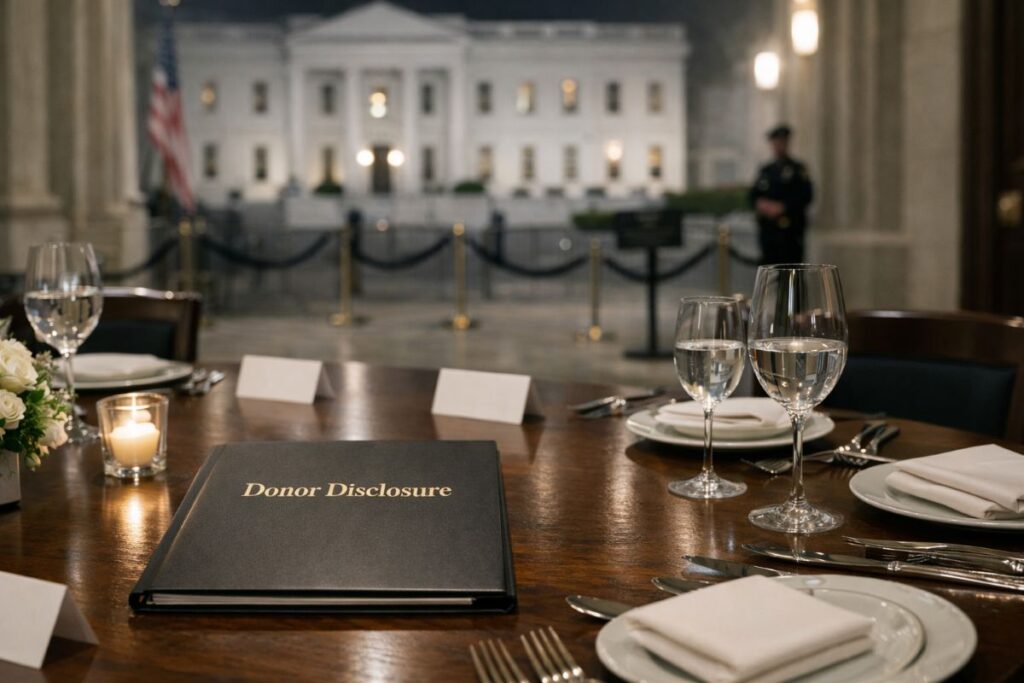
The White House donor dinner at the center of Senator Richard Blumenthal’s latest inquiry is not just another political fundraiser story. It is a test of whether the public can get clear answers when private money intersects with public property, presidential access, and a major construction project at the White House complex. In late December 2025, Blumenthal, the ranking member of the Senate Permanent Subcommittee on Investigations, sent letters seeking information from both the ballroom project’s newly hired architect and people reported to have attended a donor dinner held at the White House on October 15. CBS News+1
Blumenthal’s focus is straightforward: who attended the White House donor dinner, who donated, how much they gave, whether anyone was offered anonymity, and whether donors have business before the federal government that could create conflicts of interest. CBS News+1 The inquiry sits inside a larger controversy over the funding and oversight of a new White House ballroom project promoted by President Donald Trump, including questions about transparency, ethics safeguards, and how private donors are being solicited for a construction effort at the seat of executive power. The Washington Post+2The Wall Street Journal+2
Background on the Inquiry
Blumenthal’s letters were triggered by reporting and disclosures related to the White House ballroom project and the White House donor dinner that recognized contributors. CBS News reported that the White House disclosed only a partial list of attendees for the October 15 dinner, while CBS obtained a more complete list of invitees through sources. CBS News In that reporting, Blumenthal asked several reported attendees who were not on the official list how they decided whether to donate and how much to give, and whether they were offered a way to remain off the publicly released list of attendees. CBS News
This is a key point: the White House donor dinner is being treated as more than a social event. It is being treated as part of a fundraising and influence ecosystem tied to a high-dollar, high-visibility project. The White House ballroom project has been described across outlets as costing hundreds of millions of dollars, with figures reported around $250 million earlier in the fall and later reporting describing $300 million and even $400 million estimates. The Wall Street Journal+2Reuters+2 The wide spread in numbers is itself part of the oversight story, because cost ranges often reflect shifting scopes, unclear procurement arrangements, or incomplete public documentation.
Blumenthal’s inquiry also builds on months of scrutiny by Democrats and watchdog groups. Earlier reporting described Democrats pressing the White House for details about donors, potential conflicts, and how the project is structured, including the role of outside entities used to receive and manage donations. The Washington Post+2The Wall Street Journal+2
Why the White House Donor Dinner Matters
A White House donor dinner is politically sensitive because it collapses distance between public office and private fundraising. Political fundraising events are common. Holding a donor recognition dinner at the White House, tied to a major privately funded construction project on the White House campus, raises a distinct set of questions about access and influence that do not exist in the same way at a hotel ballroom or a private club.
The central issue Blumenthal is pressing is not that donors exist. It is whether the administration created an environment where major donors could reasonably believe financial support would improve their access or standing with the executive branch, and whether the public is being denied basic transparency about that relationship.
Details of the White House Donor Dinner
According to CBS News, the October 15 White House donor dinner was held to recognize financial contributors to the ballroom project, and the White House publicly released only a partial attendee list. CBS News The report also states that Blumenthal’s letters went to some dinner attendees and to the architect overseeing the project. CBS News
One of the most concrete examples reported by CBS involved Roblox CEO David Baszucki. CBS reported that Baszucki attended the White House donor dinner but did not appear on the White House list, and that Blumenthal asked Baszucki to confirm in writing that he donated $5 million, saying Baszucki told him about the donation during a meeting. A Roblox spokesperson told CBS that Baszucki donated in his personal capacity to the nonprofit supporting the project but declined to specify the amount. CBS News+1
CBS also listed other recipients of Blumenthal’s letters, including wealthy donor Trish Duggan; Las Vegas Sands CEO Robert Goldstein; Parsons CEO Carey Smith; Rocket Companies Chairman Dan Gilbert; Cliff Sims, a former White House official; John Solomon of Just The News; TV personality Greta Van Susteren and her husband; and lobbyist Geoff Verhoff, among others. CBS News Not all reported attendees have confirmed they donated, which is part of why Blumenthal is collecting statements rather than relying on press reporting alone. CBS News
The Project Behind the Dinner
The White House donor dinner is connected to a construction project that has already generated unusual levels of attention. Reporting has described the ballroom as a major addition to the White House complex, and Reuters reported that Trump selected Washington architect Shalom Baranes to lead the project after replacing the previous architect following reported disagreements. Reuters That change matters because Blumenthal’s inquiry is also aimed at the architect’s role, the firm’s arrangements, and whether there are limits on information sharing that could prevent public oversight. CBS News+1
Separately, the Wall Street Journal described Trump hosting a donor dinner for contributors to the ballroom project and reported that donations were being funneled through the Trust for the National Mall, a nonprofit partner of the National Park Service, while watchdogs raised ethical concerns about corporate donors and access. The Wall Street Journal
What Blumenthal Is Asking For
The substance of Blumenthal’s request is best understood as three buckets of information tied to the White House donor dinner.
First, he is asking about donation mechanics. That includes how attendees decided whether to donate, whether suggested amounts were provided, whether anyone was offered anonymity, and whether any donors were encouraged to stay off official attendee or donor lists. CBS News+1
Second, he is asking about conflicts and leverage. CBS quoted Blumenthal arguing that many donors have “deep financial, business, or other personal interests before the Administration,” and therefore Americans are entitled to relevant facts about who is funding the project. CBS News The concern is not abstract: if a donor has pending regulatory approvals, federal contracts, litigation exposure, or policy vulnerabilities, then a high-dollar donation tied to presidential recognition can look like access purchasing even if no explicit quid pro quo is proven.
Third, he is asking about project governance. His letter to the new architect asks how the architect became involved, whether there is a contract with the government, whether design plans have been shared, and whether there are agreements that limit the architect’s ability to share information about the project. CBS News+1
This is where the White House donor dinner becomes more than an ethics narrative. It becomes an oversight question: if the administration declines to disclose donor details, the public and Congress have fewer ways to evaluate whether the project is being run with appropriate safeguards.
Implications of the Investigation
The immediate implication of Blumenthal’s inquiry is pressure. Democrats do not currently have subpoena power in Congress, and CBS noted that the letters are requests rather than binding demands. CBS News Even so, public letters can force responses because silence becomes politically costly, especially when the subject is a White House donor dinner and a large privately funded White House construction project.
Longer term, the inquiry could feed into broader legislative and oversight efforts targeting private funding of government-adjacent projects. The Guardian reported that Sen. Elizabeth Warren has called the ballroom funding controversy a potential “golden crime scene” and highlighted proposed legislation aimed at restricting donations and requiring transparency and safeguards. The Guardian The Washington Post has also described Democrats ramping up investigations, questioning donor influence and the project’s financing and oversight. The Washington Post
The political risk for the White House is not limited to whether anything illegal occurred. The risk is that the White House donor dinner becomes a symbol of pay-to-play governance, where major donors receive recognition and proximity to power while the public cannot see what was asked, what was offered, or what guardrails exist.
Why This Can Escalate Fast
A story like the White House donor dinner escalates when it intersects with regulated industries and government business. CBS pointed out that Roblox has faced scrutiny over child safety protections and has been hit by state lawsuits, while lawmakers have paid attention to the company’s platform safety issues. CBS News When donors have active exposure to government action, donations to a project championed by the president can draw a different level of scrutiny than ordinary political giving.
Public Reaction and Political Context
Public reaction splits along a predictable line. Supporters frame the White House donor dinner as standard donor recognition for a privately funded improvement project, arguing that private philanthropy is common in civic and historic preservation contexts. Critics argue that the setting, the scale, and the donor universe make it different: the White House is not a museum wing, and donors to a president-backed project may reasonably expect intangible benefits even without explicit deals.
The political context also matters. The White House ballroom project has been described as one of the largest changes to the White House complex in decades, and Reuters reported that certain approvals may still be required from the National Capital Planning Commission for final construction plans, adding another layer of oversight interest. Reuters That means the underlying project is not purely private; it exists inside a federal planning and governance environment. In that environment, a White House donor dinner feels less like a charity gala and more like an access event tied to a public institution.
Bottom Line
Blumenthal’s probe is aimed at transparency and accountability. The White House donor dinner is the focal point because it links donor recognition, presidential access, and a major construction project funded through private contributions that the administration has not fully detailed publicly. CBS News+2The Wall Street Journal+2
If the White House can provide a complete attendee list, donor disclosure rules, amounts given, and the safeguards used to prevent conflicts of interest, the story cools down. If it cannot, or will not, the White House donor dinner becomes a standing controversy that will keep feeding oversight letters, investigative reporting, and possible legislative reform efforts.
Further Reading
CBS News reported on Blumenthal’s letters to the ballroom project’s new architect and to reported attendees of the October 15 White House donor dinner, including details about the partial attendee list released by the White House and the senator’s questions about anonymity and donation decisions: https://www.cbsnews.com/news/white-house-ballroom-blumenthal-details-architect-donor-dinner-attendees/
The Senate Homeland Security & Governmental Affairs Committee site hosts Blumenthal’s December 22, 2025 letters to donors tied to the ballroom project, which provide the senator’s stated rationale and specific information requests connected to the White House donor dinner: https://www.hsgac.senate.gov/subcommittees/investigations/library/files/2025-12-22-letters-from-ranking-member-blumenthal-to-trump-ballroom-donors/
Reuters reported on the White House selecting architect Shalom Baranes to oversee the ballroom project after replacing the prior architect, providing context for why Blumenthal’s inquiry includes questions about the architect’s involvement and contracts: https://www.reuters.com/world/us/trump-selects-new-architect-oversee-ballroom-project-white-house-says-2025-12-04/
The Wall Street Journal described Trump inviting ballroom donors to a White House dinner and reported that donations were being funneled through the Trust for the National Mall, alongside concerns from watchdog groups about ethics and donor influence: https://www.wsj.com/politics/policy/trump-invites-ballroom-donors-to-glitzy-white-house-dinner-ccba9448
The Washington Post covered Democrats ramping up investigations into the ballroom project’s financing and oversight, including questions about donor influence and transparency: https://www.washingtonpost.com/politics/2025/10/29/trump-ballroom-democrats-investigation/
The Guardian reported on broader ethics concerns around the ballroom’s private funding, including calls for investigation and proposed legislation aimed at tightening rules and increasing transparency: https://www.theguardian.com/us-news/2025/nov/20/elizabeth-warren-trump-ballroom
Connect with the Author
Curious about the inspiration behind The Unmaking of America or want to follow the latest news and insights from J.T. Mercer? Dive deeper and stay connected through the links below—then explore Vera2 for sharp, timely reporting.
About the Author
Discover more about J.T. Mercer’s background, writing journey, and the real-world events that inspired The Unmaking of America. Learn what drives the storytelling and how this trilogy came to life.
[Learn more about J.T. Mercer]
NRP Dispatch Blog
Stay informed with the NRP Dispatch blog, where you’ll find author updates, behind-the-scenes commentary, and thought-provoking articles on current events, democracy, and the writing process.
[Read the NRP Dispatch]
Vera2 — News & Analysis
Looking for the latest reporting, explainers, and investigative pieces? Visit Vera2, North River Publications’ news and analysis hub. Vera2 covers politics, civil society, global affairs, courts, technology, and more—curated with context and built for readers who want clarity over noise.
[Explore Vera2]
Whether you’re interested in the creative process, want to engage with fellow readers, or simply want the latest updates, these resources are the best way to stay in touch with the world of The Unmaking of America—and with the broader news ecosystem at Vera2.
Free Chapter
Begin reading The Unmaking of America today and experience a story that asks: What remains when the rules are gone, and who will stand up when it matters most? Join the Fall of America mailing list below to receive the first chapter of The Unmaking of America for free and stay connected for updates, bonus material, and author news.
