Washington has a coping mechanism for disgrace: find a bigger headline and climb inside it. When the story turns ugly at home, leaders reach for the kind of story that comes with maps and uniforms, which trigger automatic deference. That is wag the dog in its natural habitat.
And right now, wag the dog is having a moment.
In the same week that the Epstein files fight is turning into a slow-motion credibility test for the Justice Department, the Trump administration is feeding the country a buffet of foreign spectacle. A major U.S. operation in Venezuela. Talk of follow-on strikes, then a claim that a “second wave” was canceled because Venezuela is suddenly “cooperating.” A revived push to “acquire” Greenland, with the White House saying the military is “always an option.” Allies reacting in public because they have to. That is not an accident. That is coordination of attention.
If you feel the wag the dog pattern forming, you are not hallucinating. You are noticing incentives.
Venezuela: the headline that eats the front page
On January 9, Reuters reported that Trump said he canceled a second wave of attacks on Venezuela after what he described as cooperation from the South American nation, including the release of political prisoners. Trump also said U.S. ships would remain in place “for safety and security.”
That combination is doing a lot of work. Canceling strikes sounds like restraint. Keeping forces in place sounds like leverage. The net effect is a story that stays open and loud, which makes it hard to ignore.
Even if you support pressure on Venezuela, the politics of the moment are obvious. A foreign confrontation turns every domestic argument into a footnote. It pulls oxygen away from bureaucratic fights and puts it into crisis coverage. That is how wag the dog works. You do not need a fake war. You need a real story that dominates.
Greenland: the other shiny object, now with teeth
Then there is Greenland, back from the dead as a serious talking point.
On January 6, Reuters reported that Trump advisers were discussing options for acquiring Greenland and that the White House said the U.S. military is “always an option.” The Associated Press reported European leaders rejecting U.S. takeover talk while the White House kept the military option on the table. The Guardian reported Denmark’s prime minister responding that the United States has no right to take over Greenland after renewed Trump threats.
On January 9, Reuters reported that Italian Prime Minister Giorgia Meloni publicly ruled out a U.S. military move on Greenland and warned it would have severe repercussions for NATO.
This is why Greenland matters beyond the absurdity. It forces allied governments to respond. It turns diplomacy into theater. It creates days of coverage because it is both high stakes and weird. Weird travels fast. Weird wins the algorithm.
Wag the dog loves weird.
Now, about those Epstein files
The Epstein story is not one scandal. It is a network story, which means it threatens institutions that would rather not be threatened. It touches prosecutors and politicians, and it threatens reputations that come with security details. It also produces one of the most dangerous things in politics: a paper trail.
Congress passed the Epstein Files Transparency Act as H.R. 4405, and it became Public Law 119-38 on November 19, 2025. The law requires DOJ to release unclassified materials related to Epstein in a searchable, downloadable format, with specific redaction rules.
DOJ now hosts an “Epstein Library” portal and states it will update the site as additional documents are identified for release.
And yet the disclosure fight has already gone adversarial. On January 8 and January 9, multiple outlets reported that Representatives Thomas Massie and Ro Khanna asked a federal judge to appoint a special master or independent monitor to compel full compliance, arguing DOJ is missing deadlines and over-redacting.
That request is not a minor procedural spat. It is a public statement that normal trust is gone. When lawmakers ask a judge to supervise DOJ, the subtext is blunt: we do not believe you.
This is exactly the kind of domestic pressure that makes wag the dog so attractive. The Epstein story is document-heavy and corrosive, and it moves slowly. It does not resolve with one speech. It keeps asking the same question in different fonts.
What wag the dog actually is
The movie Wag the Dog made the concept neat: a fake war to distract from a sex scandal. Real life is never that tidy, and it does not need to be.
Real life wag the dog is about swapping roles. You trade a story where you are being questioned for a story where you get to question everyone else. You trade “what did you know” for “are you with us.” You trade a domestic mess for a foreign posture that makes critics sound disloyal if they pick the wrong tone.
The key is that wag the dog does not require the foreign crisis to be invented. It only requires the crisis to be handled in a way that maximizes its domestic utility.
That is why wag the dog survives across administrations and parties. It is not a personality quirk. It is a structural temptation.
The Clinton template, and why it refuses to die
If anyone wants to claim this is a new accusation invented for the Trump era, hand them a history book and a beverage.
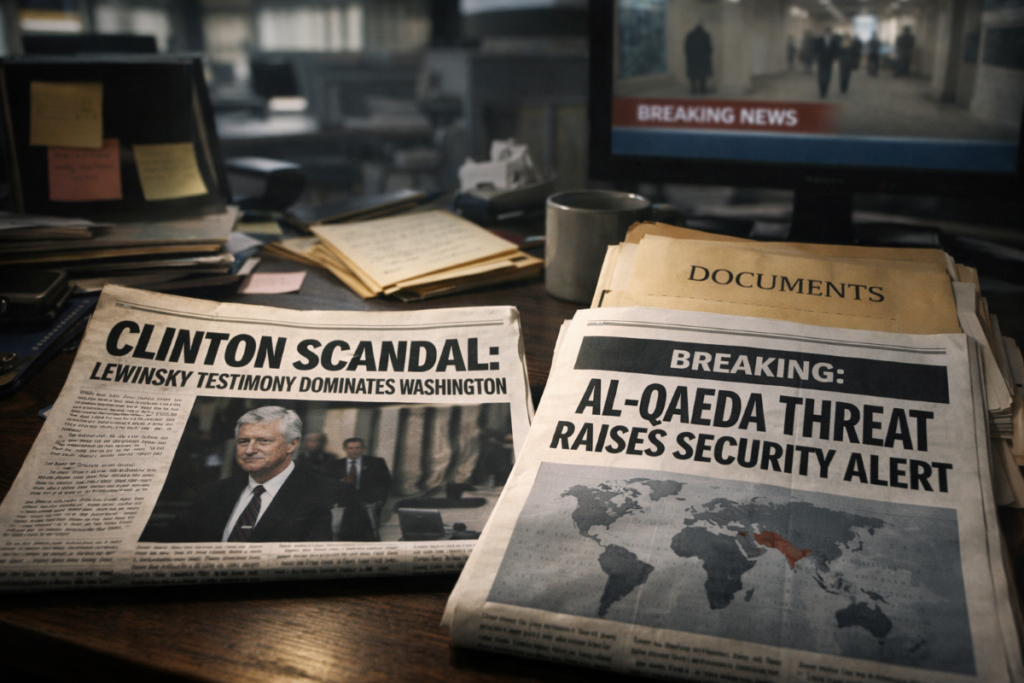
In August 1998, in the middle of the Monica Lewinsky scandal, the U.S. launched missile strikes against targets in Afghanistan and Sudan after the bombings of U.S. embassies in Kenya and Tanzania. The threat was real. The attacks were real. The wag the dog suspicion was also real.
The Los Angeles Times wrote about skeptics asking whether the strikes were truly a response to the embassy bombings or a diversion from Clinton’s personal troubles, explicitly invoking wag the dog. Variety covered the Washington chatter, noting how quickly the comparison surfaced.
This is the important part. You do not have to believe the strikes were fake to understand the accusation. The accusation was about timing and incentives, not about whether al-Qaeda existed.
So when people see a domestic scandal crest and foreign spectacle rise, they are not automatically being conspiracy-brained. They are recognizing an old play.
Why this version feels bigger
The modern attention economy rewards spectacle on steroids. If your goal is to bury a domestic story, you do not pick something subtle. You pick something that makes producers book retired generals and graphics teams draw arrows on oceans.
Venezuela and Greenland do that, and a public fight with allies does too.
Meanwhile, the Epstein files story is the opposite of television-friendly. It is compliance reports and court filings, with redaction fights baked in. Even when it is explosive, it is explosive in slow motion.
That is why the overlap matters. The timing does not prove a plot. It does, however, make the wag the dog suspicion rational. When the domestic story is a legitimacy test and the foreign stories are spectacle-rich, the incentive structure points in one direction.
This is where people get sloppy, so let’s be precise.
It is possible the Venezuela action is driven by genuine strategic calculation, and it is possible the Greenland talk is mostly posturing. DOJ may also be acting in good faith on Epstein while working through real constraints.
All of that can be true, and the wag the dog dynamic can still exist.
Wag the dog is not a claim that nothing abroad is real. Wag the dog is a claim that the foreign posture is being used as a volume knob for domestic accountability.
What to watch if you want to stay sane
Ignore the hot takes. Watch the mechanisms.
Watch whether the administration offers clear objectives and a clear legal basis for Venezuela, not just triumphal language. A government confident in its strategy can explain it without relying on vibes.
Watch whether Greenland talk turns into concrete steps that force Denmark and NATO into formal responses. The moment allies have to plan around Washington’s rhetoric, the damage is already done.
Watch the Epstein files process. DOJ’s own portal notes search limitations and redaction practices, which means the details matter, and they will be contested. If a special master is appointed, that is the system acknowledging the trust gap out loud.
And watch what stops moving. When the spectacle rises, look for the paperwork that suddenly gets quieter. That is usually where wag the dog is doing its real work.
The uncomfortable conclusion
The danger is not a single episode of wag the dog. The danger is turning it into a habit.
Once leaders learn they can dial up foreign conflict to dull domestic scrutiny, they will keep doing it because it works. A tired public, fed a constant crisis soundtrack, eventually stops demanding transparency.
That is how democratic accountability erodes. Not with one dramatic moment, but with repeated wag the dog until nobody remembers what they were supposed to be watching.
Further Reading
-
Reuters (Jan 9, 2026): Trump says he canceled a second wave of attacks on Venezuela after cooperation.
-
Reuters (Jan 6, 2026): Trump advisers discuss options for acquiring Greenland; military “always an option,” White House says.
-
AP (Jan 6, 2026): White House says military action remains an option as European leaders reject a U.S. takeover of Greenland.
-
The Guardian (Jan 4, 2026): Danish PM rejects renewed U.S. takeover threats over Greenland.
-
Reuters (Jan 9, 2026): Meloni rules out U.S. military move on Greenland, warns of NATO repercussions.
-
Congress.gov: Epstein Files Transparency Act (H.R. 4405) text, Public Law 119-38 (Nov 19, 2025).
-
White House: Statement on H.R. 4405 signed into law (Nov 19, 2025).
-
U.S. DOJ: Epstein Library portal (last updated Jan 6, 2026).
-
The Guardian (Jan 8, 2026): Massie and Khanna request a special master to compel release of remaining Epstein files.
-
Rep. Ro Khanna press release (Jan 9, 2026): Request to appoint a special master to oversee DOJ compliance.
-
Los Angeles Times (Aug 21, 1998): Are Clinton’s bombs wagging the dog?
-
Variety (Aug 21, 1998): Washington chatter on the Wag the Dog comparison.