
Vera2, Civil Rights and Society, Investigations & Corruption
Minneapolis protests after Renee Good death
Jan
Minneapolis protests after Renee Good death
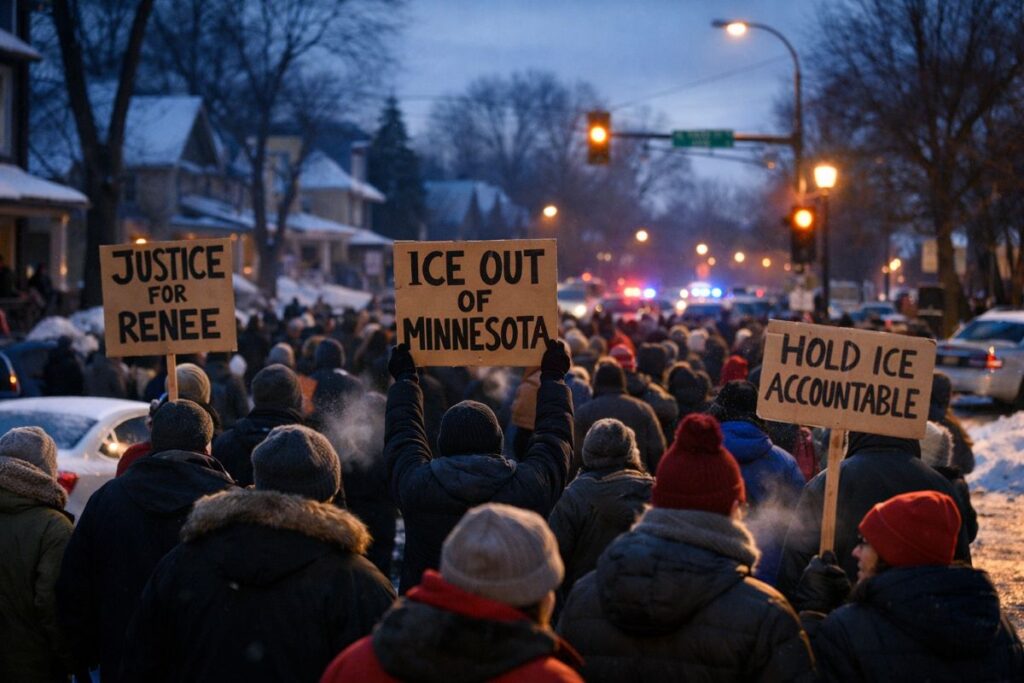
Minneapolis protests escalated in early January 2026 after Renée Nicole Macklin Good a 37 year old Minneapolis resident was fatally shot by a federal immigration officer during an enforcement operation in south Minneapolis. The death quickly became a rallying point for demonstrators calling for accountability and for changes to immigration enforcement practices.
Minneapolis protests grew fast for a familiar reason in modern American unrest cycles: there was a deadly incident during a law enforcement action, videos circulated widely, and federal and local officials offered sharply different descriptions of what happened. Those competing accounts shaped everything that followed including the tone of marches the targets of public pressure and the policing response downtown.
Background of the Minneapolis protests
Minneapolis protests began within days of the January 7 shooting as community members gathered near the location of the incident at 34th Street and Portland Avenue and in nearby neighborhoods. Local reporting described vigils and marches in south Minneapolis that blended grief with anger as participants called on ICE to leave Minnesota.
National coverage framed the demonstrations as part of a broader backlash against stepped up federal immigration activity in the Twin Cities. Reuters reported that the protests drew very large crowds and described the situation as helping set the stage for demonstrations beyond Minnesota.
What happened in the Renee Good shooting
The most basic facts are not in dispute: Renee Good died after being shot by a federal immigration officer during an operation in south Minneapolis and the incident was recorded on video that spread rapidly online.
Where accounts diverge is why the officer fired. Federal officials and the White House described the shooting as self defense. Local officials including Minneapolis Mayor Jacob Frey publicly disputed the federal description and cited video evidence in arguing that the public narrative from Washington did not match what the footage appeared to show. TIME reported that DHS Secretary Kristi Noem defended the agent’s actions and said additional federal agents would be sent to Minneapolis after protests.
To avoid turning Minneapolis protests into a contest of certainty where certainty is not available the most accurate framing is simple: the shooting is under investigation and the public debate is fueled by competing interpretations of video and intent rather than a settled official finding that everyone accepts.
Why video became central to Minneapolis protests
Minneapolis protests were shaped by how quickly video reached audiences far beyond Minnesota. In the hours after the shooting the footage gave people a concrete sequence of movements to argue over rather than relying only on official statements. That matters because protest movements usually grow faster when participants feel they can see the event for themselves even if interpretation remains contested. TIME and AP reporting both emphasized that local leaders referenced video when challenging the federal account.
Scale and locations of Minneapolis protests
Minneapolis protests included large daytime marches in south Minneapolis and high visibility gatherings around Powderhorn Park. KSTP reported that thousands marched around Powderhorn Park in protest of the ICE presence and to honor Good.
Minneapolis protests also shifted downtown at night where the dynamics changed. Downtown demonstrations often involve different crowds different tactical choices and a higher likelihood of confrontations over roadways buildings and police lines. That pattern appeared again in Minneapolis as city officials described incidents of blocked roads and property damage during a downtown march.
Arrests and policing response during Minneapolis protests
Minneapolis protests produced dozens of detentions during a Friday night and Saturday morning downtown march. The City of Minneapolis said thirty people were detained cited and released after blocking roadways and damaging property during the downtown march.
Other reporting gave similar numbers while adding detail about what police said prompted enforcement. AP reported that a Friday night protest outside a hotel turned violent with demonstrators throwing ice snow and rocks at officers and that citations followed.
This is one of the core tensions in Minneapolis protests: demonstrators argue that aggressive police tactics can chill lawful assembly while city leaders argue they have to prevent injuries and protect property especially when objects are thrown or traffic is blocked. The official city statement emphasized the request for peaceful protest while describing the conduct that led to detentions.
Immigration enforcement activity continues amid Minneapolis protests
Minneapolis protests intensified because federal enforcement activity did not pause after the shooting. AP described a climate of fear among some residents and reported continued activity by federal agents alongside plans for protests in many cities.
DHS Secretary Kristi Noem said hundreds more agents would be sent to Minneapolis to support ICE. TIME reported the announcement and noted that local leaders and state officials criticized the federal stance and expressed mistrust of a probe that did not involve state participation.
When enforcement continues during active demonstrations it creates the conditions for repeated flashpoints. Each new operation can become another rally location and each crowd can become another scene where misunderstandings escalate. That reality helps explain why Minneapolis protests stayed in the national news beyond the first day.
Community reactions and the politics around Minneapolis protests
Minneapolis protests drew support from local advocates and drew sharp criticism from federal leaders. That split matters because it determines what accountability looks like. Local leaders can demand transparency and investigations but they do not control federal agencies. Federal leaders can defend personnel and deploy resources but they do not control public trust in Minneapolis.
Local journalism and regional outlets reported on vigils statements from family and community members and the ways people described Good’s life and relationships. MPR News published coverage focused on who Good was and the immediate response near the shooting location.
Minneapolis protests also became a national organizing moment. AP reported that protests were planned across the country and described the Minneapolis march as one of hundreds planned over the weekend.
Broader implications of Minneapolis protests
Minneapolis protests now sit at the intersection of immigration enforcement public safety and federal local legitimacy. Even if the investigation ultimately resolves the narrow question of legal justification the broader political fight will remain because the protests are also about the continued presence and tactics of ICE.
In practical terms Minneapolis protests are likely to influence three near term arenas. The first is local coordination with federal agencies since trust between city leaders and federal enforcement can affect information sharing and operational cooperation. The second is congressional oversight since national attention often turns a local incident into hearings and requests for records. The third is public perception where videos and statements can shape attitudes about immigration enforcement far more than policy memos.
Minneapolis protests are also being watched by other cities for a tactical reason. When large crowds mobilize in winter conditions and still sustain multiple days of action it signals a level of organizing capacity that can reappear quickly if similar incidents occur elsewhere.
Bottom line on Minneapolis protests
Minneapolis protests after the death of Renee Good are rooted in a documented fatal shooting during a federal enforcement operation and the rapid spread of video and competing official narratives. The City of Minneapolis reported that thirty people were detained cited and released after a downtown march that included blocked roads and property damage. National reporting described additional protests across the country and the decision by DHS leadership to send more federal agents to Minneapolis.
Minneapolis protests will remain politically consequential as long as two conditions hold. The first is that the investigation and accountability process is viewed as credible by the public. The second is that federal immigration enforcement remains highly visible in the Twin Cities while community anger is still raw.
Further Reading
For a detailed account of DHS Secretary Kristi Noem’s comments about sending additional federal agents to Minneapolis and the broader political dispute with local leaders see TIME at https://time.com/7345325/ice-minneapolis-kristi-noem/
For a frame by frame timeline focused on video evidence and the seconds leading up to the shooting see ABC News at https://abcnews.go.com/US/minneapolis-ice-shooting-minute-minute-timeline-renee-nicole/story?id=129021809
For biographical reporting about Renee Good and early memorials and protest reactions see CBS News at https://www.cbsnews.com/news/renee-good-killed-ice-minneapolis-what-we-know/
For the City of Minneapolis official update on the Friday night downtown march and the 30 people detained cited and released see https://www.minneapolismn.gov/news/2026/january/protest-update/
For local on the ground coverage of the south Minneapolis march around Powderhorn Park and gatherings near 34th Street and Portland Avenue see KSTP at https://kstp.com/kstp-news/top-news/thousands-take-to-the-streets-in-protest-of-ice-presence-and-to-honor-renee-good/
For Associated Press reporting on ongoing enforcement operations and a Sunday arrest captured on video see AP News at https://apnews.com/article/ice-protests-shootings-minneapolis-portland-3f9db36657dda5bfebf9c240b6011ee5
For NPR based reporting syndicated by OPB on nationwide protests following the shooting see https://www.opb.org/article/2026/01/11/anti-ice-protests-across-u-s-demand-justice-in-goods-death/
For international photo coverage describing demonstrations in Minneapolis and other cities see Al Jazeera at https://www.aljazeera.com/gallery/2026/1/11/rallies-across-us-after-ice-agent-kills-renee-nicole-good-in-minneapolis
Connect with the Author
Curious about the inspiration behind The Unmaking of America or want to follow the latest news and insights from J.T. Mercer? Dive deeper and stay connected through the links below—then explore Vera2 for sharp, timely reporting.
About the Author
Discover more about J.T. Mercer’s background, writing journey, and the real-world events that inspired The Unmaking of America. Learn what drives the storytelling and how this trilogy came to life.
[Learn more about J.T. Mercer]
NRP Dispatch Blog
Stay informed with the NRP Dispatch blog, where you’ll find author updates, behind-the-scenes commentary, and thought-provoking articles on current events, democracy, and the writing process.
[Read the NRP Dispatch]
Vera2 — News & Analysis
Looking for the latest reporting, explainers, and investigative pieces? Visit Vera2, North River Publications’ news and analysis hub. Vera2 covers politics, civil society, global affairs, courts, technology, and more—curated with context and built for readers who want clarity over noise.
[Explore Vera2]
Whether you’re interested in the creative process, want to engage with fellow readers, or simply want the latest updates, these resources are the best way to stay in touch with the world of The Unmaking of America—and with the broader news ecosystem at Vera2.
