
Vera2, Elections & Voting
Affordability | Trump Touts Upbeat Message on Economy
Dec
Affordability: Trump’s Economic Messaging Amid Rising Costs
As Americans continue to struggle with higher prices for food, housing, healthcare and other essentials, President Donald Trump has put affordability at the center of his economic message. His recent trip to Mount Pocono, Pennsylvania, along with a series of White House remarks, is framed around a promise to “make America affordable again,” even as polls show that many voters blame his administration for persistent cost-of-living pressures.
Why affordability dominates US politics in 2025
Cost-of-living concerns have been building for years. After U.S. inflation spiked to a four-decade high in 2022, it fell back but never fully returned to the Federal Reserve’s 2% target. Recent data show annual inflation hovering around 3% in 2025, with shelter, electricity and many food items still significantly more expensive than before the pandemic.
Multiple polls now rank the cost of living as the top economic worry for Americans. A December 2025 Harvard CAPS / Harris poll reported that affordability and inflation are the leading economic concerns heading into the 2026 midterms, with 59% of voters saying inflation and cost of living matter most when they think about the economy. A Reuters/Ipsos survey in October likewise found that Americans are most worried about paying for basics such as food, housing, healthcare and energy, and that these worries could be decisive in the midterm elections that will determine control of Congress.
Other research reinforces the picture of an affordability crisis. A recent CBS News analysis described how housing, childcare, healthcare and groceries have outpaced wage growth for many families and identified inflation and the economy as Americans’ top national concerns. Meanwhile, a Harvard Joint Center for Housing Studies–linked analysis summarized by Investopedia found that 65% of working-age renters struggle to cover basic living costs after paying rent, a problem that now affects many middle-income households as well as low-income renters.
Against this backdrop, Trump’s decision to build a messaging tour around the cost of living is not accidental; it targets the issue voters consistently say matters most.
Trump’s message: “make America affordable again”
In comments at the White House on the eve of his Pennsylvania rally, Trump argued that his administration is focused on fixing what he calls a problem created by Democrats. “You can call it affordability or anything you want, but the Democrats caused the affordability problem, and we’re the ones that are fixing it,” he said, previewing his speech to supporters.
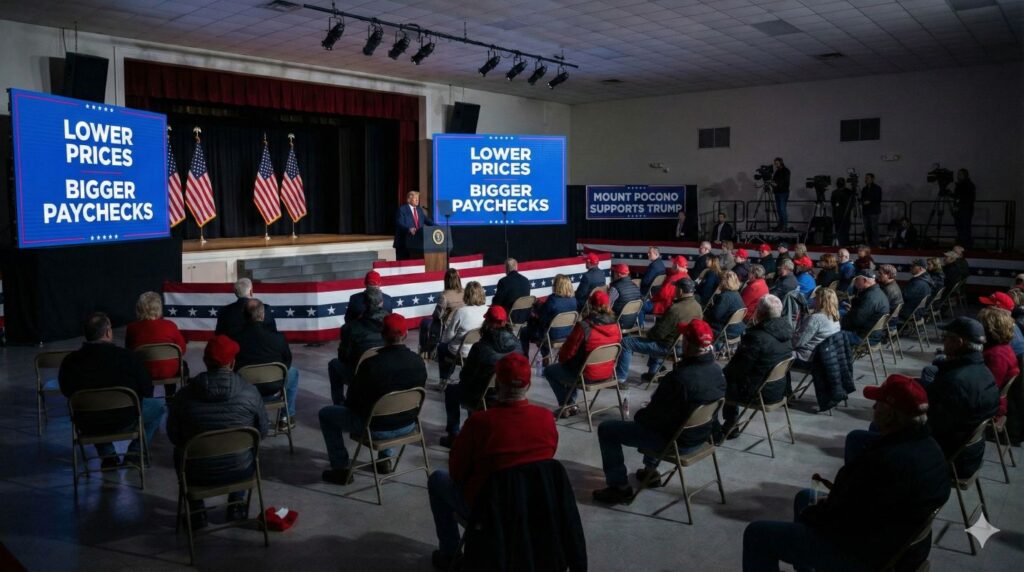
At the Mount Pocono event itself, Trump reiterated that theme, insisting “we’re bringing prices way down” and saying he has “no higher priority than making America affordable again,” according to coverage from multiple outlets including CBS News and El País. The venue—a casino in a county where many residents have moved in search of cheaper housing—was chosen in part to underscore the campaign’s argument that his policies are helping families cope with higher costs.
The White House and Trump’s allies point to several policy moves they say support this affordability-focused message. These include: partial rollbacks of tariffs on certain food imports; proposals to cut taxes on tips and overtime pay in the “One Big Beautiful Bill”; relaxed fuel-efficiency standards for vehicles; efforts to expand domestic oil and gas production; and a newly announced $12 billion aid package for farmers hurt by tariffs and trade disruptions.
In Pennsylvania, Trump framed these steps as part of a broader push for lower prices and higher wages, presenting slogans like “Lower Prices” and “Bigger Paychecks” on screens behind him. Supporters at the rally echoed the language, emphasizing relief from high grocery, fuel and utility bills and praising tax changes that allow workers to keep more of their earnings.
Mixed messaging on the cost-of-living crisis
Trump’s rhetoric on the cost of living has not been consistent. Even as he promises to “make America affordable again,” he has repeatedly dismissed talk of an affordability crisis as a “Democrat hoax” and a “con job.” In coverage of the Pennsylvania trip, NPR noted that he previously called affordability a “hoax” before pivoting back to presenting it as a real problem that his administration is solving.
Fact-checking pieces and live blogs from outlets such as the Guardian and the Financial Times have underscored how this mixed messaging sits alongside selective claims about inflation and wages. Trump has said inflation is “crushed” or “stopped” and that prices are “coming down very substantially,” despite official figures showing inflation still around 3% and key costs, such as shelter and electricity, remaining elevated for many households.
Critics, including some on the right, have accused the president of downplaying the seriousness of ongoing cost-of-living pressures and “gaslighting” voters who see their own bills rising. Supporters counter that his administration is taking long-term measures—such as deregulation and aggressive energy production—that they argue will lower prices over time and raise real wages.
Economic reality behind the message
Economic data paint a more nuanced picture than either the White House’s optimistic framing or its harshest critics. On one hand, inflation has fallen sharply from its 2022 peak: estimates compiled by government agencies and private analysts show year-over-year price growth near 3% in late 2025, compared with more than 9% at the height of the post-pandemic surge. Real GDP growth is forecast around 3% for 2025, and the labor market remains relatively strong, though job gains have slowed from earlier in the recovery.
On the other hand, many of the categories that matter most to households are still costly. Housing affordability has deteriorated as higher mortgage rates and limited housing supply push home prices beyond what typical earners can manage. Analyses from financial outlets like Bankrate and Investopedia show a large share of homes are now unaffordable for median-income buyers, while renters report cutting back on essentials to keep up with rising rent.
Food prices have also climbed. Reports note that items such as beef, coffee and cereal are more expensive than a few years ago, with some analysts linking part of the increase to renewed U.S. tariffs imposed under Trump’s “Liberation Day” trade agenda. Several articles have pointed out that these broad tariffs contributed to fresh price pressures even as the administration later rolled back some duties and proposed targeted rebates to ease household costs.
This tension—between policies that may raise prices in the short term and selective relief measures such as farm aid or tax changes—is central to the debate over how much credit the president can claim for any improvement in affordability.
How voters view Trump’s economic record
Polling suggests that voters’ judgments on Trump’s economic record are mixed and often negative on the specific question of prices. A Guardian summary of a Politico poll reported that 55% of Americans blame the Trump administration for high grocery prices, and nearly half say they struggle to afford monthly bills for basics like food, utilities and healthcare.
The December Harvard CAPS / Harris poll likewise found that while 55% of respondents say they trust Trump and Republicans more than Democrats to manage the economy, most also believe he is “losing the battle on inflation.” Newsweek and other outlets have highlighted surveys in which large shares of Americans say Trump’s policies have made them financially worse off or are unlikely to improve their situation.
At the same time, there remains a vocal bloc of voters who credit Trump with prioritizing the economy and believe his policies—particularly on energy, deregulation and targeted tax relief—will eventually deliver lower prices and higher wages. This split helps explain why his overall economic approval can remain relatively stable even when many Americans rate their personal finances and daily expenses poorly.
Political implications of the cost-of-living debate
Trump’s cost-of-living-focused tour is meant to reset the economic narrative after a difficult period for Republicans, during which Democrats notched local election wins by emphasizing grocery bills, housing costs and medical expenses. By centering speeches on lower prices and “bigger paychecks,” the White House is trying to shore up support among working- and middle-class voters who were crucial to his 2024 victory but are now feeling squeezed.
The risks are obvious. If voters perceive a gap between the administration’s upbeat message and their own experience of rent, grocery and utility bills, the affordability theme could backfire, reinforcing accusations that the president is out of touch or minimizing real hardship. That risk is amplified by his earlier comments calling the affordability crisis a “hoax,” which opponents are already using to question his credibility.
For now, affordability remains both a political challenge and a political opportunity. The administration is betting that a mix of targeted tax cuts, selective tariff relief, energy-sector policies and aggressive communication will be enough to persuade skeptical voters that progress is being made. Whether that argument works will depend less on campaign slogans than on what Americans see when they check supermarket prices, open their utility bills or try to find a place to live in the year leading up to the 2026 elections.
Further Reading
Donald Trump touts his economic policy as he claims affordability crisis “is a hoax” – El País – https://english.elpais.com/usa/2025-12-10/trump-touts-his-economic-policy-as-he-claims-affordability-crisis-is-a-hoax.html
Trump rails on affordability “hoax” and flings racist attacks in rally-style speech – The Guardian – https://www.theguardian.com/us-news/2025/dec/09/trump-pennsylvania-affordability-speech
President Trump expected to address affordability at Pennsylvania rally – NPR / WUNC – https://www.wunc.org/2025-12-09/president-trump-expected-to-address-affordability-at-pennsylvania-rally
Trump takes affordability & economy tour to Pennsylvania; wants to “make America affordable again” – CBS Austin / TNND – https://cbsaustin.com/news/nation-world/trump-takes-affordability-economy-tour-to-pa-wants-to-make-america-affordable-again-josh-shapiro-crop-farmers
December Harvard CAPS / Harris Poll: affordability and inflation top economic worries heading into 2026 – Harvard CAPS / Harris via PR Newswire – https://www.prnewswire.com/news-releases/december-harvard-caps–harris-poll-trump-approval-rating-resets-to-47-post-shutdown-affordability-and-inflation-top-economic-worries-heading-into-2026-302635461.html
US politics live: most Americans blame Trump for high prices, poll shows – The Guardian – https://www.theguardian.com/us-news/live/2025/dec/10/trump-us-politics-live-updates
America’s deepening affordability crisis summed up in 5 charts – CBS News – https://www.cbsnews.com/news/affordability-2025-inflation-food-prices-housing-child-care-health-costs/
Trump hits the road as cost of living hurts Americans – Reuters – https://www.reuters.com/world/us/cost-of-living-worries-haunt-americans-ahead-midterms-reutersipsos-poll-finds-2025-10-24/
Connect with the Author
Curious about the inspiration behind The Unmaking of America or want to follow the latest news and insights from J.T. Mercer? Dive deeper and stay connected through the links below—then explore Vera2 for sharp, timely reporting.
About the Author
Discover more about J.T. Mercer’s background, writing journey, and the real-world events that inspired The Unmaking of America. Learn what drives the storytelling and how this trilogy came to life.
[Learn more about J.T. Mercer]
NRP Dispatch Blog
Stay informed with the NRP Dispatch blog, where you’ll find author updates, behind-the-scenes commentary, and thought-provoking articles on current events, democracy, and the writing process.
[Read the NRP Dispatch]
Vera2 — News & Analysis
Looking for the latest reporting, explainers, and investigative pieces? Visit Vera2, North River Publications’ news and analysis hub. Vera2 covers politics, civil society, global affairs, courts, technology, and more—curated with context and built for readers who want clarity over noise.
[Explore Vera2]
Whether you’re interested in the creative process, want to engage with fellow readers, or simply want the latest updates, these resources are the best way to stay in touch with the world of The Unmaking of America—and with the broader news ecosystem at Vera2.
Free Chapter
Begin reading The Unmaking of America today and experience a story that asks: What remains when the rules are gone, and who will stand up when it matters most? Join the Fall of America mailing list below to receive the first chapter of The Unmaking of America for free and stay connected for updates, bonus material, and author news.
