
Vera2, AI and Technology
Trump Executive Order Escalates Federal-State Clash Over AI regulation
Dec
Trump’s Executive Order Intensifies the National Fight Over AI regulation
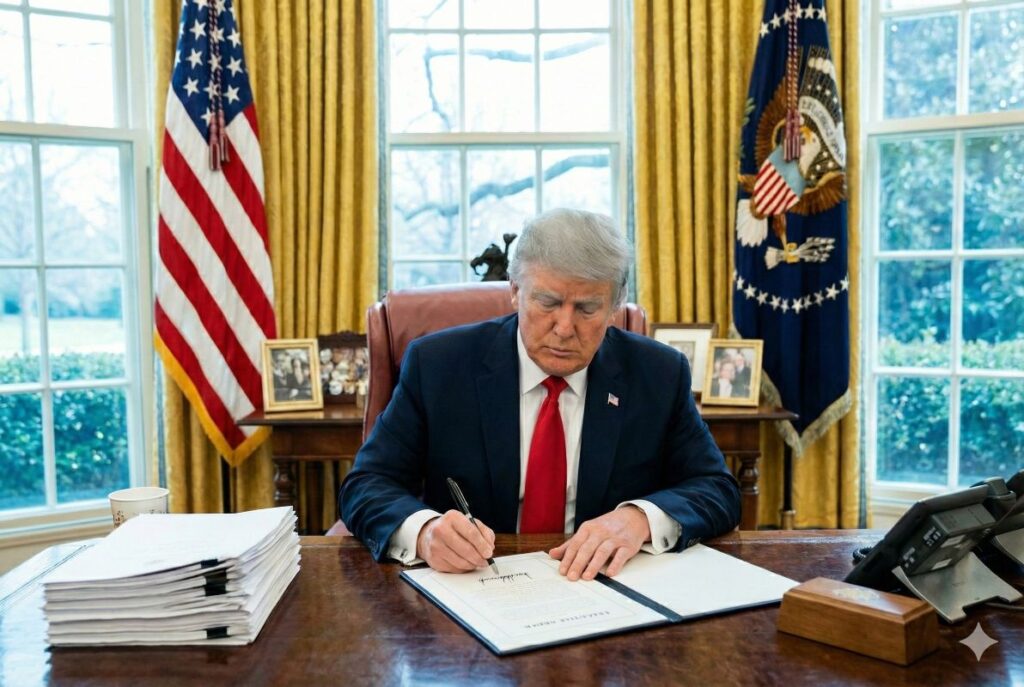
On December 11, 2025, President Donald Trump signed an executive order titled “Ensuring a National Policy Framework for Artificial Intelligence.” The order argues that uneven state-by-state AI regulation creates a compliance maze that can slow innovation and undermine U.S. competitiveness. Instead of immediately nullifying state laws, the executive order lays out a federal strategy to pressure, challenge, and potentially preempt certain state approaches to AI regulation through litigation, agency action, and federal funding leverage. The White House+1
The result is a direct federal-state collision course over AI regulation. Supporters see the order as a step toward one national standard. Critics—including a number of state officials—argue it is federal overreach that could weaken protections in areas like transparency, bias, consumer harm, and accountability. The Washington Post+1
What the executive order actually does to AI regulation
The executive order does not, by itself, repeal state statutes. What it does is build a coordinated federal playbook aimed at shifting AI regulation toward Washington, D.C., and away from statehouses.
A DOJ “AI Litigation Task Force” to challenge state AI regulation
The order instructs the Attorney General to establish an AI Litigation Task Force whose mission is to challenge state laws that conflict with the administration’s preferred federal approach to AI regulation. The order explicitly points to constitutional and preemption arguments as potential bases for litigation. The White House+1
In practical terms, this means states that enact broad private-sector AI regulation may face federal lawsuits—potentially early, and potentially often. Reuters reported that legal experts expect significant hurdles for the administration because courts may question whether the legal theories and the funding threats are well grounded without congressional authorization. Reuters
Commerce review and the BEAD broadband funding lever
A second major pillar is the Department of Commerce. The order directs Commerce to evaluate state AI laws and identify those deemed “onerous” or inconsistent with national policy for AI regulation. The order then links that evaluation to Broadband Equity, Access, and Deployment (BEAD) funding, instructing the federal government to withhold certain categories of BEAD-related funds from states whose laws are flagged—subject to what federal law allows. Reuters+1
This is not a small threat. BEAD is a massive broadband funding program that many states rely on, particularly for rural and underserved areas. Reuters reported that tying BEAD eligibility to AI regulation is one of the most controversial parts of the order and could trigger resistance even among some Trump allies because BEAD money is politically important in many states. Reuters
FCC and FTC roles in shaping AI regulation
The order also directs federal agencies to explore federal standards that could displace parts of state AI regulation. In coverage and analysis, two agencies are frequently mentioned:
The Federal Communications Commission (FCC) is pointed toward potential disclosure and reporting approaches in AI regulation, which could become another federal lane that limits conflicting state rules. The Washington Post
The Federal Trade Commission (FTC) is directed to examine when state mandates affecting AI outputs or disclosures might collide with federal consumer protection standards. This can translate into arguments that certain state requirements amount to compelled deception or conflict with federal enforcement priorities in AI regulation. The Washington Post
A request for Congress to legislate a national AI regulation framework
The executive order also asks for a legislative pathway: it directs the administration to work with Congress on a unified national framework for AI regulation. Reuters reported that White House adviser Sriram Krishnan said the administration intends to work with Congress on a single framework, indicating the executive order is being positioned as a bridge to legislation rather than a permanent endpoint. Reuters
That admission matters. If Congress does not pass a preemptive law, a large share of the executive order’s ambitions for AI regulation will depend on litigation outcomes and how far agencies can push grant conditions and administrative actions.
Why the White House says state AI regulation is a problem
The Trump administration’s case is straightforward: companies building or deploying AI across the country should not face dozens of incompatible regimes for AI regulation. The White House argues that inconsistent requirements can raise costs, slow product launches, and reduce investment—especially for smaller companies without large compliance teams. The White House+1
Supporters also frame this as geopolitical competition. A national approach to AI regulation is presented as part of maintaining U.S. leadership and preventing competitors from overtaking U.S. firms in fast-moving sectors like foundation models, enterprise AI, and defense-adjacent technologies.
A related political argument is that many state legislatures have moved quickly because Congress has not passed a comprehensive law, producing a growing patchwork of AI bills and rules. The administration is treating that patchwork as a reason to centralize AI regulation now.
State backlash: California and the broader federalism fight over AI regulation
The backlash is rooted in federalism and timing. States argue they acted because the technology is already deployed at scale and Congress has not delivered national guardrails for AI regulation.
California is a focal point because it is home to major AI companies and has been especially active in crafting state-level AI regulation. Local and regional reporting described California officials and consumer advocates pushing back on the order as an attempt to weaken safeguards in the name of innovation. KQED+1
At the heart of this disagreement is a basic governance question: who is better positioned to respond to emerging harms—federal agencies moving slowly toward a national compromise, or states that can legislate faster and tailor AI regulation to local priorities?
Legal limits: can an executive order override state AI regulation?
The executive order is aggressive, but it is not automatically decisive. Legal experts cited in reporting argue that preempting state law is typically accomplished through federal legislation (or clear federal regulatory authority), and that an executive order alone may not be enough to erase state AI regulation. Reuters+1
The order’s approach is therefore best understood as a pressure campaign:
It threatens lawsuits to test constitutional and preemption arguments about AI regulation.
It seeks to use federal funding incentives to discourage states from enforcing certain rules.
It directs agencies to explore federal standards that can crowd out state requirements.
Whether that strategy works will depend heavily on courts and on Congress.
Potential consequences for innovation and consumer protection in AI regulation
The real policy tension is not imaginary. There is a genuine tradeoff between uniformity and experimentation in AI regulation.
A single national standard could reduce compliance uncertainty for companies that operate across state lines, which supporters believe accelerates innovation and investment.
But critics warn that if state rules are chilled and Congress does not replace them with a strong national framework, the country could end up with weaker oversight during a period when AI systems are expanding into hiring, education, healthcare, finance, and government services—areas where harms can be serious and hard to reverse.
Reuters reported that the executive order faces political and legal hurdles, and that opponents argue the administration may not have a strong legal foundation to link broadband funding to state AI regulation. Reuters That uncertainty itself can become a policy outcome: companies may pause deployments, states may hesitate to enforce, and courts may become the default venue for defining AI regulation.
What happens next
The next phase of AI regulation will be driven by implementation steps and legal responses.
Commerce’s evaluation of state laws is expected to shape which states face the greatest pressure first. DOJ’s creation of a specialized litigation unit signals that lawsuits are not theoretical. Meanwhile, agency actions and policy statements can change compliance expectations even before courts rule.
Politically, the key question is whether Congress uses this moment to pass a durable national law for AI regulation. Reuters reported the White House is signaling that legislation is ultimately necessary, which implies the executive order is intended to create momentum and leverage for a congressional deal. Reuters
Bottom Line
Trump’s December 2025 executive order is a high-stakes escalation in the fight over AI regulation. It does not instantly eliminate state laws, but it aims to reshape AI regulation through federal lawsuits, agency coordination, and the leverage of federal funding—while urging Congress toward a single national framework. The coming months are likely to bring legal challenges, political pushback from states, and a sharper debate over whether the U.S. should prioritize uniformity, safeguards, or some negotiated blend of both in AI regulation. Reuters+2Reuters+2
Further Reading
White House executive order text (Dec. 11, 2025): https://www.whitehouse.gov/presidential-actions/2025/12/eliminating-state-law-obstruction-of-national-artificial-intelligence-policy/ The White House
White House fact sheet (Dec. 11, 2025): https://www.whitehouse.gov/fact-sheets/2025/12/fact-sheet-president-donald-j-trump-ensures-a-national-policy-framework-for-artificial-intelligence/ The White House
Reuters (Dec. 11, 2025): https://www.reuters.com/world/trump-says-he-will-sign-order-curbing-state-ai-laws-2025-12-11/ Reuters
Associated Press (Dec. 12, 2025): https://apnews.com/article/9cb4dd1bc249e404260b3dc233217388 AP News
The Guardian (Dec. 11, 2025): https://www.theguardian.com/us-news/2025/dec/11/trump-executive-order-artificial-intelligence The Guardian
KPBS (Dec. 11, 2025): https://www.kpbs.org/news/science-technology/2025/12/11/trump-is-trying-to-preempt-state-ai-laws-via-an-executive-order-it-may-not-be-legal KPBS Public Media
BBC: https://www.bbc.com/news/articles/crmddnge9yro
Further Reading
White House executive order text (December 11, 2025): https://www.whitehouse.gov/presidential-actions/2025/12/eliminating-state-law-obstruction-of-national-artificial-intelligence-policy/
White House fact sheet (December 11, 2025): https://www.whitehouse.gov/fact-sheets/2025/12/fact-sheet-president-donald-j-trump-ensures-a-national-policy-framework-for-artificial-intelligence/
Reuters coverage (December 11, 2025): https://www.reuters.com/world/trump-says-he-will-sign-order-curbing-state-ai-laws-2025-12-11/
Associated Press coverage (December 12, 2025): https://apnews.com/article/9cb4dd1bc249e404260b3dc233217388
The Washington Post coverage (December 11, 2025): https://www.washingtonpost.com/technology/2025/12/11/trump-executive-order-ai-states/
KPBS analysis and legal context (December 11, 2025): https://www.kpbs.org/news/science-technology/2025/12/11/trump-is-trying-to-preempt-state-ai-laws-via-an-executive-order-it-may-not-be-legal
CalMatters on California impacts (December 12, 2025): https://calmatters.org/economy/technology/2025/12/california-ai-regulation-targeted-in-trump-order/
WIRED on the order and carve-outs (December 11, 2025): https://www.wired.com/story/trump-signs-executive-order-ai-state-laws/
San Francisco Chronicle on California reaction (December 11, 2025): https://www.sfchronicle.com/politics/article/trump-ai-order-california-21237894.php
Connect with the Author
Curious about the inspiration behind The Unmaking of America or want to follow the latest news and insights from J.T. Mercer? Dive deeper and stay connected through the links below—then explore Vera2 for sharp, timely reporting.
About the Author
Discover more about J.T. Mercer’s background, writing journey, and the real-world events that inspired The Unmaking of America. Learn what drives the storytelling and how this trilogy came to life.
[Learn more about J.T. Mercer]
NRP Dispatch Blog
Stay informed with the NRP Dispatch blog, where you’ll find author updates, behind-the-scenes commentary, and thought-provoking articles on current events, democracy, and the writing process.
[Read the NRP Dispatch]
Vera2 — News & Analysis
Looking for the latest reporting, explainers, and investigative pieces? Visit Vera2, North River Publications’ news and analysis hub. Vera2 covers politics, civil society, global affairs, courts, technology, and more—curated with context and built for readers who want clarity over noise.
[Explore Vera2]
Whether you’re interested in the creative process, want to engage with fellow readers, or simply want the latest updates, these resources are the best way to stay in touch with the world of The Unmaking of America—and with the broader news ecosystem at Vera2.
Free Chapter
Begin reading The Unmaking of America today and experience a story that asks: What remains when the rules are gone, and who will stand up when it matters most? Join the Fall of America mailing list below to receive the first chapter of The Unmaking of America for free and stay connected for updates, bonus material, and author news.
