
Vera2, Global Affairs
Severe Flooding in Southeast Asia: A 300-Year Storm
Nov
Severe Flooding in Southeast Asia: A 300-Year Storm
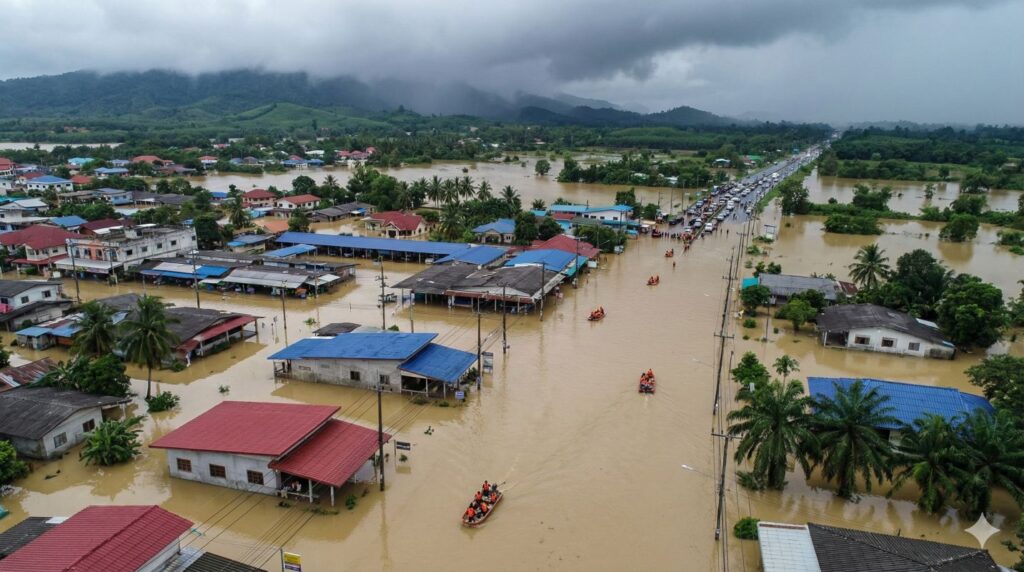
Southern Thailand is living through the kind of disaster that usually gets described in history books, not news alerts. Days of torrential rain have triggered severe flooding across multiple provinces, killing dozens of people, displacing tens of thousands, and disrupting the lives of nearly 2 million. Officials report record-breaking rainfall in the city of Hat Yai, where more than 300 millimeters fell in a single day, the heaviest downpour in roughly 300 years.Reuters+1
This so-called “300-year storm” is not an isolated anomaly. It is part of a broader wave of extreme weather hammering Southeast Asia, from Vietnam to Malaysia and Indonesia, where heavy rain, landslides, and more flooding are turning climate risk into a daily reality.AP News+2AP News+2
Impact of the Floods — flooding
Lives lost and communities underwater
In southern Thailand, heavy monsoon rains have unleashed severe flooding across at least nine provinces, with official estimates indicating that close to 2 million people have been affected and hundreds of thousands of homes damaged or submerged.Reuters+2Al Jazeera+2
The human toll is already devastating. Government spokespeople report at least 33 deaths linked to the disaster, with causes including landslides, electrocution, and people swept away by rapidly rising water.Reuters+1 Thousands more have been forced to evacuate to temporary shelters after severe flooding cut off entire neighborhoods, inundated ground floors, and destroyed vehicles and household possessions.
In Hat Yai, one of Thailand’s largest cities and a major commercial hub, streets have become rivers. Flood levels in some areas reached up to two meters, submerging cars, shops, and low-lying homes. Emergency responders have carried out rooftop rescues as families trapped by the flooding waited for boats or helicopters to reach them.AP News+1
Critical infrastructure at risk
The flooding has not only wrecked houses; it has pushed essential infrastructure to the brink. In Hat Yai’s main hospital, water inundated lower floors and threatened electrical systems, forcing authorities to airlift critically ill patients to safer locations.Reuters+1 Roads have become impassable in multiple provinces, and key highways are blocked or damaged, complicating any attempt to move relief supplies.Gulf News+1
Schools and clinics are closed. Power outages in flooded neighborhoods increase the risk of accidents, particularly electrocution. Humanitarian groups warn that children are especially vulnerable in these conditions, with nearly half a million children directly impacted by the flooding in southern Thailand alone.Save the Children UK+1
Government Response
Emergency measures and military deployment
The Thai government has declared disaster zones in the hardest-hit areas to unlock emergency funding and accelerate relief operations. Provinces such as Songkhla, home to Hat Yai, have been granted special powers to reroute budgets and coordinate rapid disaster relief.Gulf News+1
Authorities have deployed thousands of emergency personnel, soldiers, and volunteers to conduct rescues, distribute essential supplies, and reinforce levees and drainage systems. The navy’s only aircraft carrier, HTMS Chakri Naruebet, has been sent to the region as a floating operations center and mobile hospital, carrying helicopters, medical teams, and food supplies to areas cut off by the flooding.Reuters+1
Military units are ferrying people out of isolated neighborhoods using flat-bottomed boats and high-clearance vehicles. Helicopters are dropping food, drinking water, generators, and medical supplies into communities where the flooding has made road access impossible.AP News+1
Limits of national capacity
Despite these efforts, the scale of the disaster has overwhelmed local response capacity. Many affected communities report long delays in receiving aid, and social media feeds are filled with urgent pleas for rescue from people trapped by the flooding with limited food or electricity.Reuters+1
Thailand is not new to such crises. The 2011 floods, often described as the country’s worst in half a century, caused an estimated $46.5 billion in economic damage and disrupted global supply chains for electronics and automobiles.PreventionWeb+1 Yet the current event, concentrated in the south and amplified by a historic rain episode, shows that lessons from the past have not been fully translated into resilient infrastructure and land-use planning.
Government ministries and the disaster management agency are now coordinating with international organizations, regional partners, and NGOs to scale up relief operations, but access issues and ongoing heavy rain still limit what can be done on the ground.Save the Children UK+1
Regional Dimension: Southeast Asia’s New Flood Reality
A wider Southeast Asian emergency
The severe flooding in southern Thailand is part of a broader pattern unfolding across Southeast Asia. Recent weeks have seen deadly floods and landslides in Vietnam and Indonesia, displacing hundreds of thousands and destroying homes, farms, and critical infrastructure.AP News+2AP News+2
In Vietnam’s northern and central regions, sustained heavy rain has submerged more than 200,000 houses, wrecked vehicles, and devastated markets and small businesses.Wikipedia+1 In Indonesia’s Sumatra, flash floods and landslides have killed dozens and forced thousands into emergency shelters.AP News+1
The picture is clear: severe flooding is no longer a rare, isolated disaster in Southeast Asia. It is becoming a recurring regional emergency that tests the capacity of multiple governments at once.
Climate systems aligning in dangerous ways
Meteorologists point to an unusual alignment of two large-scale climate drivers—La Niña conditions in the Pacific and a negative Indian Ocean Dipole—to explain why this season’s monsoon rains have been so extreme. Warmer-than-average sea surface temperatures in key ocean regions have supercharged moisture in the atmosphere, making intense downpours and severe flooding more likely when storm systems pass over land.CNA+1
Climate scientists stress that while no single storm can be blamed solely on climate change, human-driven warming is loading the dice. A hotter atmosphere can hold more water vapor, which in turn means that when it rains, it tends to rain harder. In a region with dense populations in low-lying river basins and coastal plains, those shifts translate directly into more destructive flooding.nationthailand+2Open Knowledge +2
Long-Term Implications — flooding, climate, and vulnerability
Thailand’s exposure to climate shocks
Thailand’s own climate and development assessments are blunt: floods and storms are among the country’s most frequent and damaging natural hazards, hitting agriculture, industry, and poor households hardest.Open Knowledge +2PreventionWeb+2
Rural communities depending on rice, rubber, and other crops are especially vulnerable to flooding. Cropland inundation destroys harvests, erodes soil, and leaves farmers with new debts they cannot easily repay. Recent research suggests that climate-related shocks already cost Thailand about 2.5 percent of its agricultural GDP every year, and that rising temperatures could cut agricultural output further in both the short and long run.STC+2Wiley Online Library+2
When a “300-year storm” hits such exposed systems, the damage ripples across entire supply chains—from local food prices to export revenues. With southern Thailand also serving as a key rubber hub, extended flooding in this region can have knock-on effects for global commodity markets.Reuters+1
Urban risk and informal settlements
Urban centers like Hat Yai illustrate another dimension of the problem. Rapid growth has outpaced drainage capacity, and development has encroached on natural waterways and wetlands that once absorbed excess rainfall. When extreme downpours coincide with high tides or already saturated soils, urban flooding becomes both more frequent and more severe.nationthailand+1
Informal settlements on flood-prone land are hit hardest. Residents often lack formal land titles, insurance, or savings, making it difficult to rebuild after a disaster. Without targeted support, each new episode of flooding deepens existing inequalities.
Building Climate Resilience After a Historic Flood
From emergency response to long-term adaptation
Once the immediate crisis passes and the floodwaters recede, Thailand and its neighbors will face familiar questions: how to rebuild, where to rebuild, and how to reduce risk before the next round of severe flooding arrives.
International institutions and development agencies have already identified a set of priorities for building resilience in Thailand. These include climate-informed water management, investments in climate-resilient infrastructure, and stronger early warning systems that can give communities more time to prepare or evacuate.UNDP Adaptation+2Open Knowledge +2
That means upgrading drainage networks and levees; restoring mangroves, wetlands, and river floodplains that can buffer extreme flows; and integrating climate risk into urban planning so that critical facilities like hospitals, schools, and power stations are not left in the path of predictable flooding.
Protecting livelihoods and the most vulnerable
Adaptation is not just about concrete and pumps. It also requires social protection systems that can cushion the economic blow when disasters strike. Cash transfers, micro-insurance, debt relief for farmers, and targeted support for small businesses can help prevent temporary shocks from turning into permanent poverty traps.Interactive Country Fiches+2IOM Asia Pacific+2
Children deserve particular attention. Humanitarian organizations warn that severe flooding disrupts schooling, increases the risk of family separation, and exposes children to hazards from contaminated water to exposed electrical lines.Save the Children UK+1 Designing shelters, evacuation plans, and recovery programs with child protection at the center is not optional; it is a test of whether the response is serious.
International cooperation and finance
The scale and frequency of recent flooding across Southeast Asia make one thing obvious: this is not a problem any country can handle alone. Cross-border river basins, shared coastlines, and interconnected economies mean that climate shocks in one place quickly echo elsewhere.
Regional coordination on forecasting, data sharing, and disaster response—alongside climate finance that helps countries like Thailand invest in resilient infrastructure and agriculture—will be essential to prevent each new flooding event from spiraling into a prolonged humanitarian and economic crisis.CNA+2Center for Disaster Philanthropy+2
Bottom Line
The severe flooding now battering southern Thailand is being labeled a “once in 300 years” storm, but the underlying story is not about rarity; it is about vulnerability. Record-breaking rain has collided with exposed communities, strained infrastructure, and a warming climate that makes extreme downpours more likely. The result is a humanitarian emergency affecting millions of people, with children, rural households, and low-income urban residents bearing the brunt.Reuters+2AP News+2
As Thailand and its neighbors struggle to rescue the stranded and rebuild shattered lives, the region faces a hard choice: treat this disaster as a freak occurrence, or as the new baseline for what climate-charged flooding can do. If leaders choose the second, then investments in resilience, climate-smart infrastructure, and social protection will need to move from the margins of policy to the center.
The stakes are simple. Without a serious shift, the next “300-year storm” will not take 300 years to arrive—and the human cost of each new wave of flooding will grow.
Further Reading
Associated Press – “Families in southern Thailand perch on rooftops to escape flooding that has killed at least 33”
This report details the on-the-ground situation in southern Thailand, including rooftop rescues, hospital evacuations, and the deployment of the navy’s aircraft carrier for relief operations.
https://apnews.com/article/9fc8e497dd395c77260b0376ef84a490 AP News+1
Al Jazeera – “Deadly floods and landslides continue to plague Southeast Asia”
A regional overview of the latest floods in Thailand, Vietnam, and neighboring countries, highlighting the number of people affected and the broader climate context.
https://www.aljazeera.com/news/2025/11/24/deadly-floods-and-landslides-continue-to-plague-southeast-asia Al Jazeera+1
Save the Children – “About 400,000 children impacted, including at least three killed, as floods hit southern Thailand”
Focuses on the particular risks the disaster poses to children, from disrupted education to safety concerns in flooded communities.
https://www.savethechildren.org.uk/news/media-centre/press-releases/2025/about-400000-children-impacted-including-least-three-killed Save the Children UK
UNDP / Adaptation Fund – “Enhancing Climate Resilience in Thailand through Effective Water Management and Sustainable Agriculture”
Explains Thailand’s vulnerability to climate-driven floods and outlines key strategies for improving water management and resilience in rural areas.
https://www.adaptation-undp.org/projects/enhancing-climate-resilience-thailand-through-effective-water-management-and-sustainable UNDP Adaptation+1
World Bank – “Thailand Country Climate and Development Report”
Provides a comprehensive look at how climate change threatens Thailand’s economy, infrastructure, and communities, with a strong focus on flood and water risks.
https://openknowledge.worldbank.org/entities/publication/8d0837da-8924-44aa-9e2b-0aa0a2f6a635 Open Knowledge +1
Connect with the Author
Curious about the inspiration behind The Unmaking of America or want to follow the latest news and insights from J.T. Mercer? Dive deeper and stay connected through the links below—then explore Vera2 for sharp, timely reporting.
About the Author
Discover more about J.T. Mercer’s background, writing journey, and the real-world events that inspired The Unmaking of America. Learn what drives the storytelling and how this trilogy came to life.
[Learn more about J.T. Mercer]
NRP Dispatch Blog
Stay informed with the NRP Dispatch blog, where you’ll find author updates, behind-the-scenes commentary, and thought-provoking articles on current events, democracy, and the writing process.
[Read the NRP Dispatch]
Vera2 — News & Analysis
Looking for the latest reporting, explainers, and investigative pieces? Visit Vera2, North River Publications’ news and analysis hub. Vera2 covers politics, civil society, global affairs, courts, technology, and more—curated with context and built for readers who want clarity over noise.
[Explore Vera2]
Whether you’re interested in the creative process, want to engage with fellow readers, or simply want the latest updates, these resources are the best way to stay in touch with the world of The Unmaking of America—and with the broader news ecosystem at Vera2.
Free Chapter
Begin reading The Unmaking of America today and experience a story that asks: What remains when the rules are gone, and who will stand up when it matters most? Join the Fall of America mailing list below to receive the first chapter of The Unmaking of America for free and stay connected for updates, bonus material, and author news.
