
Vera2, Investigations & Corruption
Mark Kelly Faces Pentagon Inquiry Over Unlawful Orders Video
Nov
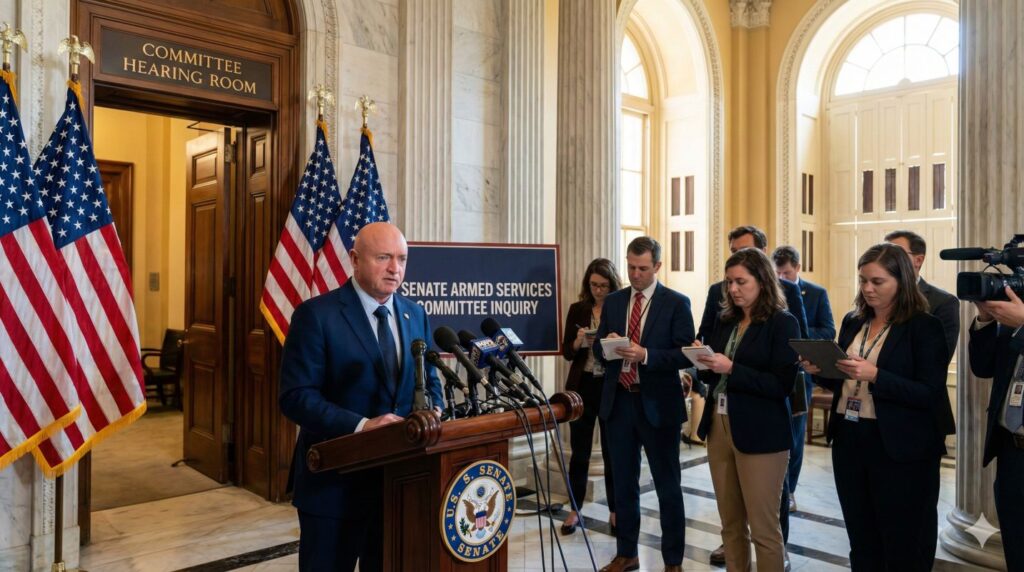
Mark Kelly Faces Pentagon Inquiry Over Controversial Remarks
Senator Mark Kelly has spent much of his life inside the military and national security world. Now he is being treated almost like a junior officer under investigation. A video in which Mark Kelly urges service members to refuse unlawful orders has triggered a formal Pentagon inquiry and opened up a fierce debate about military law, civilian control, and political speech in a hyper-partisan moment.
The Controversial Remarks — Mark Kelly
The immediate controversy began with a video released in November 2025 featuring several Democratic lawmakers with military backgrounds, including Mark Kelly, speaking directly to active-duty troops and intelligence personnel. In the video, Mark Kelly and others argue that service members must refuse unlawful orders and that their ultimate loyalty is to the Constitution, not to any individual political leader.
On the surface, this is not a radical claim; the principle that troops should disobey clearly illegal orders is embedded in U.S. military law and reinforced by historical precedent. But the timing and framing of the video made it explosive. The remarks were released against a backdrop of highly controversial directives from the Trump administration, including domestic troop deployments and aggressive use of force in operations framed as counter-drug or crowd-control missions.
Defense Secretary Pete Hegseth called Mark Kelly’s segment “despicable, reckless, and false,” arguing that the video could encourage insubordination by implying that currently serving commanders are likely to issue unlawful orders. In Hegseth’s view, telling troops to “get ready to say no” risks eroding trust in the chain of command before any actual illegal order exists. The Pentagon has now opened a formal inquiry into whether Mark Kelly’s remarks, delivered as a senator but also as a retired Navy captain, amount to incitement to disobey or a violation of norms governing retired officers.
The video went viral within hours. Supporters cast Mark Kelly as defending the Constitution; critics cast him as undermining discipline at a moment when civil–military tensions are already high.
The Pentagon’s Inquiry and Military Law
The inquiry into Mark Kelly serves two overlapping purposes. First, it is a fact-finding exercise: officials are looking closely at the exact wording of his remarks, the context provided in the video, and the intent behind the message. Second, it is a signal to the force that the Department of Defense is not going to shrug off high-profile statements that appear to tell troops when and how to resist their own commanders.
Unlawful orders and the UCMJ
Under the Uniform Code of Military Justice (UCMJ), service members are required to obey lawful orders, not every order. Article 92, for example, enforces obedience to lawful orders and regulations; an order that violates the Constitution, international law, or clearly applicable statutes is not binding. In rare but serious cases, a service member can be punished for following a manifestly unlawful order, such as an order to commit war crimes.
The problem is not the abstract principle. Virtually everyone involved in the debate agrees that troops must refuse a plainly illegal command. The tension lies in who decides when an order crosses that line, and how political actors talk about that duty in public.
Critics argue that when Mark Kelly, now an elected official and a prominent opponent of Trump, records a video telling troops to defy illegal orders without specifying any concrete scenario, it becomes easy for partisans to project their own grievances onto the phrase “illegal order.” That uncertainty, they say, is exactly what makes the message dangerous inside a rigid hierarchy that depends on clarity and trust.
Supporters counter that Mark Kelly is restating black-letter law and that reminding troops of their obligations is not sedition, it is civic education. Legal experts quoted in independent fact-checks have also noted that the video does not direct which specific orders to defy and therefore falls far short of criminal incitement.
Why the Pentagon worries about “mixed messages”
The Pentagon’s leadership is also focused on a different angle: the cumulative impact of public political messaging aimed at soldiers. In the last few years, senior officials have already had to tighten rules around troops’ social media activity, punishing posts that celebrate political violence or mock assassinations of public figures.
From that perspective, a Mark Kelly video that sounds like it is instructing troops to pre-judge orders from a sitting commander in chief is simply one more step down a dangerous path where partisan narratives infiltrate day-to-day military culture. That is why the inquiry is framed as a defense of “good order and discipline,” not just a dispute with one senator.
Mark Kelly’s Background and Credibility on Military Issues
Part of what makes this clash so charged is who Mark Kelly is. Before entering politics, Mark Kelly served as a U.S. Navy combat pilot, flying 39 missions during the Gulf War, and later as a test pilot. He was then selected as a NASA astronaut, eventually commanding the Space Shuttle on his final mission and logging more than 50 days in space.
Mark Kelly later won election to the U.S. Senate from Arizona, building a profile centered on national security, gun safety, and high-tech industry policy, particularly around semiconductors and space. His personal story—alongside his wife, former Representative Gabby Giffords, who survived an assassination attempt—gives him a moral authority that many voters and service members find compelling.
That legacy cuts both ways. When Mark Kelly speaks about unlawful orders, he does so as someone who has been inside cockpit briefings, carrier ready rooms, and classified mission reviews. His defenders say that experience makes his warning more credible. The Pentagon, however, sees the same biography and worries that junior troops may treat his political message as quasi-official guidance from a former captain and astronaut, not just another partisan video.
Political Stakes of the Mark Kelly Pentagon inquiry
This investigation is not happening in a vacuum. It comes as Trump escalates his own rhetoric about internal “enemies” and insists that those encouraging troops to resist unlawful orders are themselves seditious. At rallies and on social media, Trump has singled out Mark Kelly by name, framing the senator’s comments as an attempt to pre-emptively sabotage presidential authority over the armed forces.
Republicans aligned with Trump argue that the Mark Kelly Pentagon inquiry is necessary to restore a bright line between partisan politics and the chain of command. Some have even floated the possibility that, because Mark Kelly remains a retired officer, he could be recalled to active duty and court-martialed if investigators conclude that he urged insubordination. That would be an extraordinary step, but the fact that it is even being discussed tells you how charged this fight has become.
Democrats, meanwhile, see the inquiry into Mark Kelly as part of a broader attempt to intimidate critics of Trump’s national security decisions. They point to earlier calls to investigate other Democratic veterans in Congress and to high-profile crackdowns on speech by junior troops as evidence that the Pentagon is being used to police dissent, not just maintain discipline.
For voters, the optics are simple: a sitting president and his defense secretary are aiming the machinery of the Pentagon at a senator who is warning troops not to break the law. Whether that looks like a necessary enforcement action or a political vendetta depends heavily on where you sit.
Civil–Military Relations in the Social Media Age
One reason this Mark Kelly controversy escalated so quickly is the way social media distorts and accelerates everything touching the armed forces. Within hours of the video’s release, it had been recut into partisan clips, stripped of context, and blasted through algorithm-driven feeds that reward anger over nuance.
Researchers and military analysts have been warning for years that social platforms can both deepen public understanding of the military and erode traditional norms of deference and restraint. Social media makes it easy for troops to see themselves as direct participants in political discourse and for politicians to speak to them as a distinct audience.
That dynamic turns a Mark Kelly statement about unlawful orders into something more than a legal reminder. It becomes a signal in a rolling information war, where every side is trying to claim the mantle of “defending the Constitution” and every video is evaluated for tactical advantage.
Why This Mark Kelly controversy matters for service members
For rank-and-file troops, the Mark Kelly Pentagon inquiry raises practical questions. Service members already receive training on the difference between lawful and unlawful orders, including examples rooted in war crimes and human rights law. They also know, at least in theory, that they may face criminal liability for carrying out clearly illegal acts.
What they do not need is additional ambiguity injected by politicians on either side promising that “we’ve got your back” if they disobey. A junior enlisted soldier or a young officer has to make real-time decisions with incomplete information, guided by the UCMJ, rules of engagement, and the advice of their chain of command—not by viral videos.
At the same time, the existence of someone like Mark Kelly, with a long record of military service, publicly reminding them that their first loyalty is to the Constitution can be reassuring. It is a reminder that the duty to disobey is real, even if it should be invoked only in extreme circumstances. That tension—between duty and discipline, conscience and command—is exactly what makes this episode so fraught.
Looking Ahead: Possible Outcomes of the Mark Kelly Pentagon inquiry
The Pentagon’s options range from quietly closing the inquiry with no action, to issuing a formal letter of concern, to taking the unprecedented step of recalling Mark Kelly for disciplinary proceedings. Realistically, the most likely outcomes sit in the middle: a public statement reinforcing the rules, perhaps a rebuke couched in bureaucratic language, and an attempt to move on.
Whatever the formal result, the Mark Kelly case will linger as a precedent. Future lawmakers with military backgrounds will watch how far they can go in addressing the troops before triggering an investigation. Defense officials will feel pressure to act consistently whenever high-profile figures speak directly to service members about politics and orders.
Most importantly, this episode forces the country to confront a basic question: how do we preserve both civilian control of the military and the individual responsibility of each service member to refuse illegal commands, in a system where every statement by Mark Kelly, Trump, or anyone else is instantly weaponized online? There is no easy answer—but the way this inquiry is handled will tell us a lot about which side of that balance currently has the upper hand.
Further Reading
Politico – “Pentagon to investigate Sen. Mark Kelly for anti-Trump video”
A reported overview of the investigation into Mark Kelly and the broader controversy surrounding the video about unlawful orders.
https://www.politico.com/news/2025/11/24/pentagon-to-investigate-sen-mark-kelly-for-anti-trump-video-00666894
Associated Press – “Who is Mark Kelly, the senator the Pentagon is targeting for urging troops to defy illegal orders?”
Biographical and political context on Mark Kelly, including his Navy and NASA background.
https://apnews.com/article/d3f67f108de8de7569305fca5a913c27
Washington Post – “Does the military have to follow unlawful orders? What the oath says.”
Explains how military law defines unlawful orders and the obligations of service members under the UCMJ.
https://www.washingtonpost.com/politics/2025/11/21/military-orders-unlawful-trump-democrats-seditious/
R Street Institute – “Civilian control is a fundamental part of our norms and Constitution”
Discusses the principles of civilian control of the military in the American system.
https://www.rstreet.org/commentary/civilian-control-is-a-fundamental-part-of-our-norms-and-constitution/
U.S. Air Force – “Social media’s impact on civil-military relations: Balancing the good with the bad”
Looks at how social media shapes perceptions of the military and affects civil–military relations.
https://www.960cyber.afrc.af.mil/News/Article-Display/Article/2872659/social-medias-impact-on-civil-military-relations-balancing-the-good-with-the-bad/
Army University Press – “Soldiers and Social Media: Challenges, Benefits, and Boundaries”
Explores how soldiers’ online behavior can support or undermine good order and discipline.
https://www.armyupress.army.mil/Journals/NCO-Journal/Archives/2018/June/Soldiers-and-Social-Media/
Connect with the Author
Curious about the inspiration behind The Unmaking of America or want to follow the latest news and insights from J.T. Mercer? Dive deeper and stay connected through the links below—then explore Vera2 for sharp, timely reporting.
About the Author
Discover more about J.T. Mercer’s background, writing journey, and the real-world events that inspired The Unmaking of America. Learn what drives the storytelling and how this trilogy came to life.
[Learn more about J.T. Mercer]
NRP Dispatch Blog
Stay informed with the NRP Dispatch blog, where you’ll find author updates, behind-the-scenes commentary, and thought-provoking articles on current events, democracy, and the writing process.
[Read the NRP Dispatch]
Vera2 — News & Analysis
Looking for the latest reporting, explainers, and investigative pieces? Visit Vera2, North River Publications’ news and analysis hub. Vera2 covers politics, civil society, global affairs, courts, technology, and more—curated with context and built for readers who want clarity over noise.
[Explore Vera2]
Whether you’re interested in the creative process, want to engage with fellow readers, or simply want the latest updates, these resources are the best way to stay in touch with the world of The Unmaking of America—and with the broader news ecosystem at Vera2.
Free Chapter
Begin reading The Unmaking of America today and experience a story that asks: What remains when the rules are gone, and who will stand up when it matters most? Join the Fall of America mailing list below to receive the first chapter of The Unmaking of America for free and stay connected for updates, bonus material, and author news.
