
Vera2, Civil Rights and Society
Tennessee Judge Temporarily Blocks National Guard Deployment
Nov
Tennessee Judge Blocks National Guard Deployment in Memphis
A Tennessee court has stepped directly into the fight over how far executives can go in using military forces at home. Chancellor Patricia Head Moskal of the Davidson County Chancery Court has temporarily halted a planned National Guard deployment to Memphis, finding that Governor Bill Lee likely exceeded his authority under state law. AP News+1
The ruling does more than pause a single National Guard deployment. It forces a national conversation about when, if ever, political leaders can send troops into American streets for routine crime control, and what legal limits still apply when the language of “law and order” collides with constitutional boundaries.
Background of the Case — National Guard Deployment into Memphis
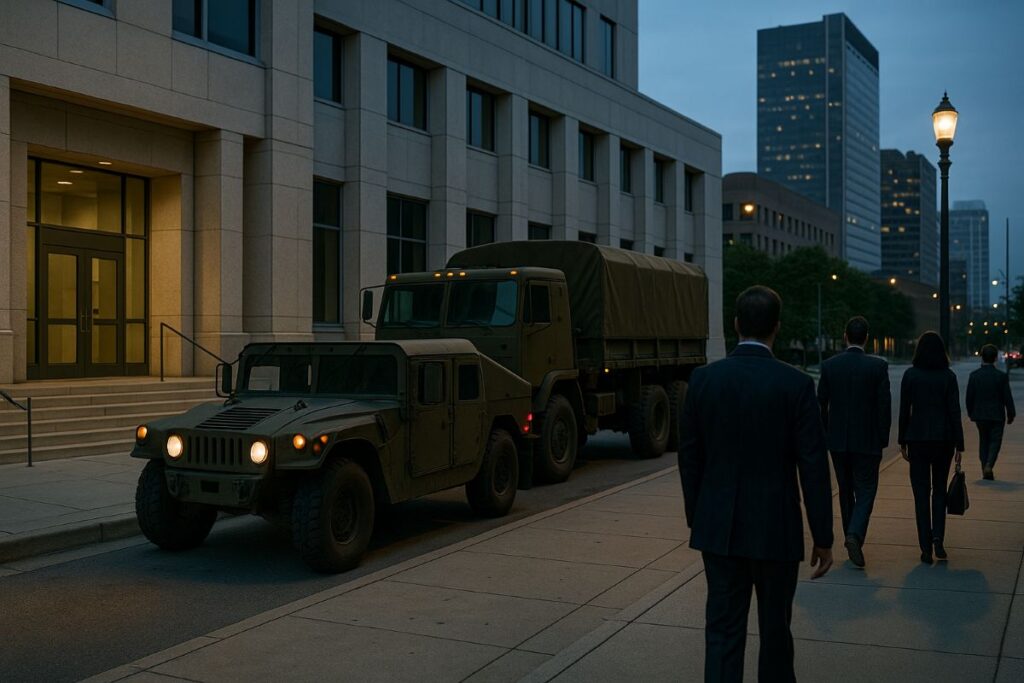
In September 2025, President Donald Trump announced a federal crime initiative targeting several cities, including Memphis, portraying them as “deeply troubled” and overrun by violence. Governor Bill Lee embraced the plan and ordered a National Guard deployment to support a multi-agency task force already operating in the city. ABC News+1
Under the plan, National Guard troops patrolled Memphis streets alongside federal and state officers. The Guard was officially restricted to a support role without arrest powers, but its presence signaled a clear escalation in the government’s response to crime. Within weeks, officials touted more than 2,000 arrests made by the task force, even as critics argued that flooding a majority-Black city with camouflage uniforms amounted to political theater and intimidation. ABC News+1
Local and state Democratic officials pushed back, filing a lawsuit on October 17 that challenged the National Guard deployment as unlawful under Tennessee’s constitution and militia statutes. The plaintiffs—among them Shelby County Mayor Lee Harris, Memphis City Councilmember JB Smiley Jr., and several state legislators—argued that the governor can only activate the Guard for situations like rebellion, invasion, “grave emergency,” or officially declared disasters, and that none of those conditions existed in Memphis. NILC+1
The Court’s Ruling and Legal Reasoning
Limits on state power over military forces
Chancellor Moskal agreed that the lawsuit raised serious constitutional issues. In granting a temporary injunction, she held that the National Guard deployment was likely unlawful because the governor had not shown a rebellion, invasion, or disaster, nor had there been a formal request from local authorities. Reuters+1
The judge noted that Memphis’s high crime rate, while serious, did not automatically justify a National Guard deployment under Tennessee law. She emphasized that the case “raises important questions concerning the use of the state’s military forces for domestic law enforcement purposes,” directly questioning whether the governor can treat generalized crime problems as a trigger for military activation. X (formerly Twitter)+1
To avoid immediate disruption, the court delayed the effect of the injunction for five days, giving the state time to appeal. If the ruling stands, however, Tennessee will have a clear precedent that a National Guard deployment into a city requires more than a governor’s political judgment; it requires specific legal conditions that can be tested in court. Reuters+1
Interaction with federal authority and the Posse Comitatus framework
The ruling also exposes the complicated overlap between state control of Guard units and federal crime initiatives. Under normal circumstances, the Posse Comitatus Act limits the use of federal military forces in domestic law enforcement. But National Guard troops operating under state authority occupy a gray zone: they can be used more flexibly, especially during emergencies. NILC
In Memphis, the National Guard deployment was justified as part of a federal–state crime crackdown while still formally operating under Tennessee command. The court’s decision cuts into that hybrid strategy. It signals that even when Washington wants visible troop presence in a city, governors cannot simply brand routine crime as an “emergency” to unlock military powers.
Civil Liberties, Public Safety, and the National Guard Deployment Debate
Supporters: a tool against violent crime
Supporters of the governor’s move argue that Memphis faces a stubborn violent crime problem and that a National Guard deployment can deter gangs, reassure residents, and supplement overstretched police. They point to the large number of arrests and say the Guard’s limited support role respects civil liberties while improving public safety. ABC News+1
From this perspective, the judge’s ruling risks tying the hands of elected leaders who are under pressure to show they are doing something about shootings and homicides. If courts second-guess every National Guard deployment, the argument goes, governors may hesitate to act even in situations that genuinely merit a strong response.
Critics: militarization and democratic accountability
Civil rights advocates and many Memphis residents see the same National Guard deployment very differently. They view camouflaged troops patrolling urban neighborhoods as a symbol of creeping militarization and a reminder of previous clashes between demonstrators and heavily armed forces in cities like Portland and Washington, D.C. NILC+1
Groups such as Democracy Forward and the National Immigration Law Center have framed the ruling as a win for the rule of law, arguing that the National Guard deployment was less about safety than politics, and that state and federal leaders must not treat American cities as staging grounds for campaign imagery. NILC+1
They also stress that Guard units are trained for military tasks, not community policing, and warn that their presence can escalate confrontations, especially in communities already skeptical of law enforcement. For these critics, the Memphis injunction is an important check on executive overreach and a signal that courts will not rubber-stamp every National Guard deployment framed as “crime fighting.”
Broader Constitutional Stakes of the Memphis Ruling
State militias, separation of powers, and precedent
At its core, the decision forces Tennessee to confront a basic constitutional question: who decides when military force is appropriate within state borders? The judge’s analysis suggests that the legislature, not just the governor, has a central role in defining when a National Guard deployment is justified, and that vague appeals to “urban unrest” are not enough. Reuters+1
If higher courts uphold this view, it will limit the ability of any future governor—Republican or Democrat—to unilaterally authorize a National Guard deployment for routine law enforcement. Other states facing similar controversies will likely look to Memphis as a model, either to copy its safeguards or to draft new statutes clarifying when military activation is allowed.
National implications for domestic troop use
The Memphis case is also part of a larger national pattern. In recent years, debates over sending federal officers and Guard units into cities during protests or crime waves have intensified. The Tennessee ruling adds a new layer by using state constitutional law to push back on a president-backed National Guard deployment, rather than relying only on federal statutes like the Posse Comitatus Act. Axios+1
For the White House, the decision is a warning that even cooperative governors face legal limits. For local officials in other states, it offers a legal roadmap for challenging a National Guard deployment they view as unlawful or politically motivated.
What Comes Next for Memphis and Beyond
In the short term, Tennessee’s attorney general is expected to appeal the injunction, arguing that the governor’s public safety powers are broad enough to justify this National Guard deployment. State lawyers are likely to stress falling crime statistics since the task force began and to insist that the Guard’s support role is narrowly tailored. Reuters+1
The plaintiffs, for their part, will try to convert the temporary injunction into a permanent bar. They will argue that the governor’s actions flipped the legal standard upside down, treating normal crime challenges as an excuse for open-ended National Guard deployment whenever politically convenient. NILC+1
Whatever the final outcome, the case has already shifted the debate. Memphis has forced judges, legislators, and the public to confront what a “last resort” really means. If ordinary spikes in crime can trigger a National Guard deployment, the line between civilian policing and military presence risks disappearing.
Bottom Line
The Tennessee judge’s decision to block the National Guard deployment in Memphis is more than a local skirmish over crime policy. It is a direct challenge to the idea that executives can casually reach for military tools in domestic law enforcement and then hide behind broad claims of authority.
As appeals unfold, one fact is already clear: any future National Guard deployment into American cities will be judged against the Memphis precedent. The ruling has put governors, presidents, and courts on notice that the balance between public safety and civil liberties cannot be quietly rewritten by executive order alone.
Further Reading
Associated Press – “Tennessee judge blocks Trump’s use of National Guard in Memphis but gives time for government appeal”
https://apnews.com/article/88524219125b811fe6f558cdbc870dee
Washington Post – “Tennessee judge temporarily blocks National Guard deployment in Memphis”
https://www.washingtonpost.com/nation/2025/11/18/tennessee-judge-blocks-memphis-national-guard/
Reuters – “Tennessee state judge blocks National Guard deployment to Memphis”
https://www.reuters.com/world/us/tennessee-state-judge-blocks-national-guard-deployment-memphis-court-ruling-2025-11-18/
ABC News – “Judge temporarily blocks deployment of National Guard into Memphis”
https://abcnews.go.com/US/judge-temporarily-blocks-deployment-national-guard-memphis/story?id=127618132
Axios – “Tennessee judge temporarily blocks National Guard deployment to Memphis”
https://www.axios.com/2025/11/18/national-guard-memphis-trump-tennessee-ruling
National Immigration Law Center – “Tennessee Court Blocks Unlawful National Guard Deployment in Memphis”
https://www.nilc.org/press/tennessee-court-blocks-unlawful-national-guard-deployment-in-memphis/
Connect with the Author
Curious about the inspiration behind The Unmaking of America or want to follow the latest news and insights from J.T. Mercer? Dive deeper and stay connected through the links below—then explore Vera2 for sharp, timely reporting.
About the Author
Discover more about J.T. Mercer’s background, writing journey, and the real-world events that inspired The Unmaking of America. Learn what drives the storytelling and how this trilogy came to life.
[Learn more about J.T. Mercer]
NRP Dispatch Blog
Stay informed with the NRP Dispatch blog, where you’ll find author updates, behind-the-scenes commentary, and thought-provoking articles on current events, democracy, and the writing process.
[Read the NRP Dispatch]
Vera2 — News & Analysis
Looking for the latest reporting, explainers, and investigative pieces? Visit Vera2, North River Publications’ news and analysis hub. Vera2 covers politics, civil society, global affairs, courts, technology, and more—curated with context and built for readers who want clarity over noise.
[Explore Vera2]
Whether you’re interested in the creative process, want to engage with fellow readers, or simply want the latest updates, these resources are the best way to stay in touch with the world of The Unmaking of America—and with the broader news ecosystem at Vera2.
Free Chapter
Begin reading The Unmaking of America today and experience a story that asks: What remains when the rules are gone, and who will stand up when it matters most? Join the Fall of America mailing list below to receive the first chapter of The Unmaking of America for free and stay connected for updates, bonus material, and author news.
