
Vera2, Civil Rights and Society
National Guardsman Slowly Healing After Being Shot In DC
Dec
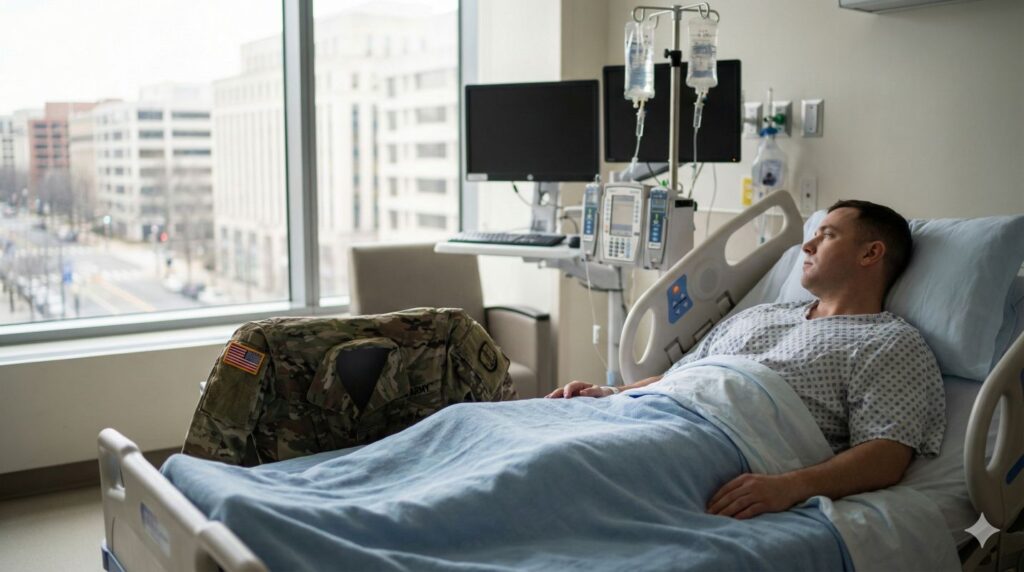
National Guardsman Recovering from Gunshot Wound in D.C.
A 24-year-old National Guardsman from West Virginia is slowly recovering after being critically wounded in a high-profile shooting near the White House. Staff Sgt. Andrew Wolfe, part of the West Virginia Air National Guard, remains in acute care in Washington, D.C., following a late-November ambush that also claimed the life of fellow Guardswoman Spc. Sarah Beckstrom.
The case has become a national flashpoint: a National Guardsman deployed to the nation’s capital, shot a few blocks from the White House amid a politically charged federal security operation. As Wolfe’s family shares cautious optimism about his recovery, officials and residents are asking hard questions about safety, deployment decisions, and the risks a National Guardsman faces even when not on an overseas battlefield.
Incident Overview — National Guardsman
On November 26, 2025, two West Virginia National Guard members on patrol near Farragut West Metro station, roughly two blocks from the White House, were shot in what authorities describe as an ambush-style attack. The victims were identified as Staff Sgt. Andrew Wolfe, an Air National Guardsman from Martinsburg, West Virginia, and Spc. Sarah Beckstrom, a 20-year-old Army National Guard soldier from Summersville.
Both were in Washington as part of a broader federal deployment of National Guard forces ordered by the Trump administration, framed as a response to what it called a “crime emergency” in the city. That deployment came despite long-term data showing crime in the District had fallen to historic lows compared to past decades, a contrast that has fueled political debate about the necessity and intent behind the mission.
The National Guardsman and his colleague were patrolling an area around 17th and I Streets when the suspect approached and opened fire. Witnesses reported hearing multiple shots and seeing a uniformed service member receiving resuscitation attempts on the sidewalk as law enforcement converged on the scene.
Timeline of the D.C. Shooting
Authorities say the shooting occurred in the early afternoon, shortly after 2 p.m. local time. Surveillance footage and court testimony indicate the attacker approached the pair, fired at close range, and then continued shooting as one of the soldiers tried to move behind a bus shelter.
Both the National Guardsman and Beckstrom were shot in the head. Emergency responders transported them to separate hospitals in critical condition. Beckstrom died of her wounds the next day, November 27. Wolfe underwent emergency surgery and was listed in serious but stable condition in the days that followed.
The shooter, identified as 29-year-old Afghan national Rahmanullah Lakanwal, was also wounded after being engaged by one of the soldiers or responding officers. He has since been charged with first-degree murder while armed for Beckstrom’s killing, as well as charges related to the ambush-style shooting of the National Guardsman.
Details of the Shooting and Suspect
Court filings and Justice Department statements paint a stark picture of the attack. Prosecutors allege that Lakanwal drove across the country from Washington state to Washington, D.C., armed with a .357-caliber revolver. Once in the city, he is accused of waiting near Farragut West station, watching for uniformed personnel before approaching the two Guard members and opening fire.
Witness accounts and initial investigative summaries describe the shooting as deliberate and targeted. Law enforcement officials have said there is video of the suspect waiting in broad daylight and then moving toward the group of law enforcement and Guard personnel before firing.
According to the Justice Department, the accused previously worked with a CIA-backed Afghan paramilitary “Zero Unit” before entering the United States under Operation Allies Welcome. He later sought and received asylum in 2025. Motive remains under investigation; prosecutors have not publicly attributed the attack to any specific ideology or organization, and Lakanwal has pleaded not guilty.
The death of Beckstrom and the critical wounding of the National Guardsman have intensified debate over how prior U.S. covert relationships, asylum processes, and domestic deployments intersect in unpredictable and sometimes deadly ways. Commentators have described the case as a form of “blowback” from past security policies, while officials emphasize that the suspect’s specific motivations are still being examined.
Current Condition and Recovery of the National Guardsman
Despite the severity of his head wound, recent updates from family members and state officials indicate that the National Guardsman is slowly improving. West Virginia Governor Patrick Morrisey has repeatedly briefed the public, reporting that Wolfe’s head injury is “slowly healing” and that doctors expect him to remain in acute care for at least two to three more weeks.
In interviews summarized by local and national outlets, Wolfe’s parents describe small but meaningful signs of progress. They have said he has begun to respond to some commands, and at times looks more like himself, even though he remains heavily sedated and under close monitoring.
Medical experts speaking generally about similar cases—not specifically about this National Guardsman—note that recovery from a gunshot wound to the head depends on multiple factors, including the exact path of the bullet, the speed of emergency response, and the presence of complications such as swelling or infection. Long-term outcomes can range from significant disability to partial or near-full functional recovery, but predicting the trajectory early on is difficult.
For now, Wolfe’s care team and family are focused on stabilizing the National Guardsman and supporting gradual neurological healing. Officials have emphasized that this will likely be a long recovery process, measured in months and years rather than days.
Family, Community, and Military Support
The shooting has prompted an outpouring of support for the National Guardsman and for Beckstrom’s family. West Virginia officials ordered flags to be flown at half-staff in honor of both soldiers, and communities in Martinsburg and Summersville have held vigils and moments of silence.
The West Virginia National Guard and the 167th Airlift Wing have released statements praising Wolfe’s service and Beckstrom’s dedication, noting that both were relatively recent arrivals in the capital as part of the federal deployment. A resolution introduced in the U.S. House of Representatives formally recognized the two as victims of a targeted attack while serving as part of a D.C. public safety task force.
For the National Guardsman and his family, this public recognition is happening alongside a very private struggle at his hospital bedside. They have requested continued prayers and privacy while they focus on his recovery, a request echoed by state officials.
Implications for Public Safety in Washington, D.C.
The ambush has deepened ongoing debates about public safety, the deployment of military forces in civilian spaces, and the political framing of crime in Washington, D.C.
The National Guardsman and Beckstrom were among more than 2,000 troops deployed to the capital as part of a Trump administration initiative that increased federal and military presence in the city. The move came even as analysts and local officials pointed to long-term declines in certain categories of crime and warned against militarizing the response to public safety concerns.
The shooting of a visibly uniformed National Guardsman just blocks from the White House has been framed by some as evidence that high-profile deployments do not necessarily deter targeted attacks and may, in some contexts, create new risks. Others argue that the rapid response of law enforcement and the fact that the suspect was quickly wounded and arrested shows that the integrated security posture can limit the scale of such incidents.
Local leaders, including the mayor of Washington, D.C., have condemned the attack and expressed condolences to the families. They have also reiterated calls for more coordinated approaches to violence prevention that combine policing, intelligence, and community-based strategies, rather than relying solely on visible deployments of federal forces and the National Guard.
Why the Recovery of a National Guardsman Matters
The story of this National Guardsman is not just about one soldier’s medical struggle. It touches on larger questions about how the United States uses its National Guard, how it manages the aftermath of foreign interventions, and how it balances security and civil life in the nation’s capital.
Wolfe and Beckstrom were not deployed overseas; they were standing watch in an American city, a few minutes’ walk from the White House. Their shooting underscores that National Guard service can carry life-threatening risk even within U.S. borders, especially when a National Guardsman is placed in missions that are politically contested and highly visible.
The charged background of the suspect—a former CIA-affiliated Afghan operative who later entered the country under a humanitarian program and received asylum—has fueled fierce political arguments over immigration, intelligence partnerships, and refugee policy. But whatever conclusions are ultimately reached in court, the immediate human reality remains: a National Guardsman faces a long, uncertain recovery, and a young soldier has been killed.
For policymakers, the case is likely to shape future debates about when and how to deploy the National Guard within U.S. cities, how to vet and monitor individuals who previously worked with U.S. security agencies abroad, and how to support a National Guardsman injured in domestic operations. For the public, it is a stark reminder that the consequences of security decisions made in Washington can come home in deeply personal and painful ways.
Further Reading
For readers who want to examine the primary reporting and official records behind this incident, the following sources provide detailed, factual coverage:
The Associated Press reports on the condition of Staff Sgt. Andrew Wolfe, detailing his head wound, current status in acute care, and the death of fellow Guardswoman Sarah Beckstrom, as well as the broader context of the deployment:
https://apnews.com/article/west-virginia-national-guard-dc-shooting-andrew-wolfe-7356604f9a85133f2044ac8a107ba50d
People Magazine summarizes updates from Wolfe’s family and West Virginia Governor Patrick Morrisey, describing his surgeries, sedation, and the family’s cautious optimism about his recovery:
https://people.com/national-guardsman-injured-in-d-c-shooting-recovery-update-11863593
NBC Washington provides local coverage of the attack and subsequent updates on the National Guardsman, including details of the ambush near the White House and the governor’s remarks about Wolfe’s progress:
https://www.nbcwashington.com/news/national-international/andrew-wolfe-national-guard-update/4024945/
The U.S. Attorney’s Office in D.C. offers the official charging document and narrative describing the suspect, Rahmanullah Lakanwal, and the counts related to the murder of Sarah Beckstrom and the ambush of Guardsman Wolfe:
https://www.justice.gov/usao-dc/pr/afghan-national-charged-murder-national-guard-soldier-sarah-beckstrom
Background on the attack, the victims, and the suspect’s history with CIA-backed Afghan units is compiled in the encyclopedia entry on the 2025 Washington, D.C., National Guard shooting:
https://en.wikipedia.org/wiki/2025_Washington,_D.C.,_National_Guard_shooting
For broader analysis of crime, deployment, and political framing around the incident, The Guardian’s coverage examines the federal “crime emergency” narrative and how it contrasts with long-term crime trends in Washington, D.C.:
https://www.theguardian.com/us-news/2025/dec/06/west-virginia-national-guard-dc-attack
Connect with the Author
Curious about the inspiration behind The Unmaking of America or want to follow the latest news and insights from J.T. Mercer? Dive deeper and stay connected through the links below—then explore Vera2 for sharp, timely reporting.
About the Author
Discover more about J.T. Mercer’s background, writing journey, and the real-world events that inspired The Unmaking of America. Learn what drives the storytelling and how this trilogy came to life.
[Learn more about J.T. Mercer]
NRP Dispatch Blog
Stay informed with the NRP Dispatch blog, where you’ll find author updates, behind-the-scenes commentary, and thought-provoking articles on current events, democracy, and the writing process.
[Read the NRP Dispatch]
Vera2 — News & Analysis
Looking for the latest reporting, explainers, and investigative pieces? Visit Vera2, North River Publications’ news and analysis hub. Vera2 covers politics, civil society, global affairs, courts, technology, and more—curated with context and built for readers who want clarity over noise.
[Explore Vera2]
Whether you’re interested in the creative process, want to engage with fellow readers, or simply want the latest updates, these resources are the best way to stay in touch with the world of The Unmaking of America—and with the broader news ecosystem at Vera2.
Free Chapter
Begin reading The Unmaking of America today and experience a story that asks: What remains when the rules are gone, and who will stand up when it matters most? Join the Fall of America mailing list below to receive the first chapter of The Unmaking of America for free and stay connected for updates, bonus material, and author news.
