
Vera2, Global Affairs
North American Leaders Take Stage Together for the First Time
Dec
North American Leaders Meet at World Cup Draw
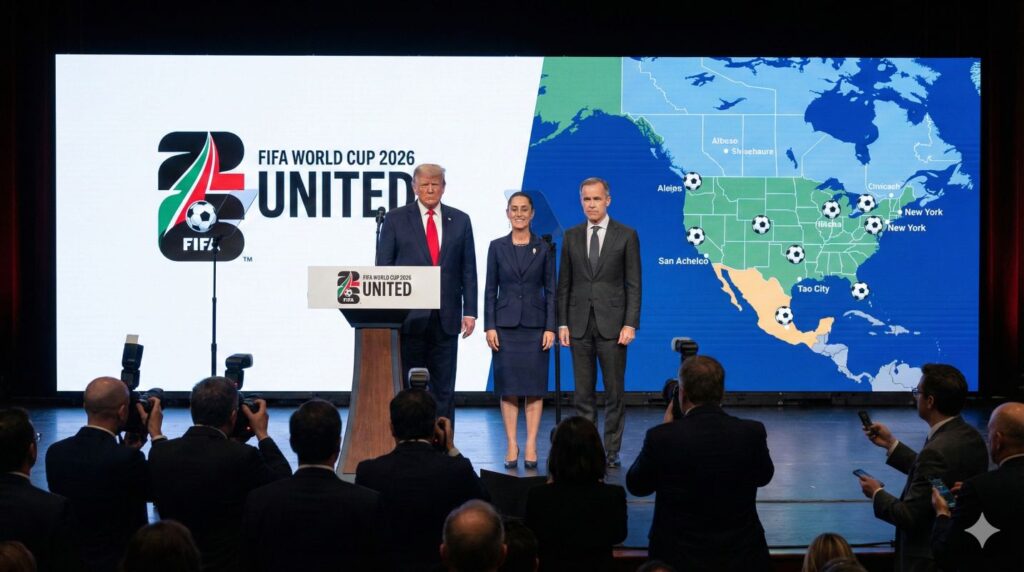
The 2026 FIFA World Cup is already shaping politics before a single match kicks off. At the official draw in Washington, D.C., the spectacle of global football doubled as a de facto mini-summit for North American leaders. U.S. President Donald Trump, Mexican President Claudia Sheinbaum, and Canadian Prime Minister Mark Carney all appeared at the Kennedy Center, turning what should have been a procedural draw into a carefully staged moment of regional diplomacy.
The event was dominated by images of the three North American leaders sharing the stage with FIFA President Gianni Infantino, who awarded Trump the inaugural FIFA Peace Prize during a ceremony that mixed pop culture, politics, and sport in equal measure. CBS News+2Vanity Fair+2 But behind the music and celebrity cameos, the World Cup draw became an opportunity for North American leaders to signal whether they intend to manage their tensions or inflame them as the 2026 tournament approaches.
Historic Meeting of Leaders — North American leaders
The draw took place on December 5, 2025, at the John F. Kennedy Center for the Performing Arts in Washington, D.C., setting the groups for the expanded 48-team 2026 FIFA Men’s World Cup, which will be co-hosted by the United States, Mexico, and Canada. Wikipedia+1
What elevated this particular draw beyond normal sports coverage was the presence of all three North American leaders:
Trump, attending as host head of state and as the first recipient of FIFA’s new peace prize. CBS News+2Reuters+2
Sheinbaum, Mexico’s first woman president, whose first year in office has been marked by high approval ratings and a promise to balance social justice with economic stability. AS/COA+2KTEP+2
Carney, Canada’s prime minister, who has been trying to keep Canada positioned as a stabilizing partner between its much larger neighbors. Facebook+1
According to reporting on and around the event, Trump, Sheinbaum, and Carney had discussions on trade and broader regional issues on the sidelines of the draw, even as the public focus remained on group assignments and fan spectacle. PRPeak+2The Economic Times+2 That turned the draw into an improvised stage for North American leaders to test whether they can still cooperate after years of tariff threats, migration disputes, and political theater.
The World Cup Draw as a Diplomatic Platform
The Kennedy Center ceremony was more than a set of envelopes and group charts. The show featured musical performances, celebrity presenters, and an elaborate tribute to Trump, culminating in Infantino awarding him the FIFA Peace Prize for his claimed role in “promoting dialogue” and “settling conflicts,” a move widely criticized as political flattery. Wikipedia+3Vanity Fair+3The New Yorker+3
In that setting, the optics of North American leaders standing together mattered. The 2026 tournament demands close cooperation on security, visa policy, air travel, stadium readiness, and crowd management across three national borders. If the relationships among North American leaders are openly hostile, the entire logistical effort becomes harder and more fragile. If they can at least project basic alignment, the World Cup can become a practical driver of deeper regional integration.
The draw made that tension visible: North American leaders smiling for cameras in public while journalists and analysts parsed their body language and side conversations for clues about the future of USMCA, tariffs, and migration enforcement.
Trade and USMCA: What North American Leaders Are Really Worried About
Whenever North American leaders meet, trade hangs over everything. NAFTA created one of the world’s largest free-trade zones; its replacement, the United States–Mexico–Canada Agreement (USMCA), updated rules for autos, agriculture, labor, and digital commerce while preserving most tariff-free access across the region. France 24+2KTEP+2
In recent years, Trump has repeatedly used tariff threats against both Canada and Mexico as leverage on issues ranging from migration enforcement to cultural disputes. Facebook+2PRPeak+2 Those moves rattled businesses and workers whose livelihoods depend on cross-border supply chains for autos, electronics, energy, and food.
At the World Cup draw, the informal talks among North American leaders reportedly touched on tariffs and trade disputes, with Carney and Sheinbaum both signaling that they want predictable rules rather than sudden shocks. PRPeak+1 For them, the question is whether the United States will treat USMCA as a binding rules-based framework or as a tool for ongoing pressure.
The Coming USMCA Review
USMCA contains a built-in review mechanism that forces North American leaders to revisit the agreement on a regular cycle. France 24+1 That looming review gives extra weight to even informal conversations at events like the World Cup draw.
If North American leaders can use this period to align on core goals—such as protecting labor standards, clarifying auto content rules, and streamlining border customs—then the upcoming review could strengthen confidence in the system. If not, the region risks drifting into repeated trade crises, with companies holding back on long-term investments.
By meeting on the sidelines of an event watched worldwide, North American leaders framed themselves not just as co-hosts of a tournament but as co-architects of a shared economic zone. Investors, unions, and industry groups will be watching closely to see whether that framing turns into concrete policy shifts.
Supply Chains, Nearshoring, and Regional Resilience
After the COVID-19 pandemic and ongoing geopolitical tensions, all three countries are talking about “nearshoring” and supply chain resilience. Government strategies and private-sector plans increasingly point toward relocating crucial manufacturing away from China and closer to home. USMCA gives a legal foundation for this shift, but it requires trust among North American leaders to sustain it. KTEP+1
At the World Cup draw, the presence of all three North American leaders presented an opportunity—formal or not—to reinforce that message. A stable, predictable North American trade zone is central to any serious nearshoring strategy. Energy integration, EV supply chains, critical minerals, and cross-border logistics are all easier if North American leaders are not constantly threatening each other with new tariffs or inspections.
Political Context: Three North American Leaders, Three Different Agendas
The political profiles of these three North American leaders could hardly be more different.
Trump is pursuing an aggressive nationalist agenda, mixing demands for loyalty with heavy use of cultural and economic grievance. His appearance at the draw, complete with dancing to “Y.M.C.A.” and accepting FIFA’s peace prize, underscored his appetite for televised spectacle and personal praise. San Francisco Chronicle+2The New Yorker+2
Sheinbaum leads a progressive Mexican government built on promises of social investment, climate action, and a continuation—yet adjustment—of the political project started under Andrés Manuel López Obrador. Her approval ratings have stayed above 70 percent for much of her first year, giving her a strong domestic mandate even as she faces protests and policy challenges. KTEP+3AS/COA+3France 24+3
Carney, a former central banker, represents a technocratic and pragmatic approach in Canada, trying to balance climate ambition, economic competitiveness, and close ties with both Washington and Mexico City. He has positioned Canada as a broker and stabilizer when North American leaders clash. PRPeak+1
Domestic Audiences and the Optics of Cooperation
Each of these North American leaders walked into the World Cup draw thinking about domestic audiences.
Trump could present the event as proof of his global clout, a chance to claim credit for “bringing the World Cup to America” and for alleged diplomatic wins around the world. Reuters+2Wikipedia+2
Sheinbaum could show Mexican voters that she is treated as an equal partner, not a junior appendage, standing shoulder to shoulder with Trump and Carney on one of the sport’s biggest stages.
Carney could reassure Canadians that their prime minister is present wherever decisions that affect North American trade and security are being shaped, even informally.
Media coverage picked up on all of these themes. Reuters and other outlets highlighted the peace prize theatrics and Trump’s central role at the event. Reuters+2The New Yorker+2 Regional outlets described how Carney, Trump, and Sheinbaum briefly discussed trade on the sidelines, framing it as a sign that despite high-profile disputes, the machinery of diplomacy is still turning. PRPeak+2The Economic Times+2
Public reaction, both in North America and abroad, has been split. Some see the image of North American leaders appearing together as a welcome shift toward basic cooperation. Others see the entire spectacle—the peace prize, the music, the staging—as proof that institutions like FIFA are all too willing to launder political reputations and help leaders chase domestic optics.
Why This Meeting of North American Leaders Matters
From a Vera2 perspective, the key question is whether this high-visibility encounter among North American leaders will translate into tangible policy outcomes. Sports events have long served as platforms for diplomacy, but they can just as easily become empty photo-ops.
There are several reasons this particular meeting matters:
It happens at a moment when USMCA is moving toward future review cycles and trade tensions are never far from the surface. North American leaders chose to meet rather than avoid each other, which is at least a minimal signal of intent to keep channels open. France 24+2KTEP+2
It takes place against the backdrop of the 2026 World Cup, an event that structurally forces cooperation on security, travel, and infrastructure, whether the leaders like it or not.
It provides an early test of how Trump, Sheinbaum, and Carney handle one another in public. If they can navigate this stage without escalating into open hostility, it may be easier to convene a formal North American Leaders’ Summit later, possibly during the tournament itself. CBS News+1
For now, the outcome is mostly symbolic. But symbols matter. The image of North American leaders standing together at the World Cup draw is already circulating across social media, news broadcasts, and political feeds. It sets expectations—fair or not—that these governments can at least talk to each other while managing disagreements. Whether that expectation survives the next tariff threat, border crisis, or election cycle remains the open question.
Bottom Line
The World Cup draw at the Kennedy Center was supposed to be about football. Instead, it became a window into the evolving relationships among North American leaders.
Trump walked away with a FIFA Peace Prize and another made-for-TV moment. Sheinbaum and Carney left having shared a stage and at least some words with a U.S. president whose policies have often put them on the defensive. For the region’s workers, businesses, and migrants, the real test is not the handshake or the group photos, but whether this brief encounter among North American leaders helps stabilize USMCA, reduce surprise tariff shocks, and support a more coherent approach to migration and climate policy.
The 2026 World Cup will force the three countries into deep practical cooperation. The meeting of North American leaders at the draw is an early signal of whether they can do that without dragging the region back into permanent crisis mode.
Further Reading
FIFA’s official page on the 2026 World Cup explains the shared hosting by the United States, Mexico, and Canada, the expanded 48-team format, and the role of the draw at the Kennedy Center in Washington, D.C.:
https://www.fifa.com/en/tournaments/mens/worldcup/canadamexicousa2026 Wikipedia
CBS News provides a detailed breakdown of the 2026 World Cup draw, including group compositions, and notes Trump’s presence at the Kennedy Center and his FIFA Peace Prize moment:
https://www.cbsnews.com/live-updates/fifa-mens-world-cup-draw-2026-kennedy-center/ CBS News+1
Vanity Fair and The New Yorker both critique the heavily politicized nature of the World Cup draw, describing the event as a bizarre mix of sports, celebrity, and Trump-focused spectacle:
https://www.vanityfair.com/news/story/donald-trump-fifa-peace-prize-kennedy-center
https://www.newyorker.com/sports/sporting-scene/the-weird-spectacle-of-the-world-cup-draw Vanity Fair+1
The U.S. Trade Representative’s official USMCA page and the U.S. Department of Commerce’s overview of USMCA offer context on how the agreement structures trade among the three countries and why it is central whenever North American leaders meet:
https://ustr.gov/trade-agreements/free-trade-agreements/united-states-mexico-canada-agreement
https://www.trade.gov/usmca France 24+1
For insight into Claudia Sheinbaum’s first year and her approval ratings, see the Americas Society/Council of the Americas tracker and coverage from Mexico-focused outlets:
https://www.as-coa.org/articles/approval-tracker-mexicos-president-claudia-sheinbaum
https://mexiconewsdaily.com/politics/president-sheinbaums-first-year-in-office-in-12-numbers-part-2/ AS/COA+1
Further Reading
FIFA’s official overview of the 2026 World Cup, including host countries, match structure, and cities across the United States, Canada, and Mexico, provides context for why the tournament is such a powerful stage for regional diplomacy:
https://www.fifa.com/en/tournaments/mens/worldcup/canadamexicousa2026 FIFA
Reuters’ reporting on the match schedule for the 2026 World Cup details the spread of games across North America and highlights how deeply integrated the tournament will be among the three host nations:
https://www.reuters.com/sports/soccer/soccer-world-cup-match-schedule-2025-12-06/ Reuters
Background on Claudia Sheinbaum’s presidency, political profile, and approval ratings helps explain how Mexico’s first woman president is reshaping domestic politics and regional diplomacy:
https://www.as-coa.org/articles/approval-tracker-mexicos-president-claudia-sheinbaum AS/COA
For a concise official overview of the United States–Mexico–Canada Agreement, including how it updated NAFTA and what it means for trade in the region, see the U.S. Trade Representative’s USMCA page:
https://ustr.gov/trade-agreements/free-trade-agreements/united-states-mexico-canada-agreement United States Trade Representative
The U.S. Department of Commerce’s USMCA portal provides additional detail on how the agreement is intended to support workers, farmers, and businesses across North America:
https://www.trade.gov/usmca Trade.gov
For broader context on how recent North American Leaders’ Summits have approached cooperation and conflict, the Wilson Center’s analysis of the 2023 summit is a useful reference:
https://www.wilsoncenter.org/article/2023-north-american-leaders-summit-when-three-amigos-meet-mexico-city-building-cooperation
Connect with the Author
Curious about the inspiration behind The Unmaking of America or want to follow the latest news and insights from J.T. Mercer? Dive deeper and stay connected through the links below—then explore Vera2 for sharp, timely reporting.
About the Author
Discover more about J.T. Mercer’s background, writing journey, and the real-world events that inspired The Unmaking of America. Learn what drives the storytelling and how this trilogy came to life.
[Learn more about J.T. Mercer]
NRP Dispatch Blog
Stay informed with the NRP Dispatch blog, where you’ll find author updates, behind-the-scenes commentary, and thought-provoking articles on current events, democracy, and the writing process.
[Read the NRP Dispatch]
Vera2 — News & Analysis
Looking for the latest reporting, explainers, and investigative pieces? Visit Vera2, North River Publications’ news and analysis hub. Vera2 covers politics, civil society, global affairs, courts, technology, and more—curated with context and built for readers who want clarity over noise.
[Explore Vera2]
Whether you’re interested in the creative process, want to engage with fellow readers, or simply want the latest updates, these resources are the best way to stay in touch with the world of The Unmaking of America—and with the broader news ecosystem at Vera2.
Free Chapter
Begin reading The Unmaking of America today and experience a story that asks: What remains when the rules are gone, and who will stand up when it matters most? Join the Fall of America mailing list below to receive the first chapter of The Unmaking of America for free and stay connected for updates, bonus material, and author news.
