
Vera2, Global Affairs
US Oil Tanker Seizure: A Critical Move Against Venezuela
Dec
US Oil Tanker Seizure: A Critical Move Against Venezuela
The United States oil tanker seizure off the coast of Venezuela on 10 December 2025 has instantly become a flashpoint in already fraught relations between Washington and Caracas. The operation targeted the Skipper, a large crude carrier long tied to sanctions violations, and has been denounced by Venezuela as “international piracy” and an attempt to turn the country into an “oil colony.” Reuters+2AP News+2
President Donald Trump publicly confirmed the oil tanker seizure, calling the vessel “very large, the largest one ever seized actually,” and presenting the move as part of a broader campaign to increase pressure on President Nicolás Maduro’s government. U.S. officials say the Skipper was linked to a network moving sanctioned Venezuelan and Iranian oil, while Venezuela insists the action violates its sovereignty and international maritime law. The Guardian+2Reuters+2
— oil tanker seizure
Background of the Seizure — oil tanker seizure
The tanker Skipper and its sanctions history
The Skipper is a 20-year-old very large crude carrier (VLCC) that previously operated under other names, including Adisa. In November 2022, the U.S. Treasury Department sanctioned the vessel and its Marshall Islands–based owner, Triton Navigation, alleging involvement in an illicit shipping network that moved oil on behalf of Iran’s Islamic Revolutionary Guard Corps and Hezbollah. Wikipedia+1
By late 2025, tanker-tracking services and satellite imagery showed the Skipper docked at Puerto José, a major Venezuelan oil terminal, loading heavy crude for export despite ongoing U.S. sanctions on Venezuela’s state oil company PDVSA. Analysts reported that the ship had repeatedly broadcast false transponder data, making it appear in different locations and marking it as part of a broader shadow fleet used to evade sanctions. Wikipedia+2Wikipedia+2
This context is central to how the United States has framed the oil tanker seizure: not as a one-off action off Venezuela’s coast, but as an enforcement step against what Washington describes as a global network shipping sanctioned oil in violation of U.S. measures. Forces News+1
Timing and regional military buildup
The oil tanker seizure took place amid a significant U.S. naval deployment in the Caribbean. In 2025, Washington expanded counter-narcotics and sanctions-enforcement operations in the region, including deploying the aircraft carrier USS Gerald R. Ford and associated forces. A December 2025 operation from that carrier had already drawn scrutiny for lethal strikes on alleged drug-smuggling vessels. AP News+1
Against that backdrop, the decision to carry out a high-profile oil tanker seizure off Venezuela signaled that the mission set was broadening from drug interdiction and pressure on Iran to direct action against a sanctioned Venezuelan shipment.
Details of the Operation
How the oil tanker seizure unfolded
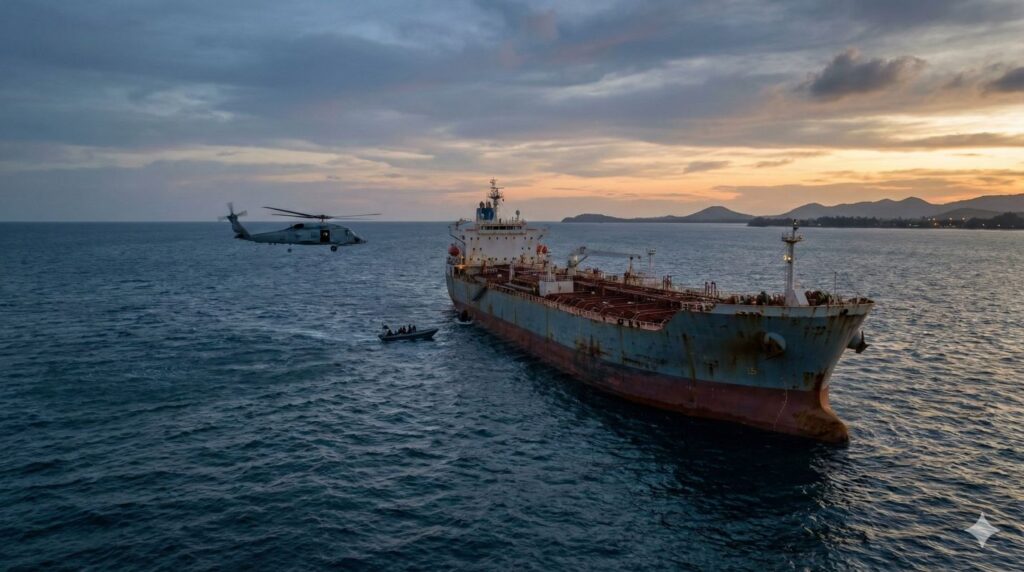
According to U.S. officials cited by multiple outlets, the operation began shortly after the Skipper departed Venezuelan waters with a cargo of crude oil. Special operations forces, including U.S. Coast Guard and Marine Corps personnel, deployed from helicopters launched off the USS Gerald R. Ford and boarded the tanker in the Caribbean Sea, off the Venezuelan coast. CBS News+2Wikipedia+2
Officials say the boarding party encountered no resistance; the crew complied with orders, and there were no reported casualties. The Skipper was then brought under U.S. control pursuant to a federal seizure warrant obtained weeks earlier in connection with its sanctioned activities. The Justice Department has stated that the warrant was tied to the ship’s past role in moving Iranian oil, though Attorney General Pam Bondi has also said the tanker was carrying both Venezuelan and Iranian crude. Wikipedia+2Al Jazeera+2
Reports differ slightly on the volume of oil involved, but U.S. and commercial sources suggest the Skipper loaded roughly 1.8 million barrels of Merey crude at Puerto José, transferring part of that cargo before the oil tanker seizure and retaining a substantial volume when U.S. forces intervened. Reuters+2The Guardian+2
Official U.S. justification
Pam Bondi described the oil tanker seizure as a lawful enforcement action aimed at stopping “sanctioned oil” from reaching buyers and cutting off revenue streams used by Iran-linked networks and allied governments. Anonymous officials quoted in U.S. media stressed that the warrant was tied to prior Iranian smuggling activity, not specifically to ties with Maduro’s government, although the crude on board was Venezuelan. Wikipedia+2Forces News+2
President Trump, speaking publicly, framed the oil tanker seizure as part of his administration’s broader maximum-pressure campaign, promising that the United States would retain the oil and warning that additional seizures could follow. Reuters+1
Venezuela’s Response and International Reactions
Caracas denounces “international piracy” and “oil colony” threats
Venezuela has condemned the oil tanker seizure in uncompromising terms. The Foreign Ministry called it a “shameless robbery” and an “act of international piracy,” accusing Washington of trying to “steal” the country’s oil and deny Venezuelans control over their resources. myRepublica+2Wikipedia+2
President Nicolás Maduro, speaking at a rally in Caracas, declared that Venezuela would never become an “oil colony” and vowed to defend the nation’s sovereignty, natural resources, and “national dignity with absolute determination.” Other senior officials, including powerful figure Diosdado Cabello, accused the United States of acting as “thieves” and “pirates” under the cover of sanctions enforcement. myRepublica+2Rolling Out+2
The Venezuelan government has signaled plans to denounce the oil tanker seizure before international bodies, emphasizing that the Skipper was seized in waters it considers part of its maritime domain and that the cargo is Venezuelan state property. Al Jazeera+1
Wider international and regional response
International reactions to the oil tanker seizure have varied. Some U.S. partners critical of Maduro view the move as consistent with sanctions aimed at pressuring the Venezuelan government and curbing illicit oil flows that benefit Iran and other sanctioned actors. Others, including countries that oppose unilateral U.S. sanctions, have raised concerns about the precedent of using military force to carry out an oil tanker seizure tied to domestic sanctions law rather than a U.N. mandate. Reuters+2Newsbook+2
Maritime law experts note that the legal basis for such an oil tanker seizure typically hinges on jurisdiction created by sanctions violations, use of U.S. financial systems, or flag-state consent. In this case, the U.S. has emphasized prior sanctions on the ship and its owner and the alleged use of deceptive practices to hide sanctioned cargoes, but Venezuela argues that the operation still infringes on its sovereignty. Wikipedia+2Reuters+2
Sanctions, Strategy, and the Oil Tanker Seizure
Part of a broader sanctions and enforcement campaign
The United States has for years imposed extensive sanctions on Venezuela’s oil sector, targeting PDVSA, senior officials, and entities that help Caracas export crude. The oil tanker seizure fits a pattern in which Washington has increasingly gone after shipping companies and individual vessels that help sanctioned states move oil in violation of U.S. measures. Similar actions have previously targeted tankers carrying Iranian crude, including the Suez Rajan (later renamed St Nikolas). Wikipedia+2Forces News+2
What makes this oil tanker seizure stand out is the use of U.S. forces to physically take control of a merchant ship near a country that sees itself as the target of regime-change pressure. That elevates the enforcement of sanctions from financial and legal action into a visible, military-backed intervention in the maritime domain. AP News+2The Guardian+2
Implications for US–Venezuela relations
US–Venezuela relations, already at a low point, are likely to deteriorate further as a result of the oil tanker seizure. Washington argues that the operation is a lawful enforcement step against sanctioned networks and that Maduro’s government remains illegitimate and implicated in narcoterrorism. Caracas, in turn, sees the oil tanker seizure as proof that the United States is willing to use armed force to seize Venezuelan resources and to escalate beyond economic pressure. AP News+2Reuters+2
Analysts warn that Venezuela may respond by increasing naval patrols, deepening security cooperation with allies such as Russia or Iran, or taking legal action in international forums. At the same time, the practical options for direct retaliation against U.S. shipping are limited, given Venezuela’s constrained maritime capabilities and economic crisis. Wikipedia+2Newsbook+2
Oil Markets and Global Signal
Limited market shock, significant political message
So far, global oil markets have reacted only modestly to the oil tanker seizure. While the Skipper was carrying a large cargo of Venezuelan crude, the global market remains well supplied, and traders are accustomed to episodic disruptions involving sanctioned barrels. Price movements after the announcement were small, suggesting that the direct physical impact of this single oil tanker seizure is limited. Reuters+1
The political signal, however, is significant. By conducting a high-profile oil tanker seizure off Venezuela’s coast, the United States has made clear that it is willing to enforce sanctions at sea using military assets, not just through financial penalties. That message is aimed not only at Caracas but also at other actors involved in shadow fleets that move sanctioned oil for Iran, Russia, and other states. Wikipedia+2Forces News+2
Shipping companies, insurers, and commodity traders may respond by tightening compliance checks and avoiding vessels, routes, or counterparties perceived as sanction-exposed, which could further complicate Venezuela’s efforts to export crude outside formal channels.
Bottom Line
The U.S. oil tanker seizure of the Skipper near Venezuela marks a sharp escalation in the use of maritime enforcement tools to uphold sanctions policy. U.S. officials portray the action as a targeted move against a sanctioned vessel operating within a global dark fleet, while Venezuela denounces it as international piracy and an assault on its sovereignty. Reuters+2myRepublica+2
Beyond the immediate standoff, this oil tanker seizure underscores how economic pressure, naval deployments, and sanctions enforcement have merged into a single, highly visible strategy in the Caribbean. The outcome will shape not only US–Venezuela relations, but also how other sanctioned states and maritime actors gauge the risks of challenging U.S. sanctions at sea.
Further Reading
Reuters – “US seizes sanctioned oil tanker off coast of Venezuela, Trump says”
https://www.reuters.com/world/americas/trump-administration-seizes-oil-tanker-off-venezuela-coast-us-officials-say-2025-12-10/ Reuters
BBC News – “US seizes oil tanker off coast of Venezuela, Trump says”
https://www.bbc.com/news/world-us-canada-68799999 AP News
The Guardian – “What do we know about the oil tanker seized by the US off the Venezuela coast?”
https://www.theguardian.com/us-news/2025/dec/11/venezuela-oil-tanker-seized-us The Guardian
CBS News – “What we know about The Skipper, the oil tanker seized by the U.S. near Venezuela”
https://www.cbsnews.com/news/what-we-know-oil-tanker-the-skipper-seized-us-near-venezuela/ CBS News
Al Jazeera – “Trump administration says it seized oil tanker off Venezuela coast, reports”
https://www.aljazeera.com/news/2025/12/10/trump-admin-seizes-oil-tanker-off-venezuela-coast-reports Al Jazeera
Wikipedia – “United States seizure of the oil tanker Skipper”
https://en.wikipedia.org/wiki/United_States_seizure_of_the_oil_tanker_Skipper Wikipedia
Connect with the Author
Curious about the inspiration behind The Unmaking of America or want to follow the latest news and insights from J.T. Mercer? Dive deeper and stay connected through the links below—then explore Vera2 for sharp, timely reporting.
About the Author
Discover more about J.T. Mercer’s background, writing journey, and the real-world events that inspired The Unmaking of America. Learn what drives the storytelling and how this trilogy came to life.
[Learn more about J.T. Mercer]
NRP Dispatch Blog
Stay informed with the NRP Dispatch blog, where you’ll find author updates, behind-the-scenes commentary, and thought-provoking articles on current events, democracy, and the writing process.
[Read the NRP Dispatch]
Vera2 — News & Analysis
Looking for the latest reporting, explainers, and investigative pieces? Visit Vera2, North River Publications’ news and analysis hub. Vera2 covers politics, civil society, global affairs, courts, technology, and more—curated with context and built for readers who want clarity over noise.
[Explore Vera2]
Whether you’re interested in the creative process, want to engage with fellow readers, or simply want the latest updates, these resources are the best way to stay in touch with the world of The Unmaking of America—and with the broader news ecosystem at Vera2.
Free Chapter
Begin reading The Unmaking of America today and experience a story that asks: What remains when the rules are gone, and who will stand up when it matters most? Join the Fall of America mailing list below to receive the first chapter of The Unmaking of America for free and stay connected for updates, bonus material, and author news.
