
Vera2, Civil Rights and Society
Heightened Fear Among Minnesota’s Somali Community Amid Immigration Crackdown
Dec
Heightened Fear Among Minnesota’s Somali Community Amid Immigration Crackdown
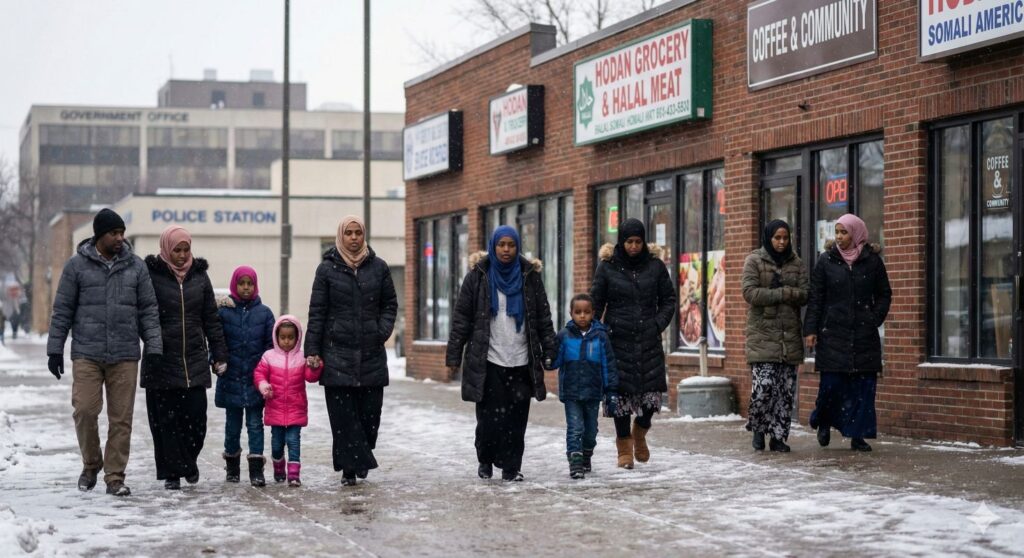
Somali-Americans in Minnesota are used to living under a spotlight, but the past few weeks have turned that spotlight into a harsh floodlight. After a new wave of inflammatory presidential rhetoric and reports of targeted immigration operations in the Twin Cities, the Somali community in Minnesota is living with a renewed sense of fear, anger, and exhaustion.
Community Concerns — Somali community
The Somali community in Minnesota has long been described as one of the state’s success stories, transforming neighborhoods, opening businesses, and sending children to colleges across the country. Minnesota now hosts the largest Somali population in the United States, with tens of thousands of residents reporting Somali ancestry. Most are citizens or permanent residents, with only a small fraction living under temporary or precarious forms of immigration protection. Yet the entire population finds itself under suspicion when the president singles them out in speeches and social media posts.
In late November and early December, the president escalated his attacks, referring to Somali immigrants as “garbage,” claiming they “contribute nothing,” and tying the entire group to isolated fraud cases and crime narratives. Those remarks came alongside promises to “permanently pause” migration from so-called “Third World” countries and a pledge to end key protections for Somali migrants. The message many families heard was simple and chilling: you are not welcome here, no matter how long you have called Minnesota home.
Members of the Somali community say this rhetoric does not stay confined to Washington. It filters into workplaces, schools, and public spaces, where Somali Americans report an uptick in hostile comments, suspicious looks, and online harassment. Parents describe children asking whether they will be forced to “go back,” even if those children were born in Minneapolis or St. Paul and have never set foot in Somalia. Community members who once felt settled now talk about keeping passports in a safe place, reviewing documents, and quietly asking lawyers whether they still “belong” in the country.
Political Climate And Intensifying Enforcement
The fear gripping the Somali community is not just about words. It is about what follows those words.
Federal authorities have reportedly launched immigration enforcement operations focused on Somali immigrants in Minnesota, with ICE agents appearing in immigrant-dense neighborhoods, outside apartment towers, local malls, and even near day-laborer gathering spots. Advocates have documented arrests and detentions during these sweeps, including reports of agents using unmarked vehicles or disguising themselves as rideshare drivers. For residents who already lived through previous waves of enforcement, it feels like history repeating itself, only louder and more brazen this time.
At the same time, the administration has moved to terminate Temporary Protected Status, or TPS, for nationals from Somalia. TPS is a limited program created by Congress that allows people from countries facing war, disaster, or other crises to remain and work legally in the United States. Only a few hundred Somalis in Minnesota rely on TPS, but the decision sends a clear signal that even the smallest humanitarian protections are on the chopping block. For affected families, losing TPS can mean suddenly facing job loss, detention, and deportation to a country many have not seen in decades.
Local leaders have pushed back. The mayors of Minneapolis and St. Paul, along with state and city officials, have condemned the rhetoric and pledged to support Somali residents. Minneapolis has moved to restrict the use of city property for immigration operations, while Saint Paul and other jurisdictions have issued guidance on how residents with uncertain status can seek legal help. Those steps offer some reassurance to the Somali community, but they cannot stop federal agents from operating in the state, and they cannot erase the anxiety that sets in when people hear about dawn raids in a neighboring tower.
From National Talking Point To Local Panic
The immigration debate often treats communities like this as abstractions—numbers on a chart, “flows” at the border, or talking points about crime and public benefits. On the ground, it lands in much more personal ways.
For the Somali community, national talking points become local panic the moment rumors start circulating on WhatsApp and Telegram about vans parked outside known Somali malls or mosque parking lots. Parents share warnings not to open doors without a warrant. Workers exchange advice about which routes to use to avoid police or federal agents. Students swap TikToks explaining what to do if an officer stops them on the way to school.
Rumors spread quickly, and not all of them are accurate. But in a climate where elected leaders scapegoat one specific group by name, even an unverified story can feel plausible enough to change a person’s daily routine. The Somali community ends up living in a constant state of low-level emergency, never sure which alert is real and which is just fear echoing back through the network.
Impact On Daily Life And Mental Health
The impact of this crackdown on everyday life is immediate and pervasive.
Some people in the Somali community are limiting trips outside the home to the essentials—work, groceries, school—while avoiding social gatherings, evening events, or visits to extended family. Community centers report lower attendance at cultural programs and youth activities. Religious leaders say some worshippers are skipping services or changing their schedules to avoid being out after dark, even though attending mosque has always been a core part of their routine.
Schools are also feeling the strain. Teachers and counselors report students who are distracted, anxious, or missing class altogether because their parents fear encounters with immigration authorities on the way to school. Some parents are reluctant to attend conferences or school events where they worry they could be identified or questioned, even if they themselves are citizens or permanent residents. The fear is not always rational, but it is entirely understandable in a climate where the president rails against the Somali community in prime time.
Mental health providers describe a rise in stress symptoms: insomnia, headaches, panic attacks, and a general sense of dread. Many Somali families have already lived through trauma in Somalia or in refugee camps. They rebuilt their lives in Minnesota precisely because it offered stability and safety. Now they feel those foundations shaking. Some describe it as living with “layers” of fear: one layer about the situation back in Somalia, another about the politics in Washington, and a third about whether their neighbors and coworkers still see them as part of the community.
The economic fallout is quieter but real. Business owners in Somali malls and commercial corridors talk about fewer customers and more canceled appointments. Driving for rideshare services, running a home daycare, or working in health care—all common jobs in the Somali community—suddenly involves an extra calculation about risk, visibility, and the possibility of running into law enforcement or federal agents.
Community Resilience, Legal Rights, And Advocacy
Even under this pressure, the Somali community is not simply hunkering down. It is organizing.
Mosques, cultural centers, and advocacy groups are holding “know your rights” trainings that explain what immigration agents can and cannot do, when residents must open the door, and how to respond if a loved one is detained. Legal aid organizations are scrambling to meet demand from families who want to review their paperwork, explore paths to citizenship, or confirm whether they might qualify for asylum, TPS, or other forms of relief.
These efforts are not just technical. They are emotional lifelines. Standing in a crowded community hall, hearing an attorney explain that you have rights and options, can turn paralyzing fear into at least a sense of agency. For parents, having a plan—copies of key documents, emergency contact information, written guardianship arrangements for children—can reduce the constant mental strain of “what if” scenarios.
Young people from the Somali community are stepping up as interpreters, organizers, and storytellers. Some are using social media to counter misinformation about immigration status, while others are documenting stories of contribution: the nurse who worked through the pandemic, the small business owner who employs dozens of local residents, the student heading to a top university. Their message is simple: this community is not a caricature drawn from a campaign rally; it is a complex, rooted part of Minnesota.
Allies outside the Somali community are also getting involved. Faith groups, labor unions, neighborhood associations, and immigrant-rights coalitions are organizing rallies, coordinating rapid-response networks, and pressing local officials to maintain clear boundaries between local policing and federal immigration enforcement. That cross-community support matters, because it signals to Somali Americans that they are not standing alone.
The Limits Of “Good Immigrant” Narratives
At the same time, community leaders are wary of falling into the trap of constantly presenting the Somali community as “model” or “exceptional” just to justify basic rights. They argue that human dignity and legal protections should not depend on perfect behavior or economic productivity. While it is important to highlight positive contributions, it is also important to push back against the idea that one fraud case or one crime story can be used to smear an entire population.
This is where the political and moral stakes of the current moment become clear. If the government can successfully brand one immigrant group as disposable, it becomes easier to target others. Today it is the Somali community; tomorrow it is a different group whose presence becomes politically useful to attack.
What This Moment Means For Minnesota And The Nation
Minnesota likes to see itself as welcoming and pragmatic, a place where new communities can put down roots. The Somali community is one of the clearest examples of that story made real. Since the early 1990s, Somali families have turned former industrial corridors into thriving commercial districts, built mosques alongside churches, and elected representatives at the city, state, and federal levels.
The current crackdown is not just a test of federal power. It is a test of whether that story of shared belonging still holds when it becomes politically costly. For now, state and local officials are mostly saying the right things and taking some concrete steps to resist the harshest federal measures. But the real measure will be whether Somali families, months from now, feel safer, more secure, and more rooted than they do today.
Nationally, this episode lays bare how quickly an administration can weaponize fear against a specific community, using a mix of hostile rhetoric, selective statistics, and targeted enforcement. It also shows how dependent millions of residents are on fragile legal categories—like TPS or discretionary enforcement policies—that can be reshaped or revoked with a single announcement.
For the Somali community in Minnesota, the path forward is uncertain. Yet their response so far—organizing, educating, supporting one another, and refusing to disappear from public life—offers its own quiet form of defiance. In a political environment that treats them as a convenient target, simply staying visible and insisting on their place in Minnesota may be the most powerful statement they can make.
Further Reading
Time: “What to Know About Trump’s Targeting of Somalis in Minnesota”
https://time.com/7337670/somalia-minnesota-fraud-walz-trump-tps-explainer/
Politico: “Country’s Largest Somali Community Shocked by Trump’s Contempt”
https://www.politico.com/news/2025/12/03/countrys-largest-somali-community-shocked-by-trumps-contempt-00676305
MPR News: “Somali Community Responds to Reports of Federal Immigration Crackdown”
https://www.mprnews.org/story/2025/12/03/somali-community-responds-to-reports-of-federal-immigration-crackdown
KSTP: “ICE Starts Operations in Minnesota Targeting Somali Immigrants”
https://kstp.com/kstp-news/top-news/ice-starts-operations-in-minnesota-targeting-somali-immigrants/
Sahan Journal: “ICE Enforcement Actions Rattle Somali Immigrants in Twin Cities”
https://sahanjournal.com/immigration/ice-enforcement-somali-immigrants-minnesota-twin-cities-sweep/
Star Tribune: “Trump’s Threat to Revoke Immigration Protections Alarms Minnesota’s Somali Community”
https://www.startribune.com/minnesota-somali-community-panic-alarm-response-trump-temporary-protected-status-tps/601531756
USCIS: “Temporary Protected Status – Designated Country: Somalia”
https://www.uscis.gov/humanitarian/temporary-protected-status/temporary-protected-status-designated-country-somalia
Connect with the Author
Curious about the inspiration behind The Unmaking of America or want to follow the latest news and insights from J.T. Mercer? Dive deeper and stay connected through the links below—then explore Vera2 for sharp, timely reporting.
About the Author
Discover more about J.T. Mercer’s background, writing journey, and the real-world events that inspired The Unmaking of America. Learn what drives the storytelling and how this trilogy came to life.
[Learn more about J.T. Mercer]
NRP Dispatch Blog
Stay informed with the NRP Dispatch blog, where you’ll find author updates, behind-the-scenes commentary, and thought-provoking articles on current events, democracy, and the writing process.
[Read the NRP Dispatch]
Vera2 — News & Analysis
Looking for the latest reporting, explainers, and investigative pieces? Visit Vera2, North River Publications’ news and analysis hub. Vera2 covers politics, civil society, global affairs, courts, technology, and more—curated with context and built for readers who want clarity over noise.
[Explore Vera2]
Whether you’re interested in the creative process, want to engage with fellow readers, or simply want the latest updates, these resources are the best way to stay in touch with the world of The Unmaking of America—and with the broader news ecosystem at Vera2.
Free Chapter
Begin reading The Unmaking of America today and experience a story that asks: What remains when the rules are gone, and who will stand up when it matters most? Join the Fall of America mailing list below to receive the first chapter of The Unmaking of America for free and stay connected for updates, bonus material, and author news.
