
Vera2, White House & Politics
Speaker Johnson | Republicans Undercut Johnson
Dec
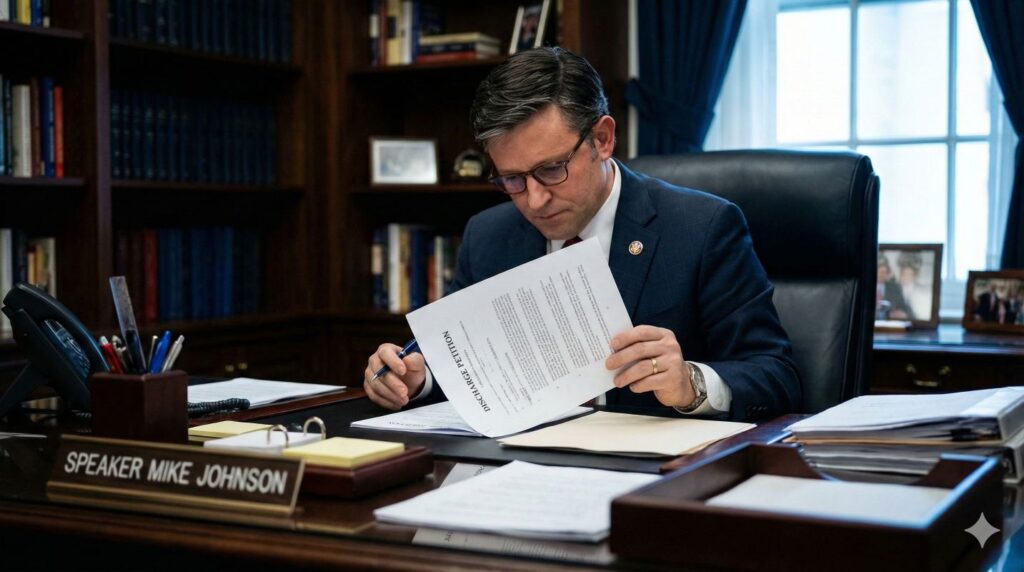
Speaker Johnson authority undercut as House Republicans use discharge petitions to force votes
Speaker Johnson authority is being challenged in a way that does not require a leadership coup, a formal rebellion, or even a public break with the Speaker. Instead, it is being tested through a procedural pressure campaign: House Republicans (often alongside Democrats) using discharge petitions and related floor tactics to force votes that leadership would rather avoid. Speaker Johnson authority traditionally depends on one core advantage: controlling what reaches the House floor, when it reaches the floor, and under what rules it will be debated. The more lawmakers demonstrate they can route around that control, the more Speaker Johnson authority becomes conditional rather than assumed. Reuters+1
This trend intensified in December 2025 as the House moved through a compressed end-of-year calendar and into a politically volatile election year. Reuters reported that Republicans hold a narrow House majority and are increasingly divided between moderates, who want votes on issues that matter in swing districts, and hard-liners, who often resist compromise. That split is pushing members to use discharge petitions as both a governing tool and a signaling device: a way to prove they can deliver outcomes even when leadership will not schedule them. Reuters
Why this matters now: a narrow majority makes Speaker Johnson authority fragile
Speaker Johnson authority is structurally more vulnerable when the majority is small. Reuters reported that Republicans held a 220–213 majority at the time, meaning only a handful of defections can sink a party-line plan. Reuters In that environment, the Speaker needs near-perfect internal coordination to move major legislation. But internal coordination is exactly what a fracturing conference cannot reliably deliver.
Speaker Johnson authority is also vulnerable because some issues create bipartisan “real majorities” that do not align with the majority party’s internal preferences. When that happens, leaders sometimes choose to avoid floor action altogether to prevent a messy vote, protect vulnerable members, or preserve negotiating leverage. A discharge petition exists specifically to break that blockade. The more often members reach for discharge, the more Speaker Johnson authority looks less like command and more like constant triage.
The core maneuver: what a discharge petition is and why it hits Speaker Johnson authority directly
Speaker Johnson authority comes from agenda control, but discharge petitions are designed to weaken agenda control by giving rank-and-file members a formal path to force consideration of a measure even without leadership cooperation.
The Congressional Research Service explains that discharge is “designed to be difficult” and is rarely successful, precisely because it bypasses the committee system and majority-party leadership. CRS notes that it is generally the only procedure by which House members can secure consideration without cooperation from the committee of referral or the majority-party leadership and Rules Committee. Congress.gov+1
Speaker Johnson authority takes a visible blow the moment a discharge effort becomes credible. Even before a petition reaches the threshold needed for floor action, the signatures themselves are a public ledger of defiance. They show which members are willing to step outside leadership’s preferred process, and they convert internal frustration into a measurable threat that grows day by day.
How discharge petitions become a public test of Speaker Johnson authority
Speaker Johnson authority is weakened in three ways when discharge petitions are used aggressively.
First, discharge petitions create an alternative agenda-setting track. The Speaker can still schedule votes, but members can also schedule a confrontation by gathering signatures and letting the process mature.
Second, discharge petitions are public and cumulative. CRS notes that the Clerk updates signatories and publishes information for public inspection. Every CRS Report+1 That transparency means leadership cannot easily bury the conflict, and outside groups can pressure members to sign or not sign.
Third, discharge petitions can create bipartisan governing coalitions that function without leadership sponsorship. Once members learn that a cross-party group can force a vote and win, Speaker Johnson authority is no longer the only route to legislative action.
The clearest recent example: a discharge petition forced a vote on federal worker bargaining rights
Speaker Johnson authority faced a direct, measurable bypass on December 11, 2025, when the House passed legislation to reverse a 2025 executive order by President Donald Trump that restricted collective bargaining rights for many federal workers in national-security-related agencies. The Associated Press reported that the bill reached the floor through a rare bipartisan discharge petition, and that nearly two dozen Republicans joined Democrats to pass it 231–195. AP News+1
Speaker Johnson authority is weakened by outcomes like this because the vote demonstrates a complete workflow that does not depend on leadership approval. Members assembled signatures, forced floor action, and won. Even if leadership attempts to frame it as an exception, it becomes a precedent inside the institution: proof that bypass tactics can succeed.
Speaker Johnson authority also takes reputational damage when discharge becomes the explanation for why a major vote happened at all. The story is no longer “the Speaker moved the House,” but “the House moved despite the Speaker.”
The ACA subsidies fight: discharge petitions as leverage under a deadline
Speaker Johnson authority is also being tested on health policy, where timing pressure amplifies procedural conflict. The Washington Post reported that enhanced Affordable Care Act premium subsidies were nearing expiration at the end of the year and that attention shifted to the House, where multiple discharge petitions were in play to force votes on competing extension proposals. The Washington Post+1
In parallel, Reuters described the ACA subsidy dispute as part of the broader Republican disunity stressing the Speaker’s position, with moderates using discharge petitions to bypass leadership. Reuters The specific legislative outcome is not the only point. The fact that members felt the need to pursue discharge—rather than rely on leadership to schedule action—illustrates why Speaker Johnson authority is being questioned: lawmakers do not believe the normal channels will deliver.
Speaker Johnson authority weakens further when the issue is one that vulnerable members consider politically dangerous to ignore. In those cases, the threat of a forced vote is not just about policy; it is about survival in competitive districts.
Moderates versus hard-liners: why both sides undermine Speaker Johnson authority
Speaker Johnson authority is being squeezed from both directions.
Moderates often want recorded votes on policies they can defend at home—especially health costs, ethics reforms, and “kitchen table” issues. When leadership avoids these votes to protect the conference, moderates may see discharge petitions as the only way to get action.
Hard-liners sometimes undermine Speaker Johnson authority differently: by opposing procedural rules, threatening leadership, or demanding confrontational stances that make it harder for the Speaker to assemble majority votes.
Reuters reported that frustrations with Republican leadership are building as Congress enters an election year, and even raised concerns that a significant number of Republicans could retire before the 2026 elections, which is the kind of internal instability that makes centralized leadership harder. Reuters When members are looking for exits—or looking to protect themselves—they are less responsive to leadership discipline. Speaker Johnson authority suffers because it relies on members valuing the collective project more than their individual incentives.
Why this trend can make the House more chaotic
Speaker Johnson authority is not only about personal power; it is also about making the House legible and governable. When agenda control fragments, the legislative process becomes less predictable and more reactive.
CRS emphasizes that discharge is intentionally difficult and historically rare. Congress.gov+1 When it becomes less rare, it signals that the House is entering a period where members increasingly treat procedure as a weapon rather than a guardrail.
Speaker Johnson authority weakens in practical terms because leadership loses the ability to plan weeks ahead with confidence. If a discharge effort can force floor time, it competes with leadership priorities, complicates negotiations with the Senate, and makes it harder to manage deadlines.
Speaker Johnson authority also declines as a bargaining tool. Traditionally, leadership can trade floor time, amendment opportunities, or committee considerations for loyalty. A credible discharge coalition reduces the value of those trades, because members can attempt to get what they want without leadership permission.
Historical context: discharge was built to be hard for a reason
Speaker Johnson authority exists in part because the modern House is designed to centralize scheduling power. Discharge petitions are the counterweight, but one engineered with friction.
CRS explains that House Rule XV creates the discharge process and that it is generally the only procedure to secure consideration without leadership and Rules Committee cooperation, which is why it is structured to be difficult. Congress.gov+1 That institutional design choice reflects a tradeoff: too-easy discharge would make leadership irrelevant, but too-hard discharge can lock the House into gridlock when leadership refuses to act.
Speaker Johnson authority is now being tested at that pressure point. Members are signaling that the balance has tilted too far toward centralized control—or that leadership is failing to use its control to deliver on issues members consider urgent.
What to watch next for Speaker Johnson authority
Speaker Johnson authority will be shaped by whether discharge petitions remain occasional emergencies or become a routine governing strategy.
If discharge petitions keep reaching the floor successfully, Speaker Johnson authority will erode further because the conference will learn that bypassing leadership is not only possible but repeatable. If discharge petitions stall, Speaker Johnson authority may rebound, but the damage is still real: the willingness to challenge the Speaker publicly has already been demonstrated.
Also watch the interaction between discharge efforts and the legislative calendar. When deadlines are near—expiring programs, fiscal cliffs, or politically salient year-end fights—members have more incentive to force action. The Washington Post reporting on ACA subsidies highlights how deadlines convert internal debates into procedural warfare. The Washington Post+1
Finally, watch whether leadership tries to preempt discharge by scheduling votes earlier or offering structured alternatives. If the Speaker starts bringing issues to the floor specifically to prevent discharge petitions from maturing, that is an implicit acknowledgment that Speaker Johnson authority is being constrained by member-driven pressure.
Bottom Line
Speaker Johnson authority is being undercut by House Republicans increasingly willing to use discharge petitions and related parliamentary moves to force floor votes without leadership’s blessing. Recent events show that these tactics are no longer merely symbolic; they can produce real outcomes, including major bipartisan votes that bypass the Speaker’s preferred process. As long as the Republican majority remains narrow and the conference remains divided, Speaker Johnson authority is likely to be contested not through speeches, but through signatures and procedure.
Further Reading
House discharge procedure overview (Congressional Research Service): https://www.congress.gov/crs-product/R45920
Associated Press on the discharge petition vote restoring federal worker bargaining rights: https://apnews.com/article/1bbd71bb6236aa2ff2c3b816e54327a1
Reuters on Republican disunity and discharge petitions testing Johnson’s grip: https://www.reuters.com/legal/litigation/republican-disunity-tests-johnsons-grip-power-congress-enters-election-year-2025-12-12/
Washington Post on bipartisan discharge petitions around ACA subsidy extension: https://www.washingtonpost.com/politics/2025/12/10/bipartisan-effort-extend-aca-subsidies/
Reuters on the bipartisan push to ban lawmaker stock trading and efforts to force votes: https://www.reuters.com/sustainability/boards-policy-regulation/push-is-us-congress-impose-ban-lawmaker-stock-trades-2025-12-03/
Connect with the Author
Curious about the inspiration behind The Unmaking of America or want to follow the latest news and insights from J.T. Mercer? Dive deeper and stay connected through the links below—then explore Vera2 for sharp, timely reporting.
About the Author
Discover more about J.T. Mercer’s background, writing journey, and the real-world events that inspired The Unmaking of America. Learn what drives the storytelling and how this trilogy came to life.
[Learn more about J.T. Mercer]
NRP Dispatch Blog
Stay informed with the NRP Dispatch blog, where you’ll find author updates, behind-the-scenes commentary, and thought-provoking articles on current events, democracy, and the writing process.
[Read the NRP Dispatch]
Vera2 — News & Analysis
Looking for the latest reporting, explainers, and investigative pieces? Visit Vera2, North River Publications’ news and analysis hub. Vera2 covers politics, civil society, global affairs, courts, technology, and more—curated with context and built for readers who want clarity over noise.
[Explore Vera2]
Whether you’re interested in the creative process, want to engage with fellow readers, or simply want the latest updates, these resources are the best way to stay in touch with the world of The Unmaking of America—and with the broader news ecosystem at Vera2.
Free Chapter
Begin reading The Unmaking of America today and experience a story that asks: What remains when the rules are gone, and who will stand up when it matters most? Join the Fall of America mailing list below to receive the first chapter of The Unmaking of America for free and stay connected for updates, bonus material, and author news.
