
Vera2, AI and Technology
Steam Machine: Valve’s New Console Is a Game Changer for PC Gaming
Nov
Steam Machine: Valve’s New Console: A Game Changer for PC Gaming
Valve is taking another swing at the living room. A decade after the first wave of Linux-based boxes fizzled, the company has announced a new Steam Machine [1] that is explicitly designed to sit under the TV, run SteamOS, and go head-to-head with the latest Xbox and PlayStation hardware. Early previews suggest a compact mini-PC that behaves like a console, promising roughly six times the performance of a Steam Deck and targeting 4K gaming at 60 frames per second with AMD’s FSR upscaling.Tom’s Guide+1
For PC players who want console simplicity without giving up their Steam libraries, the new Steam Machine [2] is being framed as the missing link. It is a small, quiet box that speaks native SteamOS, understands controllers out of the gate, and is tuned for the living room rather than the desk. That makes it a direct challenge to Sony and Microsoft, but it also raises a bigger question: can Valve finally deliver the seamless couch experience it has been chasing for over a decade?
What exactly is Valve’s new Steam Machine?
The latest Steam Machine [3] is not a vague “partner PC” initiative like the original 2013 program. This time, Valve itself is building a standard reference console with fixed specs. According to hands-on reports and spec sheets, the system uses a semi-custom AMD APU based on Zen 4 CPU cores and RDNA 3 graphics, paired with 16 GB of DDR5 memory and additional dedicated GDDR6 for the GPU.Tom’s Guide+2TechRadar+2 Storage options range from a 512 GB NVMe SSD to a 2 TB model, with room to expand via microSD. Networking is handled by Wi-Fi 6E and Bluetooth 5.3, and there is a full spread of HDMI and USB ports for both TV and desktop setups.Tom’s Guide+1
At the software level, the Steam Machine [4] runs SteamOS, Valve’s gaming-focused Linux distribution that already powers the Steam Deck and now a growing ecosystem of third-party handhelds.Wikipedia+2Polygon+2 SteamOS boots straight into a controller-friendly interface similar to Big Picture Mode, giving the system the feel of a console rather than a traditional PC. Players see their library, store, friends list, and quick settings laid out for couch use, and they never have to touch a desktop unless they choose to.
SteamOS, Proton, and compatibility
SteamOS 3 uses Valve’s Proton compatibility layer to run a large share of Windows games on Linux with little or no tweaking. On the Steam Deck, that has already translated into tens of thousands of titles marked as Verified or Playable.Wikipedia+2The Verge+2 Valve plans to reuse that data for the new Steam Machine [5], adding specific badges that indicate whether a game is “SteamOS Compatible” on the new console. For most users, that should mean they can log in, install their favorite titles, and start playing without worrying about manual Proton installs or arcane launch options.
Bridging PC and console gaming
Valve has been inching toward the living-room PC idea for years. Big Picture Mode, Steam Link, and then the Steam Deck were all attempts to make PC gaming feel less like a workstation task and more like a laid-back console experience.Steam Store+2Steam Support+2 The latest Steam Machine [6] is the first time all those threads have been pulled together into a single, dedicated device.
For players used to consoles, the selling point is straightforward. Instead of juggling a separate gaming PC, cables, and a finicky streaming box, a Steam Machine can live next to a TV, wake with a button press on the new Steam Controller, and resume games in seconds.Tom’s Guide+2GamesHub+2 For existing PC gamers, the attraction is the opposite: they can keep the flexibility of a PC ecosystem, including mods and indie titles, while enjoying plug-and-play living-room simplicity.
Performance goals in the living room
Valve staffers have repeatedly talked about a simple target: 4K resolution at 60 fps for most modern games, with help from AMD’s FSR upscaling where needed.Digital Foundry+2TweakTown+2 Early testing from outlets like Digital Foundry suggests that in many titles the Steam Machine [7] can match or even edge out the Xbox Series X when tuned for upscaled 4K, though it will not brute-force native 4K in the most demanding releases.Digital Foundry+1
That makes the system less of a raw power monster and more of a carefully balanced console-PC hybrid. Valve appears to be banking on good-enough visuals, quiet cooling, and seamless suspend-and-resume behavior being more important than chasing the highest benchmark numbers.
Market implications and competition
The new Steam Machine [8] arrives in a console market that is shifting under everyone’s feet. PS5 hardware is maturing, an upgraded PS5 Pro is looming, and Microsoft is under pressure to justify the future of Xbox hardware at all.GamesHub+2GamesRadar++2 Into that landscape walks a device that is, on paper, less rigid than a console and less intimidating than a full PC.
Analysts note that if Valve can hold the Steam Machine near the rumored 700–800 dollar price range, it could undercut many prebuilt gaming PCs while offering a much neater living-room package.Tom’s Guide+1 Unlike Sony and Microsoft, Valve also takes a PC-like approach to its store: frequent discounts, regional pricing, and no platform fees for developers who sell elsewhere. That existing ecosystem is a major advantage.
The risk is that Valve has been here before. The original Steam Machines split across multiple vendors, failed to hit compelling price-performance points, and quietly disappeared from marketing pages by 2018.Wikipedia+1 The company insists that this time is different, arguing that the Steam Deck proved there is demand for dedicated SteamOS hardware and that Proton and Deck-based compatibility data solve problems that doomed the first attempt.
Features, design, and ecosystem advantages
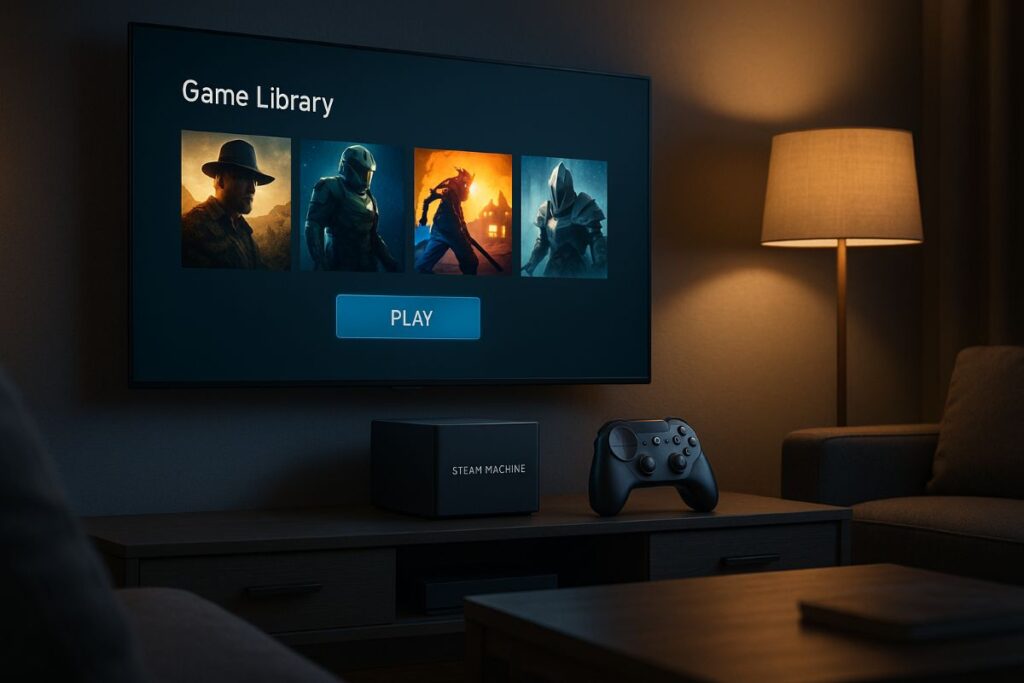
Hands-on reports describe the Steam Machine [9] as a compact cube with a minimalist front panel and a focus on thermals. Valve engineers have openly bragged about the amount of computational fluid dynamics work that went into the cooling system, emphasizing near-silent operation at living-room distances.The Verge+1
The new Steam Controller is central to the pitch. It combines traditional analog sticks with upgraded trackpads, gyro aiming, and advanced haptics, all tightly integrated with Steam Input.Tom’s Hardware+2GamesHub+2 That lets the Steam Machine behave like a console in the living room while still supporting keyboard-like precision for genres that historically avoided controllers.
Because the system is still, at heart, a PC running SteamOS, it brings a handful of advantages the closed consoles cannot match. Players can install mods from the Steam Workshop, side-load non-Steam apps, and even drop to a full Linux desktop for traditional computing tasks.Wikipedia+2TechRadar+2 That flexibility might not matter to someone who only plays big yearly releases, but it will matter to tinkerers, indie fans, and creators.
Consumer reception and early skepticism
The initial wave of coverage has been cautiously optimistic. Opinion pieces from mainstream tech outlets argue that for many players the Steam Machine [10] could finally replace a bulky gaming tower, especially as living-room TVs take over from desk monitors.Windows Central+2TechRadar+2 Social media reactions, though, tell a more fragmented story. Some PC loyalists are unhappy about the use of upscaling and a mid-range GPU rather than a top-tier card, while others worry about anti-cheat compatibility for competitive multiplayer titles on Linux.PC Gamer+2TweakTown+2
Valve is leaning heavily on its Deck-era community playbook: public compatibility lists, open conversations with developers, and regular SteamOS updates that improve performance and accessibility.The Verge+2The Verge+2 If the company can keep that momentum and respond quickly to early complaints, the Steam Machine has a chance to build trust in a way the first generation never did.
Challenges and open questions
There are still real unknowns. Pricing is not final, and even an 800 dollar launch point would place the Steam Machine [11] above the effective street price of a PS5 or Xbox Series X in many regions.Tom’s Guide+2Kotaku+2 SteamOS has matured, but some high-profile games still rely on anti-cheat systems that do not play nicely with Proton. Cloud gaming and game-subscription competitors, from GeForce Now to Game Pass, are also fighting for the same living-room hours.
Long-term support is another concern. Valve’s history is full of brilliant products that quietly faded once internal priorities shifted. Fans still point to the original Steam Link box and the first Steam Controller as examples. The company insists that the Steam Deck, Steam Frame headset, and Steam Machine [12] are all part of a unified hardware roadmap, but the proof will be measured in years of updates, not launch-day promises.Windows Central+2The Verge+2
Bottom line
For all the caveats, it is hard to deny that the new Steam Machine [13] is one of the most interesting pieces of gaming hardware on the horizon. It tries to merge the openness of PC gaming with the convenience of a console, backed by a massive existing store, a mature Linux-based OS, and lessons learned from the Steam Deck experiment. If Valve can hit the right price, sustain long-term support, and keep compatibility strong, this compact box could seriously challenge the traditional console duopoly and redefine what “PC gaming in the living room” actually means.
If, on the other hand, pricing creeps up, anti-cheat problems linger, or Valve loses interest, the Steam Machine risks becoming another intriguing footnote in the company’s long list of experiments. For now, though, it looks like a genuine game changer—and a very real warning shot across the bows of Sony and Microsoft.
Further Reading
PC Gamer explains why Valve’s new Steam Machine could be a SteamOS-powered mini PC that finally realizes the original vision, with performance six times higher than a Steam Deck and full living-room focus: https://www.pcgamer.com/hardware/gaming-pcs/steam-machine-specs-availability/ PC Gamer+1
Tom’s Hardware offers a hands-on look at how the Steam Machine and new Steam Controller bring SteamOS to the living room with 4K 60 fps ambitions and a semi-custom AMD APU: https://www.tomshardware.com/video-games/console-gaming/valve-brings-back-steam-machine-and-steam-controller-hands-on-with-valves-new-amd-based-living-room-gaming-hardware Tom’s Hardware+1
Digital Foundry dives into performance targets for the Steam Machine, including 4K60 gameplay with FSR and how the cooling design keeps the compact box quiet: https://www.digitalfoundry.net/features/hands-on-with-steam-machine-valves-new-pcconsole-hybrid Digital Foundry+1
The Verge and GamesRadar trace the history and revival of Steam Machines, from the failed 2013 initiative to Valve’s renewed console push for 2026: https://www.theverge.com/games/819080/valve-brings-back-steam-machines-steam-os-steam-frame-news-announcements and https://www.gamesradar.com/hardware/desktop-pc/ten-years-later-the-steam-machine-is-officially-back-and-it-might-steal-your-consoles-lunch-money/ The Verge+1
The SteamOS overview page describes the Linux distribution that powers the Steam Deck and the new Steam Machine, including Proton compatibility and console-style Gaming Mode: https://store.steampowered.com/steamos Steam Store+1
Connect with the Author
Curious about the inspiration behind The Unmaking of America or want to follow the latest news and insights from J.T. Mercer? Dive deeper and stay connected through the links below—then explore Vera2 for sharp, timely reporting.
About the Author
Discover more about J.T. Mercer’s background, writing journey, and the real-world events that inspired The Unmaking of America. Learn what drives the storytelling and how this trilogy came to life.
[Learn more about J.T. Mercer]
NRP Dispatch Blog
Stay informed with the NRP Dispatch blog, where you’ll find author updates, behind-the-scenes commentary, and thought-provoking articles on current events, democracy, and the writing process.
[Read the NRP Dispatch]
Vera2 — News & Analysis
Looking for the latest reporting, explainers, and investigative pieces? Visit Vera2, North River Publications’ news and analysis hub. Vera2 covers politics, civil society, global affairs, courts, technology, and more—curated with context and built for readers who want clarity over noise.
[Explore Vera2]
Whether you’re interested in the creative process, want to engage with fellow readers, or simply want the latest updates, these resources are the best way to stay in touch with the world of The Unmaking of America—and with the broader news ecosystem at Vera2.
Free Chapter
Begin reading The Unmaking of America today and experience a story that asks: What remains when the rules are gone, and who will stand up when it matters most? Join the Fall of America mailing list below to receive the first chapter of The Unmaking of America for free and stay connected for updates, bonus material, and author news.
