
Vera2, Elections & Voting
Supreme Court Decision on Texas Redistricting Maps
Dec
Supreme Court Decision on Texas Redistricting Maps
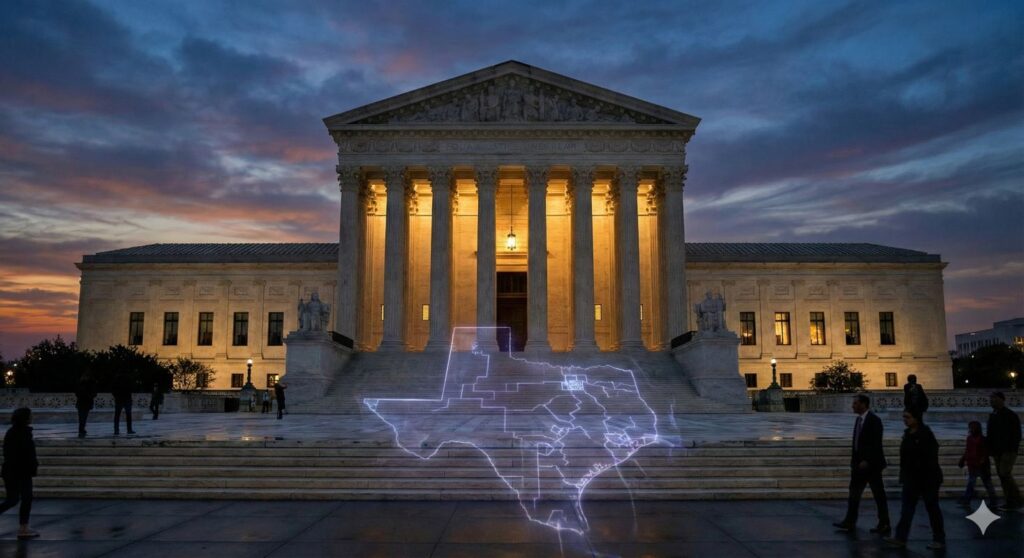
The Supreme Court’s latest ruling on Texas Redistricting Maps is more than a procedural tweak to election law. It is a hard shove in favor of a congressional map engineered to lock in Republican power, even after a lower court found it likely relied on race to achieve partisan goals. By granting Texas officials permission to use the new lines in the 2026 midterm elections, the Court has signaled once again that it is willing to tolerate extreme gerrymanders so long as states can plausibly rebrand them as “politics, not race.” The Washington Post+3AP News+3The Guardian+3
Background of the Case — Texas Redistricting Maps
The fight over Texas Redistricting Maps intensified after Republican lawmakers pushed through a mid-decade redraw in 2025 at the urging of Donald Trump and state party leaders. The new plan was designed to transform a competitive delegation into a lopsided one, giving Republicans control of roughly 30 of the state’s 38 U.S. House seats and potentially flipping as many as five districts that previously leaned Democratic. Texas officials insisted the revisions merely reflected population changes and shifting political preferences, but the timing and configuration of the districts told a different story. The Texas Tribune+3The Guardian+3Reuters+3
Civil rights organizations, Latino voter groups, and Democratic-aligned plaintiffs quickly sued, arguing that the 2025 Texas Redistricting Maps were an unconstitutional racial gerrymander that diluted the power of Black and Latino voters in violation of the Constitution and Section 2 of the Voting Rights Act. A three-judge federal panel in El Paso agreed, finding that the legislature had predominantly used race to sort voters while offering only thin partisan explanations for the new lines. The court blocked the map and ordered the state to revert to its 2021 configuration for the 2026 elections while the case proceeded on the merits. The Texas Tribune+2All About Redistricting+2
Texas appealed immediately. Governor Greg Abbott, Attorney General Ken Paxton, and other state defendants asked the Supreme Court for emergency relief, warning that forcing a late switch away from the new Texas Redistricting Maps would create chaos for candidates, election officials, and voters. They leaned heavily on the Court’s own Purcell principle, which discourages federal courts from changing election rules close to an election, and framed the lower court’s injunction as an overreach that substituted judges’ views for the judgment of elected legislators. SCOTUSblog+3Supreme Court+3Supreme Court+3
Legal Arguments and the Court’s Reasoning
This case sits at the intersection of several lines of Supreme Court doctrine: racial gerrymandering, partisan gerrymandering, and emergency “shadow docket” relief. The plaintiffs argued that the 2025 Texas Redistricting Maps dismantled minority coalition districts, packed and cracked Latino communities, and ignored the explosive growth of nonwhite Texans revealed in the 2020 census. They pointed to districts where Latino voters had previously elected candidates of their choice, only to see those communities carved up or submerged in heavily white, Republican-leaning districts. Brennan Center for Justice+3The Texas Tribune+3MALDEF+3
Texas countered that map-drawing always involves political choices and that the legislature was entitled to pursue partisan advantage so long as race was not the “predominant factor.” State lawyers insisted that the mapmakers relied primarily on past election results, not racial data, and pointed to a modest increase in nominally Black- or Hispanic-majority districts as proof that the maps were not racially discriminatory. AP News+2Reuters+2
In a brief, unsigned order, the Supreme Court sided with Texas and allowed the new Texas Redistricting Maps to be used while the legal fight continues. The majority criticized the lower court for second-guessing the legislature’s motives and for ordering a disruptive remedy so close to the 2026 election cycle. Echoing recent decisions, the Court suggested that partisan considerations can explain most of the challenged lines and that, absent clear proof that race trumped politics, federal courts should be reluctant to block a state’s chosen map on an emergency basis. SCOTUSblog+2AP News+2
Justice Elena Kagan, joined by the Court’s two other liberals, dissented sharply. She emphasized that the district court had held a full trial, made detailed factual findings that race predominated in key districts, and concluded that Texas had no adequate justification. To her, the majority’s willingness to brush aside those findings and green-light the Texas Redistricting Maps amounted to a quiet but decisive weakening of protections for minority voters. The Guardian+2The Washington Post+2
Implications for Texas Voters and Representation
The immediate consequence of the ruling is clear: the 2026 midterms in Texas will be run under a set of Texas Redistricting Maps deliberately crafted to maximize Republican seats. Analyses by independent experts suggest that Republicans could secure 30 or more of the state’s 38 House seats, even if they win only a slim majority of the statewide popular vote. That kind of seat bonus is the textbook definition of an effective gerrymander. The Texas Tribune+2AP News+2
For communities of color, the stakes are even higher. Nearly all of Texas’s population growth over the last decade came from Black, Latino, and Asian residents, yet the new Texas Redistricting Maps create only a token increase in majority-minority districts while eliminating several urban and suburban coalition districts where multiracial electorates had begun electing Democrats. Voting-rights advocates warn that the practical effect is to freeze minority political power at a level well below those communities’ share of the population, locking in underrepresentation for another decade. The Texas Tribune+2MALDEF+2
The ruling also sends a message to Texas voters who hoped the courts might curb the most extreme excesses of partisan map-drawing. After this decision, the path to change will be steeper. It will require either sustained grassroots organizing that can overcome the tilted playing field or a political earthquake large enough to break through even the most carefully engineered districts.
National Impact and the Future of Gerrymandering
The Supreme Court’s decision does not exist in a vacuum. It arrives in the middle of a nationwide arms race over congressional maps, with Republican-controlled states like Texas, North Carolina, and Missouri pushing aggressive mid-decade redraws while Democratic-leaning states explore their own hardball tactics. The ruling on Texas Redistricting Maps will be read by legislators everywhere as a green light to use redistricting for raw partisan gain so long as they maintain plausible deniability about racial motives. Reuters+2The Guardian+2
Since the Court’s 2019 ruling in Rucho v. Common Cause declared partisan gerrymandering claims nonjusticiable in federal court, the only remaining federal constraints on extreme maps have come from racial discrimination claims under the Constitution and the Voting Rights Act. By accepting Texas’s argument that the new lines are driven primarily by partisanship, even in the face of detailed findings to the contrary, the majority has made it easier for states to launder racial gerrymanders through the language of politics. Brennan Center for Justice+2All About Redistricting+2
The Texas case also fits into the Court’s broader trend of using emergency orders to reshape election law without full briefing or argument. Voting-rights groups point out that the practical effect of letting the Texas Redistricting Maps stand for 2026 is to hand Republicans a significant advantage in a closely divided U.S. House, all through an unsigned opinion that may never result in a full merits ruling before the decade’s elections are over. SCOTUSblog+2AP News+2
Political and Advocacy Reactions
Reactions to the decision have broken along familiar partisan lines. Texas Republicans and Trump allies celebrated the ruling as a vindication of their strategy and a win for what they describe as state control over elections. They argue that the Texas Redistricting Maps simply reflect where voters actually live and how they actually vote, and they accuse the lower court of trying to rig the process for Democrats. AP News+2Reuters+2
Democrats, civil rights leaders, and voting-rights organizations see something very different. Groups like MALDEF and LULAC, which helped bring the challenges, describe the ruling as a license for states to draw Texas Redistricting Maps that entrench white and Republican power while reducing Latino and Black communities to permanent second-class status. They are vowing to continue litigating under the Voting Rights Act, to pursue parallel challenges in state courts where constitutions sometimes provide stronger protections, and to press for federal legislation that would set basic national standards for fair maps. MALDEF+2LULAC+2
The decision has also reinvigorated calls for structural reforms such as independent redistricting commissions. States like Arizona, Michigan, and Colorado have already moved to take map-drawing power out of partisan hands, with mixed but generally better results than pure legislative control. Voting-rights advocates now point to the Texas Redistricting Maps as Exhibit A in the argument that leaving redistricting to self-interested politicians will always end in manipulation and minority rule. Brennan Center for Justice+1
What Comes Next for Texas Redistricting Maps
Legally, the case is not over. The Supreme Court has only stayed the lower court’s injunction; it has not issued a final ruling on whether the 2025 Texas Redistricting Maps violate the Constitution or the Voting Rights Act. The three-judge panel will continue to develop the record and could ultimately issue a permanent injunction, which would then return to the high court on a full appeal. Supreme Court+2The Texas Tribune+2
Practically, however, the damage is done for at least one election cycle. Once candidates, parties, donors, and national campaign committees adjust to the new district lines, the Texas Redistricting Maps will shape not only who wins, but which issues get attention, how campaigns allocate resources, and which communities see their concerns taken seriously.
If Republicans retain or expand their narrow House majority in 2026, the Texas maps will be one of the reasons. If Democrats manage to claw back seats despite the gerrymander, it will only be after fighting uphill in districts designed to deny them a fair share of representation.
Bottom Line
The Supreme Court’s decision on Texas Redistricting Maps is a turning point in the post-Rucho redistricting wars. By allowing a mid-decade, pro-Republican map that a lower court found likely racially discriminatory to go into effect, the Court has made clear that it will tolerate extreme partisan engineering so long as states can cloak it in the language of politics. For Texas voters—especially voters of color—that means another decade in which the lines on the map, rather than the voters themselves, play an outsized role in deciding who holds power. The Washington Post+3AP News+3The Guardian+3
For the rest of the country, Texas is now a template. Unless Congress steps in or more states adopt independent commissions, the lesson lawmakers will draw from this ruling is simple: if you control the pen, you control the map—and if you say it is “just politics,” the Supreme Court is increasingly willing to look the other way.
Further Reading
Associated Press: “Supreme Court allows Texas to use a congressional map favorable to Republicans in 2026”
https://apnews.com/article/supreme-court-redistricting-texas-trump-02b07b477b153f23ed5c387f2f9ae0c4 AP News
The Guardian: “US supreme court approves redrawn Texas congressional maps”
https://www.theguardian.com/us-news/2025/dec/04/us-supreme-court-texas-congressional-maps The Guardian
Reuters: “Supreme Court revives pro-Republican Texas voting map sought by Trump”
https://www.reuters.com/world/us-supreme-court-revives-pro-republican-texas-voting-map-2025-12-04/ Reuters
Washington Post: “Supreme Court hands Trump victory in fight over Texas congressional map”
https://www.washingtonpost.com/politics/2025/12/04/texas-redistricting-map-supreme-court/ The Washington Post
SCOTUSblog: “Supreme Court allows Texas to use redistricting map challenged as racially discriminatory”
https://www.scotusblog.com/2025/12/supreme-court-allows-texas-to-use-redistricting-map-challenged-as-racially-discriminatory/ SCOTUSblog
Texas Tribune: “Supreme Court lets Texas keep new congressional map while legal battle continues”
https://www.texastribune.org/2025/12/04/texas-redistricting-map-us-supreme-court-2026-midterms/ The Texas Tribune
MALDEF: “Statement on Supreme Court order allowing new Texas redistricting maps to be used for 2026”
https://www.maldef.org/2025/12/maldef-statement-on-supreme-court-order-allowing-new-texas-redistricting-maps-to-be-used-for-2026/ MALDEF
Democracy Docket: “Texas Redistricting Challenge (LULAC v. Abbott)”
https://www.democracydocket.com/cases/texas-redistricting-challenge-lulac/ Democracy Docket
Brennan Center: “Redistricting Litigation Roundup”
https://www.brennancenter.org/our-work/research-reports/redistricting-litigation-roundup-0 Brennan Center for Justice
Connect with the Author
Curious about the inspiration behind The Unmaking of America or want to follow the latest news and insights from J.T. Mercer? Dive deeper and stay connected through the links below—then explore Vera2 for sharp, timely reporting.
About the Author
Discover more about J.T. Mercer’s background, writing journey, and the real-world events that inspired The Unmaking of America. Learn what drives the storytelling and how this trilogy came to life.
[Learn more about J.T. Mercer]
NRP Dispatch Blog
Stay informed with the NRP Dispatch blog, where you’ll find author updates, behind-the-scenes commentary, and thought-provoking articles on current events, democracy, and the writing process.
[Read the NRP Dispatch]
Vera2 — News & Analysis
Looking for the latest reporting, explainers, and investigative pieces? Visit Vera2, North River Publications’ news and analysis hub. Vera2 covers politics, civil society, global affairs, courts, technology, and more—curated with context and built for readers who want clarity over noise.
[Explore Vera2]
Whether you’re interested in the creative process, want to engage with fellow readers, or simply want the latest updates, these resources are the best way to stay in touch with the world of The Unmaking of America—and with the broader news ecosystem at Vera2.
Free Chapter
Begin reading The Unmaking of America today and experience a story that asks: What remains when the rules are gone, and who will stand up when it matters most? Join the Fall of America mailing list below to receive the first chapter of The Unmaking of America for free and stay connected for updates, bonus material, and author news.
