
Vera2, Elections & Voting
Trump Border Wall | Trumps All-but-forgotten Border Wall
Nov
Trump’s Border Wall Construction Resurfaces in Laredo
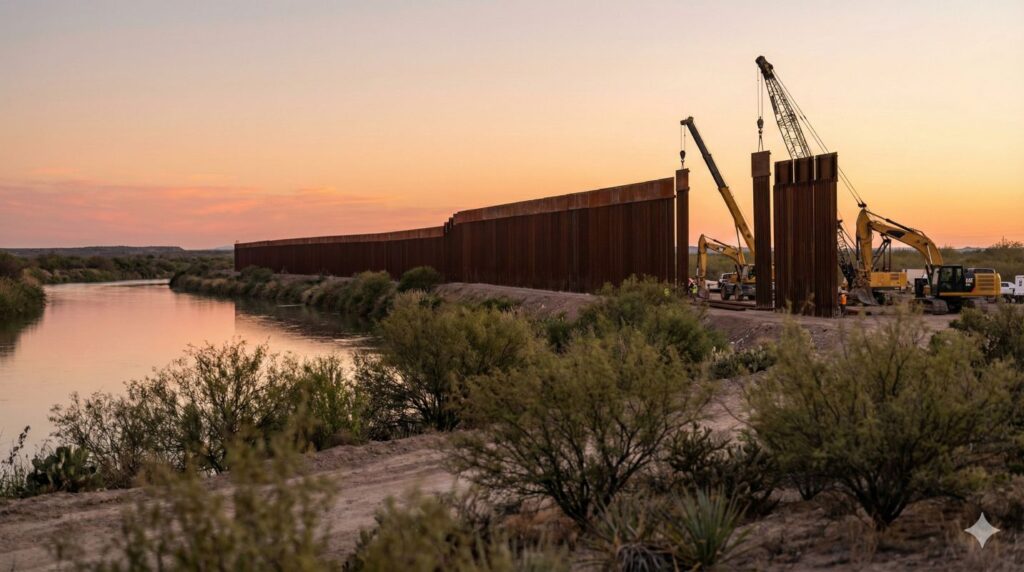
The Trump border wall was supposed to be yesterday’s fight, replaced by talk of mass deportations, razor wire, and floating barriers in the Rio Grande. Instead, the Trump border wall is back at the center of U.S. immigration politics, and nowhere is that more visible than in Laredo, Texas, where new money, new construction, and old wounds are colliding along the riverbank.
With Congress channeling tens of billions of dollars into border infrastructure and enforcement, including a massive $46.5 billion tranche earmarked specifically for wall upgrades and expansion, the Trump border wall has gone from stalled project to revived flagship policy. For Laredo, that means fresh construction activity along the Rio Grande, fresh pressure from state and federal officials, and a renewed political fight over what “security” actually means in a region that has never seen itself as a war zone.
A New Phase for the Trump Border Wall in Laredo
The latest funding surge for the Trump border wall is part of a broader Republican push to “supercharge” immigration enforcement through a mix of physical barriers, expanded detention, and a larger enforcement bureaucracy. Congress has now committed an unprecedented pool of money for the wall and related infrastructure, far beyond what was allocated in Trump’s first term, signaling that this is not a symbolic gesture but a deliberate attempt to finish and harden large stretches of the U.S.–Mexico border.
Laredo, a city that has long framed itself as a binational community rather than a fortified line, was dragged back into the center of this battle even before the new federal money landed. Local officials and residents have repeatedly pushed back against both federal and state wall plans, rejecting easements and protesting proposed barrier routes running near neighborhoods, cultural sites, and sensitive riverfront land. Despite that, new federal contracts are beginning to move forward in the Laredo sector, with engineering crews surveying sites and staging materials on tracts along the Rio Grande.
The Trump border wall in this new phase is not just a single line in the desert. It is an overlapping web of federal sections, state-funded segments promoted by Texas Governor Greg Abbott, and related infrastructure like patrol roads, lighting, and surveillance systems. In the Laredo area, Texas has already advanced its own wall projects near the Colombia Bridge, leasing land from the city and planning additional miles of barrier even as crossings in the sector remain comparatively low. The new federal push slots directly into that framework and raises the stakes for local communities.
How the New Funding Changes the Trump Border Wall Strategy
The Trump border wall in its first iteration was defined by legal fights, emergency declarations, and improvised funding maneuvers. Between 2017 and 2020, the administration cobbled together roughly $18 billion for barrier construction, much of it by reprogramming Pentagon and Treasury funds after Congress refused to fully back Trump’s requests. It produced a patchwork wall, with some heavily fortified sectors and other stretches left untouched.
The new $46.5 billion allocation is different in both scale and structure. It arrives as a direct, multi-year commitment to build out the Trump border wall and upgrade older segments, coupled with separate funding for more agents, more checkpoints, and more detention capacity. For planners, that means less improvisation and more ability to plan continuous segments of barrier, including through parts of South Texas that were previously tied up in court or local politics.
In Laredo, this shift translates into faster timelines and fewer practical escape hatches for local officials. Instead of asking whether a given project will be funded at all, the question now is where exactly Trump border wall segments will run, which parcels will be condemned or leased, and how aggressively federal agencies will waive environmental and cultural protections to hit construction targets. We have already seen the Department of Homeland Security waive major federal environmental laws to speed construction in other parts of the Rio Grande corridor, a pattern that is now being extended further upriver.
Local Reactions in Laredo: Security, Culture, and the Rio Grande
Laredo’s reaction to the revived Trump border wall is fractured but not confused. Residents know this fight; they have been through versions of it for years.
On one side, some local business owners, law-and-order voters, and officials argue that the Trump border wall is a necessary “backstop” against smuggling and unauthorized crossings, even if current migration numbers in the sector are relatively low. They see the wall as part of a broader suite of tools, alongside more agents and better technology, that they believe will deter crime and reassure anxious constituents.
On the other side, a broad coalition of residents, activists, and civic leaders has consistently argued that a wall in Laredo is unnecessary, counterproductive, and deeply disrespectful to a community that sees its identity as intertwined with Mexico. Public hearings and council meetings over the past few years have been dominated by residents denouncing wall plans as an insult to their culture and a threat to public lands and riverfront access. The removal of a “Defund the Wall” mural under threat of losing state road funds became a symbol of how state and federal pressure can override local sentiment.
The revived Trump border wall has pulled all of those tensions back to the surface. Town halls now feature familiar arguments: that the wall will “send a message” versus that it will carve up neighborhoods; that it is a “critical barrier” versus that it is a wasteful, performative structure in a sector with relatively low unauthorized crossings. The only real consensus is that Laredo is not driving the agenda; it is reacting to decisions made hundreds or thousands of miles away.
Environmental and Legal Concerns Around the Trump Border Wall
The Rio Grande is not empty scrubland. It is a complex corridor of riparian habitat, ranchlands, wildlife refuges, and small communities that rely on the river for water, recreation, and cultural life. The Trump border wall cuts through that landscape with very little subtlety, and the environmental consequences are significant.
Conservation groups have spent years documenting how border barriers fragment habitat for species like ocelots, jaguars, pronghorns, and migratory birds, severing wildlife corridors across the U.S.–Mexico line. In the Lower Rio Grande Valley, federal agencies have already waived bedrock environmental laws such as the Endangered Species Act and the National Environmental Policy Act to accelerate construction through wildlife refuges, prompting fierce backlash from scientists and local communities who argue that the security benefits are unproven while the ecological damage is permanent.
Laredo sits in the same ecological system, and environmental advocates warn that extending the Trump border wall through its stretch of the Rio Grande will magnify those harms. Barrier segments, access roads, and lighting can alter river hydrology, increase erosion, and disrupt both animal movement and human use of the riverbank. The decision to push the Trump border wall deeper into South Texas is likely to trigger fresh legal challenges from landowners, tribes, and environmental organizations, just as previous rounds of construction did earlier in the Trump era.
From a legal standpoint, the revived funding also raises familiar questions about eminent domain, due process for landowners, and the use of waiver authority to bypass federal protections. With so much money now committed, federal agencies have strong incentives to use every available shortcut, which in turn guarantees more litigation and more mistrust along the border.
National Political Stakes: Why the Trump Border Wall Is Back at Center Stage
The renewed push for the Trump border wall in Laredo is not just about Laredo. It is a national political signal.
For Trump and his allies, the wall is still the most visible physical symbol of their immigration agenda. Even as deportation plans, asylum restrictions, and state-level crackdowns like Texas’ razor-wire operations dominate the headlines, the Trump border wall offers a simple image: steel, concrete, and a line on the map that can be photographed and claimed as proof of action. The new funding lets the administration argue it is finally doing what critics said it never fully accomplished in the first term: finishing the wall.
For Republicans in Congress, backing the Trump border wall remains a convenient way to show they are “serious” about the border while also channeling money into construction, defense contracting, and local law enforcement. The $46.5 billion wall allocation is bundled with tens of billions more for detention, deportation, and staffing, creating a sprawling enforcement package that can be sold as a comprehensive border fix to primary voters.
Democrats and immigration advocates see something very different. To them, the revived Trump border wall represents a misallocation of scarce resources, a distraction from root-cause solutions, and a return to theatrical hardline politics that do little to address the realities of migration driven by violence, poverty, and climate stress in origin countries. They point out that even under the Biden administration, border barriers continued to be built or upgraded in parts of Texas, illustrating how deeply embedded wall politics have become in U.S. policy.
In that sense, the Trump border wall in Laredo is not just a local project; it is a barometer of how far the U.S. is willing to go down the path of fortress-style border policy, and how much pushback border communities can muster against decisions made in Washington and state capitals.
What Comes Next for Laredo and the Trump Border Wall
The trajectory of the Trump border wall in Laredo will depend on three moving pieces: political will in Washington, tactical decisions in Austin, and the persistence of local resistance on the ground.
In Washington, the money is already on the table. Reversing or redirecting $46.5 billion in wall funding would require a major political shift, either through court rulings or a future Congress deciding to claw back or repurpose the funds. For now, the Trump administration has the authority and the budget to keep pushing the Trump border wall deeper into Texas.
In Austin, state leaders are pursuing their own wall projects along the Rio Grande, including near Laredo, often using threats over road funding and other leverage points to pressure local governments into cooperation. That state-level push can either reinforce or complicate federal plans, depending on whether Texas and Washington stay aligned or fall into the kind of legal turf war we have already seen over razor wire and river buoys.
On the ground in Laredo, activists, landowners, and some local officials are preparing for another round of hearings, lawsuits, and public demonstrations. They have successfully stalled or reshaped wall projects before, but they now face a far better-funded and more determined enforcement machine. Whether they can meaningfully slow or reroute the Trump border wall this time will shape not only the physical landscape of the city, but also its sense of agency in the face of federal and state power.
Bottom Line
The resurgence of the Trump border wall in Laredo is not a historical rerun; it is a new chapter in a fight that has become more heavily funded, more complex, and more polarized.
On paper, the case for the Trump border wall is simple: more steel, more cameras, more agents, more security. In practice, what Laredo is experiencing looks more like a collision between national political theater and local reality, where a binational community is told that its riverfront, its neighborhoods, and its wildlife corridor must be rearranged to fit someone else’s talking points.
As the concrete is poured and the lawsuits file in, the real test is whether border security policy can move beyond symbolism. If the Trump border wall in Laredo ends up as another expensive monument to political fear rather than a measured component of a broader, humane strategy, it will confirm what many residents already suspect: that the wall is less about safety than about signaling who gets to draw the line.
Further Reading
American Immigration Council, “What’s in the ‘Big Beautiful Bill’? Immigration & Border Security” – a breakdown of the massive enforcement and border infrastructure package, including tens of billions directed to wall construction and upgrades:
https://www.americanimmigrationcouncil.org/fact-sheet/big-beautiful-bill-immigration-border-security
Congressional Research Service, “DHS Border Barrier Funding Developments: FY2021–FY2024” – a detailed history of how much money Congress has appropriated for border barriers and how those funds have been used:
https://crsreports.congress.gov/product/pdf/R/R47979
The Texas Tribune, “Trump administration plans to build border wall in Laredo” – reporting on local political resistance, city council decisions, and community pushback to proposed wall routes in the Laredo area:
https://www.texastribune.org/2025/11/04/laredo-texas-border-wall-donald-trump/
Laredo Morning Times, “Laredo residents strongly oppose border wall in pleas to City Council” – coverage of public comments from residents citing cultural, environmental, and economic concerns about border wall construction:
https://www.lmtonline.com/local/article/texas-border-culture-public-land-city-council-20204994.php
Inside Climate News / The Texas Tribune, “Environmental laws waived to build border wall in Texas wildlife refuge” – explanation of how the federal government has waived major environmental protections to speed wall construction in the Rio Grande corridor:
https://www.texastribune.org/2025/08/26/texas-rio-grande-border-wall-wildlife-refuge-environmental-law/
Center for Biological Diversity, “No Border Wall” – an overview of the ecological impacts of border barriers on endangered species, migration corridors, and protected lands across the U.S.–Mexico border region:
https://www.biologicaldiversity.org/campaigns/border_wall/
Defenders of Wildlife, “Border Wall” – summary of how border infrastructure threatens species biodiversity, wetlands, and wildlife refuges in the Southwest:
https://defenders.org/wall
Texas Public Radio, “South Texas Residents Continue Fight Against Border Wall Despite COVID-19 Pandemic” – chronicle of protests and legal challenges from Webb and Zapata County residents, including Laredo activists:
https://www.tpr.org/news/2020-07-07/south-texas-residents-continue-fight-against-border-wall-despite-covid-19-pandemic
Connect with the Author
Curious about the inspiration behind The Unmaking of America or want to follow the latest news and insights from J.T. Mercer? Dive deeper and stay connected through the links below—then explore Vera2 for sharp, timely reporting.
About the Author
Discover more about J.T. Mercer’s background, writing journey, and the real-world events that inspired The Unmaking of America. Learn what drives the storytelling and how this trilogy came to life.
[Learn more about J.T. Mercer]
NRP Dispatch Blog
Stay informed with the NRP Dispatch blog, where you’ll find author updates, behind-the-scenes commentary, and thought-provoking articles on current events, democracy, and the writing process.
[Read the NRP Dispatch]
Vera2 — News & Analysis
Looking for the latest reporting, explainers, and investigative pieces? Visit Vera2, North River Publications’ news and analysis hub. Vera2 covers politics, civil society, global affairs, courts, technology, and more—curated with context and built for readers who want clarity over noise.
[Explore Vera2]
Whether you’re interested in the creative process, want to engage with fellow readers, or simply want the latest updates, these resources are the best way to stay in touch with the world of The Unmaking of America—and with the broader news ecosystem at Vera2.
Free Chapter
Begin reading The Unmaking of America today and experience a story that asks: What remains when the rules are gone, and who will stand up when it matters most? Join the Fall of America mailing list below to receive the first chapter of The Unmaking of America for free and stay connected for updates, bonus material, and author news.
