
Vera2, Economy & Labor
Trump economy: Trump’s Defense Collides With Persistent Affordability Concerns
Dec
Trump economy: Trump’s Economic Defense Faces an Affordability Reality Check
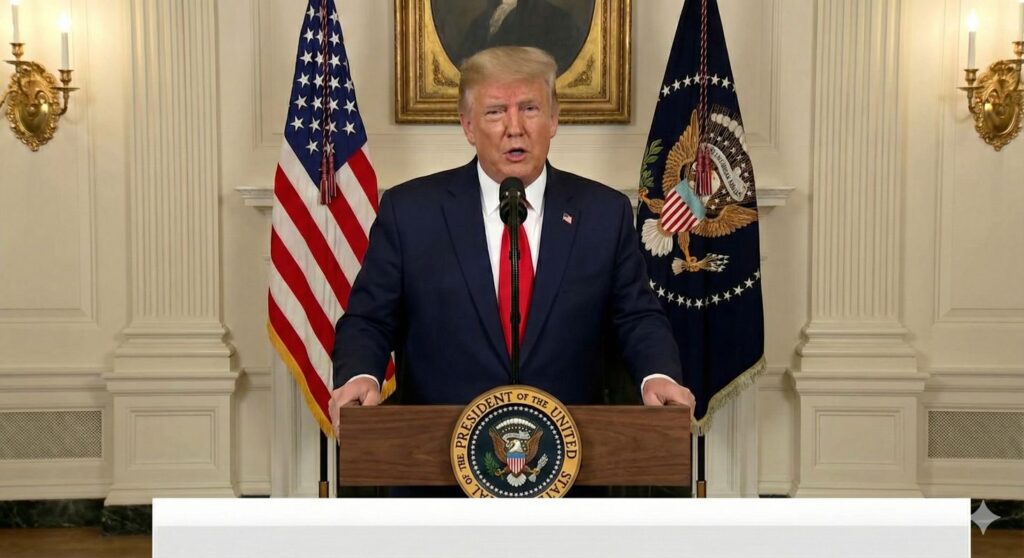
President Donald Trump used a prime-time address in mid-December 2025 to defend his economic record, arguing that the United States economy is stronger than public skepticism suggests. Speaking from the White House, Trump asserted that his administration’s policies have produced economic momentum, job creation, and renewed confidence, despite persistent voter concerns about inflation and the rising cost of living. The address was framed as both a rebuttal to critics and a political signal ahead of the 2026 midterm election cycle. Trump economy.
The Trump economy message emphasized optimism, resilience, and blame-shifting toward the previous administration. Trump portrayed current economic stress as inherited rather than self-inflicted, arguing that inflationary pressures and price increases stem from decisions made before his return to office. However, polling, inflation data, and economic reporting suggest a persistent gap between White House messaging and the lived financial experiences of many Americans.
Trump’s Economic Claims — Trump economy
During the roughly 18-minute address, Trump repeatedly stated that the economy is “booming” and “stronger than ever,” citing job creation, stock market performance, and what he described as early progress on inflation. He presented his economic record as evidence that his policies—particularly trade actions, deregulation, and tax initiatives—are restoring American economic strength.
Trump also announced a proposed one-time $1,776 payment to U.S. military service members, suggesting that tariff revenue could help fund the initiative. The figure was symbolic, referencing the year of American independence, and was framed as proof that the Trump economy can generate revenue without raising domestic taxes. Critics immediately questioned both the feasibility of the proposal and the broader claim that tariffs do not ultimately raise consumer prices.
The address was delivered from the Diplomatic Reception Room rather than a traditional legislative setting, underscoring its political tone. Coverage described the speech as partisan and campaign-oriented, blending economic claims with attacks on political opponents and the media.
Public Sentiment vs. Presidential Optimism
Despite Trump’s assertions, public opinion data paints a less optimistic picture of the Trump economy. Polling conducted in late 2025 shows that inflation and cost-of-living concerns remain top issues for American voters. Surveys indicate that a significant majority of Americans believe prices are rising faster than wages, eroding household purchasing power and financial security.
Economic approval ratings for Trump remain subdued compared with other policy areas. A NPR/PBS News/Marist poll found that Trump’s approval on the economy hovered in the mid-30 percent range, with affordability cited as the dominant concern. This disconnect suggests that macroeconomic indicators alone are failing to reassure voters who experience inflation through rent, groceries, healthcare costs, and interest rates.
The Trump economy narrative relies heavily on aggregate metrics, but public confidence is shaped more by personal financial conditions than by GDP growth or stock market indices. Even when inflation slows, prices rarely fall back to previous levels, leaving many households feeling permanently squeezed.
Inflation, Wages, and Economic Data
Inflation remains central to evaluations of the Trump economy. According to the U.S. Bureau of Labor Statistics, the Consumer Price Index rose approximately 3.0 percent year over year as of September 2025. While this represents a decline from earlier inflation peaks, prices for essential categories such as housing, food, and energy remain elevated.
Reuters reporting in December 2025 suggested that inflation may have accelerated again in November, with analysts warning that tariff-related costs could filter through to consumers. Economists noted that tariffs often function as indirect taxes, disproportionately affecting lower- and middle-income households.
Labor market data further complicates the Trump economy narrative. The unemployment rate stood at roughly 4.6 percent in November 2025, according to federal labor data. While historically moderate, the figure reflects a cooling labor market compared with earlier periods of expansion. Job growth and wage gains have slowed, weakening one of the administration’s key economic talking points.
Financial analysts and economic commentators have noted that these trends do not align cleanly with claims of a booming economy. While the United States is not in recession, indicators suggest a mixed and uneven recovery rather than broad-based prosperity.
Economic Policies Under Scrutiny
Trump attributed economic improvement to several policy pillars, including tariffs, deregulation, and anticipated changes to monetary leadership. He reiterated his belief that tariffs strengthen domestic industries and generate government revenue, dismissing concerns about consumer price impacts.
However, critics argue that tariffs contribute directly to higher prices for imported goods and materials, raising costs across supply chains. Reuters and other outlets have highlighted evidence that tariff-driven inflation disproportionately affects households already struggling with affordability.
Trump also referenced future housing initiatives and hinted at plans to influence the Federal Reserve by appointing new leadership. Housing affordability has become one of the most acute economic pressures facing Americans, with mortgage rates and rental costs remaining historically high. Any sustained improvement in housing costs would significantly affect perceptions of the Trump economy.
The Political Stakes of the Trump economy Narrative
As the 2026 midterm elections approach, the Trump economy message is likely to remain central to Republican strategy. Economic conditions historically play a decisive role in voter behavior, particularly when inflation and living costs dominate public concern.
Opposition candidates have already begun framing Trump’s economic claims as detached from reality, arguing that optimism without tangible relief rings hollow. The question facing the administration is whether economic conditions will materially improve in ways that voters can feel before ballots are cast.
If prices stabilize or fall and wages accelerate, the Trump economy narrative may gain traction. If affordability remains strained, the gap between rhetoric and reality could become a political liability.
Bottom Line
Trump’s December 2025 address underscored a fundamental tension at the heart of the Trump economy narrative. While the administration highlights growth, resilience, and future promise, many Americans continue to judge economic success by whether they can afford housing, food, and basic necessities. Until those pressures ease, presidential assurances that the economy is booming may struggle to resonate beyond the White House.
Further Reading
Associated Press. “Trump gives a partisan prime-time address insisting the economy is stronger than many voters feel.”
https://apnews.com/article/trump-prime-time-address-economy-inflation-2025
Reuters. “Takeaways from Trump’s year-end address to the nation.”
https://www.reuters.com/world/us/takeaways-trumps-year-end-address-nation-2025-12-18/
Reuters. “US consumer prices likely posted largest annual increase in 1-1/2 years in November.”
https://www.reuters.com/business/us-consumer-prices-likely-posted-largest-annual-increase-1-12-years-november-2025-12-18/
Barron’s. “Trump Says the Economy Is Booming. The Data Tell a More Complicated Story.”
https://www.barrons.com/articles/trump-economy-prime-time-address-inflation-jobs-2025
Bureau of Labor Statistics. “Consumer Price Index Summary.”
https://www.bls.gov/news.release/cpi.nr0.htm
Connect with the Author
Curious about the inspiration behind The Unmaking of America or want to follow the latest news and insights from J.T. Mercer? Dive deeper and stay connected through the links below—then explore Vera2 for sharp, timely reporting.
About the Author
Discover more about J.T. Mercer’s background, writing journey, and the real-world events that inspired The Unmaking of America. Learn what drives the storytelling and how this trilogy came to life.
[Learn more about J.T. Mercer]
NRP Dispatch Blog
Stay informed with the NRP Dispatch blog, where you’ll find author updates, behind-the-scenes commentary, and thought-provoking articles on current events, democracy, and the writing process.
[Read the NRP Dispatch]
Vera2 — News & Analysis
Looking for the latest reporting, explainers, and investigative pieces? Visit Vera2, North River Publications’ news and analysis hub. Vera2 covers politics, civil society, global affairs, courts, technology, and more—curated with context and built for readers who want clarity over noise.
[Explore Vera2]
Whether you’re interested in the creative process, want to engage with fellow readers, or simply want the latest updates, these resources are the best way to stay in touch with the world of The Unmaking of America—and with the broader news ecosystem at Vera2.
Free Chapter
Begin reading The Unmaking of America today and experience a story that asks: What remains when the rules are gone, and who will stand up when it matters most? Join the Fall of America mailing list below to receive the first chapter of The Unmaking of America for free and stay connected for updates, bonus material, and author news.
