
Vera2, Health and Wellness
Trump M.R.I. Claim Raises Fresh Questions About White House Transparency
Dec
Trump M.R.I. claim: Trump’s M.R.I. Claim Raises Questions About Transparency
For years, the health of American presidents has been treated as a mix of legitimate public concern and tightly controlled political messaging. The latest controversy, centered on the Trump M.R.I. claim and the White House’s carefully worded medical memo, is another reminder of how fragile that balance really is.
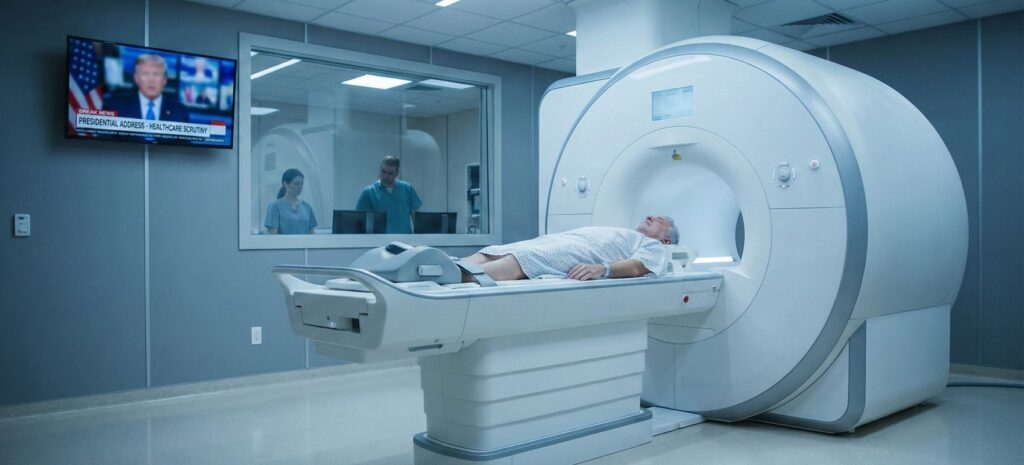
In October 2025, President Donald Trump underwent what the White House later described as “advanced imaging” of his cardiovascular system and abdomen during an executive physical at Walter Reed National Military Medical Center. A memo from his physician, Navy Captain Sean Barbabella, said the results were “perfectly normal” and framed the scan as preventive care appropriate for a 79-year-old president.
On its face, that sounds routine. But Trump’s own description of the test — saying he had “no idea” what part of his body was scanned, insisting only that it “wasn’t the brain” because he had “aced” a cognitive test — created a gap between the memo, his rhetoric, and the unanswered questions. That gap is the heart of the Trump M.R.I. claim and why it’s now a live debate about transparency, judgment, and trust.
What We Actually Know About the Trump M.R.I. exam
The memo’s version of events
The physician’s memo, released on December 1, states that Trump’s imaging focused on his heart and abdomen. According to Barbabella, the cardiovascular images showed no arterial narrowing, no structural abnormalities, and no signs of inflammation or clotting. The abdominal images were also described as “perfectly normal,” with all major organs appearing healthy and well-perfused. The memo concludes that Trump “remains in excellent overall health.”
Those details undercut the most alarmist readings of the Trump M.R.I. claim. The White House is not denying that the scan happened, and the physician is not hinting at anything ominous. Instead, the memo sells the test as part of a high-end executive physical, the sort of comprehensive screening that affluent patients and senior officials sometimes receive even when they have no clear symptoms.
Trump’s own comments muddy the water
The controversy exists largely because Trump has been an unreliable narrator of his own health. Pressed by reporters about the scan, he said he had “no idea” which part of his body was imaged and repeated that the exam was “perfect.” He emphasized that it was not a brain scan, citing his “perfect” score on a cognitive test, but he did not explain why the imaging was ordered only months after his last public medical evaluation.
Those remarks turned what might have been a minor health note into the Trump M.R.I. claim — an episode where the official memo, the president’s words, and the timing of the disclosure do not quite line up. When the White House initially discussed the October physical, it did not mention the MRI at all. Details only emerged after Trump talked about the scan himself and critics demanded clarity, reinforcing the perception that information is being shared only when political pressure makes it unavoidable.
Why the Trump M.R.I. claim fuels transparency concerns
A pattern of selective disclosure
The Trump M.R.I. claim fits into a broader record of selective disclosure around Trump’s health. Past examples include the glowing pre-2016 letter from his private doctor that the physician later admitted Trump had largely dictated, the unexplained prior trip to Walter Reed that the White House tried to downplay, and years of vague statements about “perfect” health that never matched the limited data made public.
That history matters. It primes much of the public to doubt any new health narrative, especially one as carefully curated as this memo. Even if Barbabella’s summary is accurate and complete, people hear it through the filter of earlier spin and half-truths. In that context, the Trump M.R.I. claim is less about one imaging study and more about whether this White House can be trusted to speak plainly when the president’s capacity to serve is at stake.
What the memo says — and doesn’t say
There is also the problem of what the memo leaves out. It is a short summary, not a full report. It does not include the radiologist’s detailed findings, mention incidental issues that might require follow-up, or explain why advanced imaging was necessary just six months after a prior public physical. It focuses narrowly on cardiovascular and abdominal health and says nothing about other possible scans or tests that might have been considered.
From a purely clinical standpoint, that level of disclosure is not unusual; most patients never see their entire imaging dossier. But from a transparency standpoint, it leaves open several questions that feed the Trump M.R.I. claim. Critics argue that the White House has cherry-picked what to release, offering reassuring headline language without allowing outside experts to evaluate the full context.
The timing fuels suspicion as well. The MRI took place in October, but the White House released its detailed explanation only after days of speculation, social-media blowups, and pointed questions from figures like Minnesota Governor Tim Walz, who publicly pressed Trump to share the results.
Presidential health, precedent, and the Trump M.R.I. claim
How this fits into a long history of secrecy
Debates like the Trump M.R.I. claim are not new. Franklin D. Roosevelt concealed the full extent of his paralysis. John F. Kennedy hid serious pain, steroid use, and other chronic conditions. Ronald Reagan’s early cognitive decline was not confronted openly while he was in office. The instinct to downplay or delay bad health news is deeply ingrained in the presidency.
What is different now is the speed and intensity of information flows. Camera phones, social media, and nonstop cable coverage turn every stumble, slurred phrase, or awkward moment into fodder for speculation. In that climate, the Trump M.R.I. claim feeds broader narratives about advanced age, cognitive fitness, and a president’s ability to handle crisis. When this latest exam follows visible signs like ankle swelling, a hand bruise, and a diagnosis of chronic venous insufficiency — disclosures that themselves arrived late — it becomes harder to persuade skeptics that everything is truly routine.
Why national security is part of this story
Presidential health is not just a private matter; it is a national security variable. Adversaries watch closely for signs of weakness or distraction. Allies worry about continuity of leadership. Financial markets react to uncertainty. If the White House appears evasive or inconsistent, as some critics say it has throughout the Trump M.R.I. claim episode, the damage extends beyond partisan talking points and into questions about stability and command.
That is why many former White House physicians and independent experts have argued for clearer norms. They suggest regular, comprehensive exams with standardized disclosure, and even some form of independent review, so that the country is not reliant on spin-heavy memos issued only when political pressure builds. The contours of the Trump M.R.I. claim — vague presidential comments, delayed explanation, and partial documentation — are exactly the kind of pattern they say should be avoided.
What the Trump M.R.I. claim means for future transparency
Pressure for standardized disclosure rules
Looking forward, the Trump M.R.I. claim is likely to intensify demands for formal rules or at least strong norms around presidential health reporting. Proposals already floating around Washington include requiring major candidates to release a baseline medical summary during campaigns and then submit annual updates while in office, including some assessment of both physical and cognitive function.
Another idea is to define a standard format for presidential medical disclosures, with comparable metrics from year to year instead of ad-hoc memos that change with each administration. The goal would be to make episodes like the Trump M.R.I. claim less about whether any information is released at all and more about how the latest results fit into a clear, consistent record over time.
Whether any of this happens depends on how voters respond. If much of the public shrugs off the Trump M.R.I. claim as just another partisan argument, future presidents will have little incentive to change the status quo. If, instead, this episode becomes part of a broader demand for honesty about age, health, and capacity to serve, it could eventually push both parties toward a more transparent standard.
The role of media and critics
Media outlets and political opponents face their own choices. When they treat every rumor as breaking news, they risk burying the facts under speculation. When they ignore legitimate questions about a president’s health, they do the opposite and fail to hold power accountable.
In the case of the Trump M.R.I. claim, responsible scrutiny focuses on verifiable points: the timing of the exam, the decision not to mention it initially, Trump’s contradictory public comments, and the limited scope of the memo itself. The real issue is not inventing dramatic diagnoses but asking why such a simple story — preventive imaging with normal results — was handled in such a convoluted way.
Bottom Line: Why the Trump M.R.I. claim matters
The Trump M.R.I. claim is not just a curiosity about one medical test. It is a case study in how modern presidents manage, and often mismanage, the politics of their own health. A preventive scan with reassuring findings became a flashpoint because the narrative around it was inconsistent, late, and shaped by years of earlier spin.
In a country that keeps electing older presidents, that should be taken seriously. Clear, consistent, and independently credible health disclosures are no longer a nice-to-have; they are a basic requirement for public trust. Until the norms and rules catch up with that reality, episodes like the Trump M.R.I. claim will keep surfacing, and each ambiguous memo will look less like reassurance and more like a warning sign about how much we are not being told.
Further Reading
New York Times – Trump’s MRI Results Raise New Questions About White House Transparency
https://www.nytimes.com/2025/12/01/health/trump-mri-results.html
Washington Post – White House says Trump got MRI for “preventive” cardiovascular checkup
https://www.washingtonpost.com/politics/2025/12/01/trump-mri-advanced-imaging-results/
CBS News – White House releases details of Trump’s MRI scan
https://www.cbsnews.com/news/trump-mri-abdomen-heart-white-house-says/
Associated Press – Doctor says Trump had screening MRI on heart, abdomen with “perfectly normal” results
https://apnews.com/article/0c66f2f9fca865d842ee94329a210a42
Time – White House releases more information on Trump’s MRI amid questions over president’s health
https://time.com/7337936/trump-mri-results-health-white-house/
Connect with the Author
Curious about the inspiration behind The Unmaking of America or want to follow the latest news and insights from J.T. Mercer? Dive deeper and stay connected through the links below—then explore Vera2 for sharp, timely reporting.
About the Author
Discover more about J.T. Mercer’s background, writing journey, and the real-world events that inspired The Unmaking of America. Learn what drives the storytelling and how this trilogy came to life.
[Learn more about J.T. Mercer]
NRP Dispatch Blog
Stay informed with the NRP Dispatch blog, where you’ll find author updates, behind-the-scenes commentary, and thought-provoking articles on current events, democracy, and the writing process.
[Read the NRP Dispatch]
Vera2 — News & Analysis
Looking for the latest reporting, explainers, and investigative pieces? Visit Vera2, North River Publications’ news and analysis hub. Vera2 covers politics, civil society, global affairs, courts, technology, and more—curated with context and built for readers who want clarity over noise.
[Explore Vera2]
Whether you’re interested in the creative process, want to engage with fellow readers, or simply want the latest updates, these resources are the best way to stay in touch with the world of The Unmaking of America—and with the broader news ecosystem at Vera2.
Free Chapter
Begin reading The Unmaking of America today and experience a story that asks: What remains when the rules are gone, and who will stand up when it matters most? Join the Fall of America mailing list below to receive the first chapter of The Unmaking of America for free and stay connected for updates, bonus material, and author news.
