
Vera2, Civil Rights and Society
US Immigration Requests Suspended After National Guard Shooting in Washington, D.C.
Nov
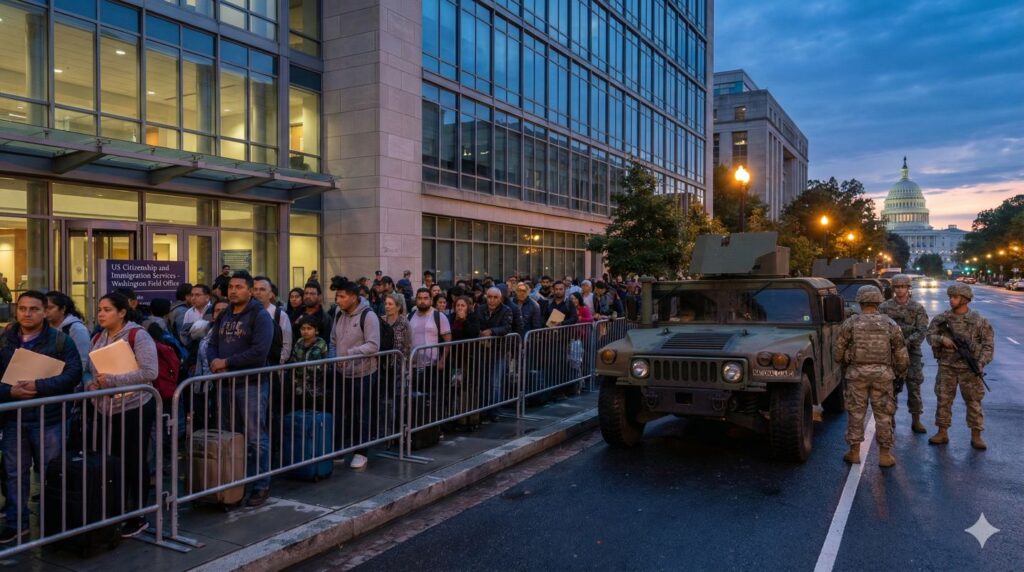
US immigration requests suspended after National Guard shooting in Washington, D.C.
The decision to suspend US immigration requests for Afghan nationals after a deadly National Guard shooting in Washington, D.C., is not a minor procedural change. It is a hard policy break with immediate consequences for tens of thousands of people who were told the United States would offer them protection. It is also a political signal: security first, even if that means treating an entire class of applicants as suspect.
This article walks through what happened in D.C., what the government has actually done to US immigration requests involving Afghans, what it means in practice for refugees and asylum seekers, and how this moment fits into the broader fight over immigration and national security.
Incident overview — US immigration requests
On November 26, 2025, two members of the West Virginia National Guard were shot near the Farragut West Metro station in downtown Washington, D.C., just blocks from the White House. One of the soldiers, 20-year-old Army Specialist Sarah Beckstrom, later died of her injuries; 24-year-old Staff Sergeant Andrew Wolfe remains hospitalized in critical condition. The Washington Post+1
The suspect, identified as 29-year-old Rahmanullah Lakanwal, is an Afghan national who entered the United States in 2021 under Operation Allies Welcome, the program used to evacuate vulnerable Afghans after the fall of Kabul. He later obtained asylum in 2025. Wikipedia+1
According to investigators, Lakanwal allegedly drove from Washington State to D.C. and carried out what officials have described as an “ambush-style” attack using a .357 revolver. He was shot and wounded by a guardsman at the scene and is now facing multiple felony charges; federal authorities are investigating the case as a potential act of terrorism. Wikipedia+1
Those core facts are not in dispute. Where the fight starts is over what the government has done next to US immigration requests from Afghans and what that choice says about the direction of U.S. policy.
What changed in policy — and how fast
Within hours of the shooting, the Trump administration moved to frame the incident as proof of systemic failure in the vetting of Afghans admitted since 2021. Homeland Security officials confirmed that U.S. Citizenship and Immigration Services (USCIS) has halted the processing of all immigration applications involving Afghan nationals, pending a “comprehensive review” of security and vetting procedures. Reuters+2CBS News+2
Reuters and CBS reporting indicate that the pause on US immigration requests is not symbolic. It covers asylum claims, Special Immigrant Visa–related filings, parole renewals and other benefit applications tied to Afghan nationals, with no clear end date. Reuters+1
At the same time, the administration has ordered a sweeping re-examination of:
-
All asylum cases approved under President Biden.
-
All green cards issued to citizens from 19 “countries of concern,” including Afghanistan.
-
Roughly 233,000 refugees admitted between January 2021 and February 2025. Reuters+1
In other words, US immigration requests involving Afghans are not just paused going forward; past approvals are being re-opened and re-litigated. That combination of a forward-looking halt and a backward-looking review is unusually aggressive, even by the standards of recent crackdowns.
Who the suspension hits — and who is left in limbo
An estimated 85,000 Afghans were brought to the United States under Operation Allies Welcome after the 2021 withdrawal, many of them people who worked alongside U.S. forces, contractors, or U.S.-backed units on the ground. Reuters+1
The pause on US immigration requests lands hardest in a few specific groups:
Afghans on humanitarian parole
Thousands remain in the U.S. on temporary humanitarian parole that was never meant to be permanent. They depend on follow-on applications – often asylum or other status adjustments – to secure a long-term future. With US immigration requests frozen, those cases now sit in a legal and emotional deep freeze. Families have no timeline, no clear appeal path, and no certainty that their paperwork will ever move again.
Afghan allies still abroad
There is also the pipeline: Afghans still in hiding in Pakistan, Iran, or inside Afghanistan who had started or were preparing to start US immigration requests under Special Immigrant Visa or refugee programs. For them, the shooting in D.C. and the resulting suspension mean the door is suddenly bolted. They are left to watch one man’s alleged crime in Washington erase their best remaining path out of danger.
People already approved, now under review
The administration has gone further, directing officials to re-screen all Afghans admitted under Biden-era policies and many other refugees as well. That means individuals who already passed security checks and built lives here now have to worry that a review triggered by the D.C. shooting could strip away status they thought was secure. Reuters+1
For all of these groups, the message is blunt: US immigration requests tied to Afghans are now treated as a security problem first, humanitarian commitment second.
Security failures and the vetting question
Officials are arguing that the suspension of US immigration requests is a necessary response to a clear intelligence and vetting failure. The suspect reportedly worked with CIA-backed “Zero Units” in Afghanistan, shadowy paramilitary formations that were controversial even during the war. Wikipedia+1
That raises hard questions:
How did someone with that background make it through layers of screening? Were risk flags missed or downplayed because he had worked with U.S.-backed forces? Did the pressure to move large numbers of Afghans quickly after the fall of Kabul lead to shortcuts that now look indefensible?
Those are legitimate questions, and there is a real public interest in getting answers. But none of them automatically support a blanket freeze on all US immigration requests involving Afghans, nor do they justify treating an entire population as a potential threat because of one man’s alleged actions.
Civil liberties, collective punishment, and due process
Refugee advocates and legal experts are already warning that the government is edging toward collective punishment. Groups working with Afghans say they are seeing a surge in fear, harassment, and threats in U.S. communities in the wake of the shooting and the political rhetoric that followed. ABC News+1
From a legal standpoint, several issues stand out:
First, mass re-examination of green cards and asylum grants from certain countries of origin pushes the line on what due process is supposed to mean. Reopening individual cases based on new evidence is one thing; launching a dragnet review because the applicants share a nationality is another.
Second, indefinite suspension of US immigration requests with no statutory deadline invites litigation. Courts have previously pushed back against broad nationality-based bans and indefinite processing freezes, especially when they appear driven more by political messaging than by narrowly tailored security concerns.
Third, there is the ugly historical pattern. The United States has a long record of making sweeping policy moves against entire communities after violent incidents – from World War II internment of Japanese Americans to post-9/11 targeting of Muslims and Arabs – and then decades later admitting those steps were wrong. The current halt on US immigration requests for Afghans fits uncomfortably into that lineage.
Trump’s political framing — and the broader immigration agenda
President Trump has not been subtle about how he sees this moment. In public comments and social media posts, he has labeled the suspect “an animal,” vowed to “re-examine every single alien who has entered our country from Afghanistan under Biden,” and promised to “permanently pause” migration from what he calls “third world countries.” ABC News+2Reuters+2
At the policy level, the administration has already:
Cut the refugee cap for fiscal year 2026 to a historic low of 7,500 and tilted future slots toward white South Africans of Afrikaner ethnicity. Reuters
Rolled out a “full-scale, rigorous re-examination” of all green cards from 19 “countries of concern.” Reuters+1
The D.C. shooting is now being used to justify both the pause on US immigration requests and that broader agenda. The risk is obvious: a single horrific crime becomes the justification for a long-term restructuring of immigration to favor some nationalities and ethnicities over others.
Community impact: backlash, fear, and silence
On the ground, Afghan communities in places like Seattle, Portland, and Northern Virginia report a mix of grief, fear, and resignation. Local coverage has documented Afghans worried about harassment, discrimination, and hate crimes as the story ricochets through partisan media and social networks. ABC News+1
For Afghans who already endured Taliban death threats, perilous escapes, and years inside U.S. bureaucracies, the suspension of US immigration requests is another reminder that their status here is contingent and fragile. Many are choosing to stay quiet, to avoid interviews, and to keep their profiles low – a rational response when a single incident is being used to question whether people like you “belong” in the country at all.
What happens next
In the short term, there are a few likely trajectories:
Courts will almost certainly be asked to review the legality of the blanket halt on US immigration requests for Afghans, especially if the pause drags on for months. Civil rights and refugee advocacy groups are already signaling they are preparing challenges.
Congress may hold hearings, though partisan dynamics are predictable. Expect Republicans to frame the halt as overdue caution and Democrats to argue the review can be done without freezing the pipeline entirely.
Inside the bureaucracy, officials at USCIS and DHS will be under pressure to show that the review is rigorous, that they are catching “missed threats,” and that re-screening is not just theater. That pressure tends to incentivize over-correction, not nuance.
For Afghan applicants and parolees, none of that offers much comfort. Their reality is simple: US immigration requests that were already painfully slow are now stopped, and every month of delay is a month of added risk for people stuck overseas and added anxiety for those already here.
Why this moment matters
The suspension of US immigration requests for Afghans after the National Guard shooting is a stress test for two competing claims the United States likes to make about itself.
One claim is that America honors its promises to those who risked everything to support U.S. missions abroad, even when it is politically inconvenient. The other is that America will always prioritize security, even if that means closing doors to whole categories of people.
Right now, the policy choices are leaning hard toward the second claim. Whether that tilt becomes permanent depends on what happens in the coming months: how the investigations are handled, how the courts rule, whether the administration quietly narrows the pause or doubles down, and whether the public buys the idea that one man’s alleged crime should effectively reset the terms of US immigration requests for an entire nation.
If history is any guide, the real damage may not be the headlines of this week, but the quiet decisions that follow: cases shelved, programs dismantled, families told to wait a little longer until, eventually, the waiting becomes the answer.
Further Reading
Reuters: “US says it stopped processing all immigration requests relating to Afghan nationals after DC shooting”
https://www.reuters.com/world/us/us-says-stopped-processing-all-immigration-requests-relating-afghan-nationals-2025-11-27/ Reuters+1
CBS News: “Federal government pauses immigration applications for Afghan nationals after National Guard shooting”
https://www.cbsnews.com/news/trump-pauses-immigration-applications-afghanistan-national-guard-shooting-dc/ CBS News+1
ABC News / AP: “Refugee groups worry about backlash after shooting of National Guard soldiers in DC”
https://abcnews.go.com/US/wireStory/refugee-groups-worry-backlash-after-shooting-national-guard-127934299 ABC News
KATU Portland: “Portland Afghan community concerned following the halt and review of refugees”
https://katu.com/news/local/portland-afghan-community-concerned-following-the-halt-and-review-of-all-afghan-refugees KATU
The Guardian: “Suspect in Washington DC national guard shooting had ties to CIA, agency confirms”
https://www.theguardian.com/us-news/2025/nov/27/washington-dc-national-guard-shooting-suspect The Guardian
Wikipedia: “2025 Washington, D.C., National Guard shooting”
https://en.wikipedia.org/wiki/2025_Washington%2C_D.C.%2C_National_Guard_shooting
Connect with the Author
Curious about the inspiration behind The Unmaking of America or want to follow the latest news and insights from J.T. Mercer? Dive deeper and stay connected through the links below—then explore Vera2 for sharp, timely reporting.
About the Author
Discover more about J.T. Mercer’s background, writing journey, and the real-world events that inspired The Unmaking of America. Learn what drives the storytelling and how this trilogy came to life.
[Learn more about J.T. Mercer]
NRP Dispatch Blog
Stay informed with the NRP Dispatch blog, where you’ll find author updates, behind-the-scenes commentary, and thought-provoking articles on current events, democracy, and the writing process.
[Read the NRP Dispatch]
Vera2 — News & Analysis
Looking for the latest reporting, explainers, and investigative pieces? Visit Vera2, North River Publications’ news and analysis hub. Vera2 covers politics, civil society, global affairs, courts, technology, and more—curated with context and built for readers who want clarity over noise.
[Explore Vera2]
Whether you’re interested in the creative process, want to engage with fellow readers, or simply want the latest updates, these resources are the best way to stay in touch with the world of The Unmaking of America—and with the broader news ecosystem at Vera2.
Free Chapter
Begin reading The Unmaking of America today and experience a story that asks: What remains when the rules are gone, and who will stand up when it matters most? Join the Fall of America mailing list below to receive the first chapter of The Unmaking of America for free and stay connected for updates, bonus material, and author news.
