
Vera2, Global Affairs
US and Ukraine Signal Progress in Geneva Peace Plan
Nov
US and Ukraine Signal Progress in Peace Plan Talks
US and Ukrainian officials are trying to turn a deeply controversial peace plan into something they can actually live with. After days of negotiations in Geneva, both governments are now talking about “intensive work” on a refined framework, signaling that they see at least a narrow path forward. For a war that has dragged on for years and reshaped global security politics, even cautious optimism around a new peace plan is notable.
The stakes are obvious. Washington has already committed well over a hundred billion dollars in military, economic, and humanitarian support to Kyiv, and the political appetite for open-ended aid is clearly eroding. Ukraine, for its part, cannot afford a peace plan that locks in Russian territorial gains or leaves it exposed to another invasion in a few years. The Geneva talks are an attempt to fix a U.S. peace proposal that was widely criticized as a Kremlin wish list, without blowing up the alliance that has kept Ukraine in the fight.
Overview of the Geneva Talks — peace plan
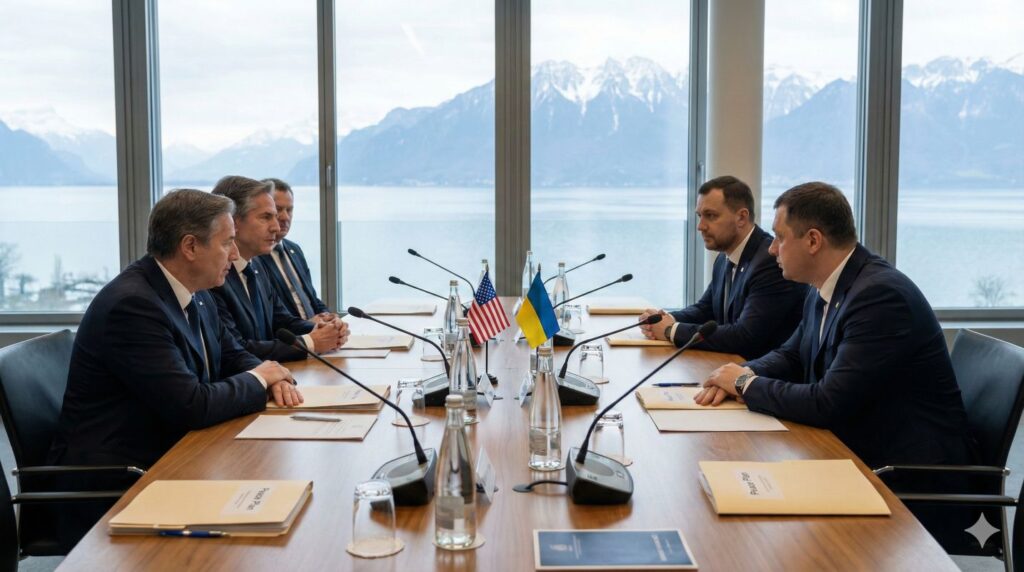
The Geneva meeting brought together senior American and Ukrainian officials to rework the earlier U.S. 28-point peace plan that Kyiv and key European allies had rejected. That original document suggested territorial concessions to Russia, limits on Ukraine’s armed forces, and restrictions on NATO’s role, prompting a backlash in European capitals and deep skepticism inside Ukraine.
In a joint statement after the first round of discussions, Washington and Kyiv described the talks as “constructive, focused, and respectful,” and said they had drafted a “refined peace framework” that would guide further work in the coming days. Both sides pledged to maintain close contact with European partners as they continue negotiating the peace plan.
What has not been publicly released is almost as important as what has. Neither side has published the full text of the updated peace plan, leaving journalists, analysts, and the Russian government to piece together its contents from leaks, selective briefings, and European counter-proposals. What is clear is that US and Ukrainian negotiators are trying to salvage parts of the peace plan that could bring an end to large-scale fighting, while rewriting clauses that would effectively reward Russia for its invasion.
Key Issues on the Table in the peace plan
While the full draft is still secret, reporting from Geneva and previous leaks of the 28-point document make it possible to sketch out the main issues now being reworked inside the peace plan.
Ceasefire and civilian protection
Any credible peace plan needs a ceasefire that actually holds. For Ukraine, that means more than just a pause in Russian artillery fire. It means verifiable withdrawal of certain Russian units, clear lines of control, and monitoring mechanisms robust enough to catch and deter violations. For the United States, a functioning ceasefire is the basic condition for selling the peace plan to a skeptical public and a divided Congress.
The humanitarian angle is central here. Years of war have displaced millions, destroyed critical infrastructure, and turned cities like Mariupol and parts of Kharkiv into ruins. A durable ceasefire embedded in the peace plan would open the door to scaled-up aid deliveries, reconstruction financing, and the safe return of at least some refugees. Without that, the peace plan is just a paper exercise.
Security guarantees and NATO questions
The original U.S. proposal linked the peace plan to long-term security guarantees for Ukraine, but it also floated sharp constraints on the size and posture of Ukraine’s military and narrowed Kyiv’s path toward NATO. That was one of the main reasons European leaders pushed back. EU Commission President Ursula von der Leyen has publicly warned that Ukraine must not be forced to shrink its army or accept changes to its borders as the price of peace.
In Geneva, negotiators are trying to realign the peace plan with those red lines. European governments have signaled they could accept some form of troop caps or arms control measures if they come with ironclad Western security guarantees and do not leave Ukraine weaker than before the invasion. The refined peace plan will rise or fall on whether it persuades Ukrainians and allies that “security guarantees” mean something more than vague future commitments.
Territorial integrity and sanctions relief
Territory is the hardest issue. The first version of the U.S. peace plan suggested that Ukraine accept Russian control over parts of its internationally recognized territory, at least for a defined period, in exchange for a ceasefire and economic incentives. That approach clashes directly with Kyiv’s stated goal of full territorial restoration and with Europe’s insistence that borders cannot be changed by force.
At the same time, any realistic peace plan must explain how sanctions on Russia could eventually be eased, and under what conditions. European leaders involved in related planning have argued that sanctions relief can only follow a genuine peace deal, not a temporary ceasefire. The Geneva talks are therefore trying to thread a needle: design a peace plan that keeps pressure on Russia while still offering a pathway out of permanent isolation if Moscow ends its aggression and accepts verifiable terms.
International reactions to the Geneva peace plan
The Geneva process is not happening in a vacuum. European governments, Canada, Japan, and other allies have already signaled that they welcome diplomatic efforts but will not back any peace plan that undermines Ukraine’s sovereignty or their own security. The earlier backlash from France, Germany, the UK, and others to the 28-point proposal is a warning that Washington cannot simply present an agreement as a done deal and expect automatic support.
Russia, for its part, is watching carefully. The Kremlin has said it will wait for official details before commenting on the refined peace plan, but Russian officials have made clear that they see the U.S. push as an opportunity to lock in territorial gains and limit Ukraine’s long-term military capacity. If Moscow concludes that the new peace plan has moved too far away from its preferred terms, it has every incentive to stall or escalate.
Inside Ukraine, public opinion on any peace plan is shaped by brutal lived experience. A society that has endured occupation, war crimes, mass deportations, and repeated missile barrages is not inclined to trust paper guarantees, especially if they appear to reward aggression. Ukrainian leaders have floated their own 10-point peace formula centered on nuclear safety, food and energy security, full territorial restoration, and long-term security guarantees. Any Geneva-based peace plan that diverges too sharply from that formula will face fierce resistance.
In the United States, the Geneva talks are unfolding amid widening partisan splits over aid to Ukraine. Polls show that a growing share of Americans—particularly Republicans—believe the U.S. is spending too much, even as others say Washington has a responsibility to support Kyiv. For some, a negotiated peace plan looks like a necessary exit strategy; for others, it looks like premature capitulation.
How this peace plan fits into the wider diplomatic timeline
The Geneva talks are just the latest chapter in a long sequence of diplomatic efforts around Ukraine. Earlier in 2025, the United States and Russia held a ministerial-level meeting in Saudi Arabia to explore possible parameters for ending the war. The UK and France then led a “coalition of the willing” and hosted the London Summit on Ukraine, aimed at building security guarantees and drafting a Europe-backed peace framework that could complement U.S. efforts.
Those initiatives built on the June 2024 peace summit at Bürgenstock in Switzerland, where more than 90 countries met to discuss nuclear safety, food security, and humanitarian issues, even though Russia itself did not attend. Taken together, these steps show that the Geneva peace plan is part of a larger attempt to move from ad-hoc crisis management to a structured, enforceable settlement.
The difference now is that the costs of failure are clearer. Another breakdown like the Minsk agreements would not just mean a return to sporadic shelling; it would mean normalizing the idea that borders in Europe can be changed by force, and that “peace plan” is just another word for a temporary timeout.
What happens next for the US-Ukraine peace plan
In the near term, U.S. and Ukrainian teams have agreed to continue “intensive work” on the refined peace plan and to keep close coordination with key European partners. That likely means detailed negotiations over troop levels, weapons systems, monitoring arrangements, sanctions sequences, and reconstruction mechanisms.
The bigger question is whether a peace plan emerging from Geneva can command legitimacy on all three fronts that matter: in Ukraine, among European allies, and inside the United States. If any of those pillars collapses, the settlement will be unstable at best. If all three hold, the Geneva document could mark the beginning of a shift from a war of attrition to an armed, uneasy peace backed by real guarantees.
Either way, the word “peace plan” should not mislead anyone. What is being hammered out in Geneva is less a clean end to the conflict than a framework to manage it at a lower temperature. The challenge for Washington, Kyiv, and their partners is to ensure that this peace plan does not simply freeze injustice in place, but actually reduces the odds of a larger catastrophe later.
Further Reading
Joint Statement on United States–Ukraine Meeting — The White House
https://www.whitehouse.gov/briefings-statements/2025/11/joint-statement-on-united-states-ukraine-meeting/
US, Ukraine to continue work on refined peace plan to end war with Russia — Reuters
https://www.reuters.com/world/europe/us-ukraine-continue-work-refined-peace-plan-end-war-with-russia-2025-11-24/
Ukraine, US draft updated peace plan during productive Geneva talks — Kyiv Independent
https://kyivindependent.com/trump-quite-pleased-with-ukraine-peace-talks-as-europe-reportedly-issues-counterproposal/
Ukraine’s allies push back on a US peace plan seen as favoring Moscow — Associated Press
https://apnews.com/article/a233bae1e394c971ff48d181cf2702d7
U.S. 28-Point Ukraine Peace Plan — Background and Reactions
https://en.wikipedia.org/wiki/U.S._28-point_Ukraine_plan
June 2024 Summit on Peace in Ukraine — Overview
https://en.wikipedia.org/wiki/June_2024_Ukraine_peace_summit
Coalition of the Willing and European Security Guarantees for Ukraine
https://en.wikipedia.org/wiki/Coalition_of_the_willing_(Russo-Ukrainian_war)
War in Ukraine: Wide Partisan Differences on U.S. Responsibility and Support — Pew Research Center
https://www.pewresearch.org/politics/2024/07/29/war-in-ukraine-wide-partisan-differences-on-u-s-responsibility-and-support/
Connect with the Author
Curious about the inspiration behind The Unmaking of America or want to follow the latest news and insights from J.T. Mercer? Dive deeper and stay connected through the links below—then explore Vera2 for sharp, timely reporting.
About the Author
Discover more about J.T. Mercer’s background, writing journey, and the real-world events that inspired The Unmaking of America. Learn what drives the storytelling and how this trilogy came to life.
[Learn more about J.T. Mercer]
NRP Dispatch Blog
Stay informed with the NRP Dispatch blog, where you’ll find author updates, behind-the-scenes commentary, and thought-provoking articles on current events, democracy, and the writing process.
[Read the NRP Dispatch]
Vera2 — News & Analysis
Looking for the latest reporting, explainers, and investigative pieces? Visit Vera2, North River Publications’ news and analysis hub. Vera2 covers politics, civil society, global affairs, courts, technology, and more—curated with context and built for readers who want clarity over noise.
[Explore Vera2]
Whether you’re interested in the creative process, want to engage with fellow readers, or simply want the latest updates, these resources are the best way to stay in touch with the world of The Unmaking of America—and with the broader news ecosystem at Vera2.
Free Chapter
Begin reading The Unmaking of America today and experience a story that asks: What remains when the rules are gone, and who will stand up when it matters most? Join the Fall of America mailing list below to receive the first chapter of The Unmaking of America for free and stay connected for updates, bonus material, and author news.
