
Vera2, Global Affairs
Us Navy Admiral Ordered Second Deadly Venezuela Boat Strike
Dec
Legal Implications of the US Navy’s Venezuela Boat Strike
The US Navy’s September 2025 operation against a suspected narco-smuggling vessel has become a flashpoint for questions about legality, ethics, and precedent. What began as a single engagement in the Caribbean has now become globally known as the Venezuela Boat Strike, and it is forcing the White House, the Pentagon, and Congress to explain exactly how far US forces may go in the name of drug interdiction.
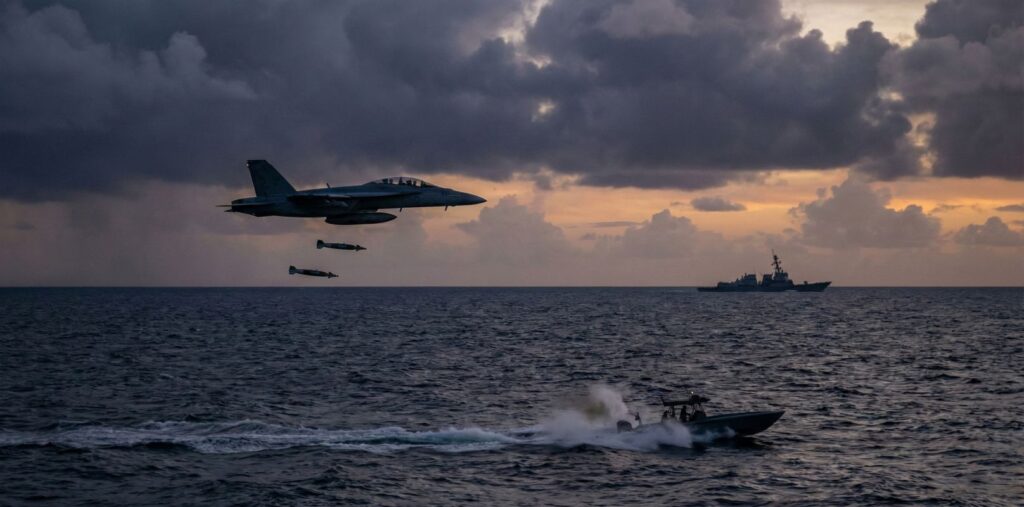
According to reporting from Reuters and other outlets, a US aircraft or ship struck a Venezuelan fast boat on September 2, 2025, killing most of those on board. Survivors were left clinging to wreckage. A US admiral then authorized a second strike that targeted the survivors, an escalation the White House now insists was “well within his authority and the law.”reuters.com+1 That second step is what turned an already controversial interdiction into the Venezuela Boat Strike.
As details emerge, legal experts, human rights advocates, and even some US allies are openly questioning whether the Venezuela Boat Strike violates international law, the UN Charter, and long-standing protections for shipwrecked and incapacitated persons at sea.
Background of the Strike — Venezuela Boat Strike
The Venezuela Boat Strike is part of a wider campaign of air and naval attacks on alleged drug-trafficking vessels in the Caribbean and Eastern Pacific, a campaign the Trump Administration has wrapped into Operation Southern Spear and the “war on cartels.”Wikipedia+1 Since early September, US forces have carried out at least a dozen lethal strikes on small boats, killing dozens of suspected traffickers linked to Venezuelan and Colombian groups like Tren de Aragua and the National Liberation Army.
In the Venezuela Boat Strike itself, US forces attacked a fast boat the administration says was operated by Venezuelan “narco-terrorists.” The first strike destroyed the vessel and killed most of the crew. Two alleged traffickers survived the initial blast and were visible in post-strike imagery. According to the White House, Admiral Frank Bradley, acting under the authority of Defense Secretary Pete Hegseth, then ordered a second strike against the survivors.reuters.com+2TIME+2
The incident took place in international waters near Venezuelan territory, at a time when the United States had already deployed warships and thousands of sailors to the region in a broader show of force against President Nicolás Maduro’s government and the cartels Washington accuses of working with Caracas.Wikipedia+1 That larger context is crucial, because it means the Venezuela Boat Strike is not just about drugs; it sits on top of an existing geopolitical confrontation with Venezuela.
White House Defense of the Venezuela Boat Strike
From the first moment reporters pressed for details, the White House has framed the Venezuela Boat Strike as a clean, legal operation. Officials argue that the admiral acted under standing rules of engagement, that the targets were part of a designated foreign terrorist organization, and that the second strike was lawful self-defense.reuters.com+1
Domestic authority and the “war on cartels”
The administration has notified Congress that it considers the United States to be in an “armed conflict” with certain drug cartels and cartel-linked groups, including the Venezuelan Tren de Aragua. That framing is meant to bring the Venezuela Boat Strike under the domestic and international rules governing armed conflict, rather than ordinary law enforcement.Wikipedia+1
In that narrative, the Venezuela Boat Strike was not just a Coast Guard-style interdiction; it was a bona fide wartime operation against enemy belligerents. Officials point to the president’s commander-in-chief powers and to counter-narcotics and counter-terrorism statutes as domestic legal support for the admiral’s authority to carry out both the initial hit and the follow-up strike.reuters.com+1
Critics counter that Congress has never clearly authorized a war against cartels and that treating drug smugglers as wartime enemies is a dangerous legal stretch. They warn that using the Venezuela Boat Strike as a template could allow future administrations to bypass normal war-powers checks whenever they label a criminal group “terrorist” or “narco-terrorist.”Wikipedia+1
Self-defense framing on the high seas
The second plank in the White House defense is self-defense. Press Secretary Karoline Leavitt has said the admiral believed the survivors posed an ongoing threat and that the second strike in the Venezuela Boat Strike was therefore a legitimate act of self-defense under both US and international law.TIME+1
Under Article 51 of the UN Charter, a state may use force in self-defense against an actual or imminent armed attack. The administration argues that the broader campaign of fentanyl and cocaine trafficking into the United States qualifies as an ongoing armed attack, and that boats like the one hit in the Venezuela Boat Strike are part of that attack.
Legal scholars are skeptical. Experts interviewed by the BBC, Chatham House, and other outlets note that the United States has historically treated drug trafficking as crime, not war, and that stretching the self-defense doctrine to cover the Venezuela Boat Strike weakens global restraints that protect all states from unilateral use of force.Chatham House+1
International Law and War-Crimes Questions
The sharpest criticism of the Venezuela Boat Strike comes from international law specialists and former military lawyers who say the second strike against survivors may violate some of the clearest rules in the law of armed conflict.
UN Charter and sovereignty
Under the UN Charter, force may not be used against another state except in self-defense or with Security Council authorization. Venezuela did not consent to US airstrikes in its near waters, and there is no UN mandate for Operation Southern Spear.Wikipedia+1 The United States argues that it is acting against non-state actors in international waters, not against Venezuela as a state, but Caracas and many international observers see the Venezuela Boat Strike as a violation of Venezuelan sovereignty in everything but name.
Are traffickers combatants in the Venezuela Boat Strike?
Another dispute centers on whether the people targeted in the Venezuela Boat Strike can legally be treated as combatants. If there is no genuine armed conflict, then international human rights law and peacetime maritime law apply. Under that framework, lethal force is allowed only when strictly necessary to protect life and when no less-harmful means are available. A deliberate second strike against shipwrecked survivors is extraordinarily hard to justify under those standards.Wikipedia+1
Even if one accepts the administration’s claim that an armed conflict exists, the law of war clearly protects those who are hors de combat — out of the fight — due to shipwreck, wounds, or surrender. Multiple experts cited by Reuters, Time, and Chatham House have noted that deliberately targeting shipwrecked persons, as alleged in the Venezuela Boat Strike, may meet the definition of a war crime under both international law and US statutes that incorporate war-crimes provisions.reuters.com+2TIME+2
That is why the Venezuela Boat Strike is now the subject of intense interest from congressional oversight committees, military investigators, and human rights groups. If the survivors were no longer actively hostile at the time of the second strike, the decision to “finish the job” could carry serious legal consequences up the chain of command.
Regional and Political Reactions to the Venezuela Boat Strike
The Venezuela Boat Strike is deepening an already volatile standoff between Washington and Caracas. Venezuela’s government has condemned the operation as an “extrajudicial execution” in international waters and a blatant violation of its sovereignty, accusing the United States of using cartels as a pretext for coercive pressure on Nicolás Maduro.Wikipedia+1
Across Latin America, governments that remember previous US interventions are nervous. Several regional leaders have warned that if the Venezuela Boat Strike becomes a model, nothing would prevent larger powers from launching their own “anti-crime” strikes in neighboring seas or airspace.
In Europe, legal and diplomatic experts quoted by Chatham House and other institutions say the Venezuela Boat Strike is a textbook example of how the United States is drifting away from the post-1945 consensus on limits to the use of force. They fear that if Washington insists the Venezuela Boat Strike is lawful, Russia, China, and others will cite the same logic to justify their own unilateral uses of force under the banner of self-defense or counter-terrorism.Chatham House+1
Domestically, the Venezuela Boat Strike has triggered rare bipartisan concern. Members of both parties on key congressional committees are demanding briefings from Admiral Bradley, Secretary Hegseth, and senior Pentagon lawyers. Lawmakers are asking what exact legal authorities were invoked, what intelligence supported the claim of imminent threat, and how many similar strikes have taken place with minimal public oversight.The Guardian+1
What the Venezuela Boat Strike Means for Future US Use of Force
The Venezuela Boat Strike is not just a backward-looking investigation; it is a preview of where US security policy may be heading.
If the administration’s theory stands, presidents would have wide latitude to declare “armed conflicts” against loosely defined criminal networks and then use military force against them anywhere in the world, including follow-up attacks on survivors at sea. That would blur the line between war and policing in a way that many legal scholars believe is unsustainable.Wikipedia+1
At the same time, the Venezuela Boat Strike is putting pressure on Congress to reassert its role. Some lawmakers are already talking about clarifying that the Authorization for Use of Military Force and other post-9/11 authorities do not apply to cartels, and that any future campaign modeled on the Venezuela Boat Strike would require explicit new authorization. Others want stronger reporting requirements for lethal strikes outside recognized theaters of war.
For the Pentagon and uniformed commanders, the Venezuela Boat Strike is a warning about reputational risk. Even if internal lawyers approved the operation, the global backlash shows that legal green lights on paper do not guarantee legitimacy. Any future Venezuela Boat Strike-style operation will be judged not just by the White House talking points, but by how closely it hews to long-standing norms that protect civilians and those out of combat.
Bottom Line
The legality of the US Navy’s second strike against survivors in the Venezuela Boat Strike is far from resolved. The White House insists the admiral’s decision was lawful self-defense carried out within his authority. A growing chorus of legal experts and foreign governments sees the Venezuela Boat Strike as a potential breach of the UN Charter, a violation of protections for shipwrecked persons, and a dangerous escalation in the war on cartels.
Whatever the outcome of investigations, the Venezuela Boat Strike has already changed the debate. It shows how quickly a “drug boat” operation can slide into the legal gray zone between war and crime, and how much damage can be done to the rules-based order when the world’s most powerful navy treats that gray zone as a free-fire space.
Further Reading
Reuters – White House defends US attack on boat from Venezuela as lawful
https://www.reuters.com/world/americas/white-house-admiral-approved-second-strike-boat-venezuela-was-well-within-legal-2025-12-01/ reuters.com
Time – White House Confirms Second Strike on Alleged Drug Boat and Defends Move as Legal
https://time.com/7337777/donald-trump-second-boat-strike-hegseth/ TIME
New York Post – White House says admiral ordered second strike on Venezuelan drug boat
https://nypost.com/2025/12/01/us-news/wh-says-admiral-ordered-second-strike-on-venezuelan-drug-boat-self-defense/ New York Post
Wikipedia – 2025 United States military strikes on alleged drug traffickers
https://en.wikipedia.org/wiki/2025_United_States_military_strikes_on_alleged_drug_traffickers Wikipedia
Chatham House – Attacks on ‘drug boats’ are pushing the US away from the consensus on the rules of international law
https://www.chathamhouse.org/2025/10/attacks-drug-boats-are-pushing-us-away-consensus-rules-international-law Chatham House
CBS News – How the Trump administration’s account of Sept. 2 boat strike has evolved
https://www.cbsnews.com/news/boat-strike-sept-2-trump-administration-statements/
Further Reading
White House defends US attack on boat from Venezuela as lawful – Reuters
https://www.reuters.com/world/americas/white-house-admiral-approved-second-strike-boat-venezuela-was-well-within-legal-2025-12-01/ Reuters
White House Confirms Second Strike on Alleged Drug Boat and Defends Move as Legal – Time
https://time.com/7337777/donald-trump-second-boat-strike-hegseth/ TIME
US admiral to brief lawmakers as bipartisan scrutiny grows over boat strike – The Guardian
https://www.theguardian.com/us-news/2025/dec/02/us-admiral-to-brief-lawmakers-as-bipartisan-scrutiny-grows-over-boat-strike The Guardian
2025 United States military strikes on alleged drug traffickers – Wikipedia
https://en.wikipedia.org/wiki/2025_United_States_military_strikes_on_alleged_drug_traffickers Wikipedia
Attacks on ‘drug boats’ are pushing the US away from the consensus on the rules of international law – Chatham House
https://www.chathamhouse.org/2025/10/attacks-drug-boats-are-pushing-us-away-consensus-rules-international-law Chatham House
What international law says about U.S. strikes on alleged drug boats – CBS News
https://www.cbsnews.com/video/what-international-law-says-us-strikes-alleged-drug-boats/
Connect with the Author
Curious about the inspiration behind The Unmaking of America or want to follow the latest news and insights from J.T. Mercer? Dive deeper and stay connected through the links below—then explore Vera2 for sharp, timely reporting.
About the Author
Discover more about J.T. Mercer’s background, writing journey, and the real-world events that inspired The Unmaking of America. Learn what drives the storytelling and how this trilogy came to life.
[Learn more about J.T. Mercer]
NRP Dispatch Blog
Stay informed with the NRP Dispatch blog, where you’ll find author updates, behind-the-scenes commentary, and thought-provoking articles on current events, democracy, and the writing process.
[Read the NRP Dispatch]
Vera2 — News & Analysis
Looking for the latest reporting, explainers, and investigative pieces? Visit Vera2, North River Publications’ news and analysis hub. Vera2 covers politics, civil society, global affairs, courts, technology, and more—curated with context and built for readers who want clarity over noise.
[Explore Vera2]
Whether you’re interested in the creative process, want to engage with fellow readers, or simply want the latest updates, these resources are the best way to stay in touch with the world of The Unmaking of America—and with the broader news ecosystem at Vera2.
Free Chapter
Begin reading The Unmaking of America today and experience a story that asks: What remains when the rules are gone, and who will stand up when it matters most? Join the Fall of America mailing list below to receive the first chapter of The Unmaking of America for free and stay connected for updates, bonus material, and author news.
