
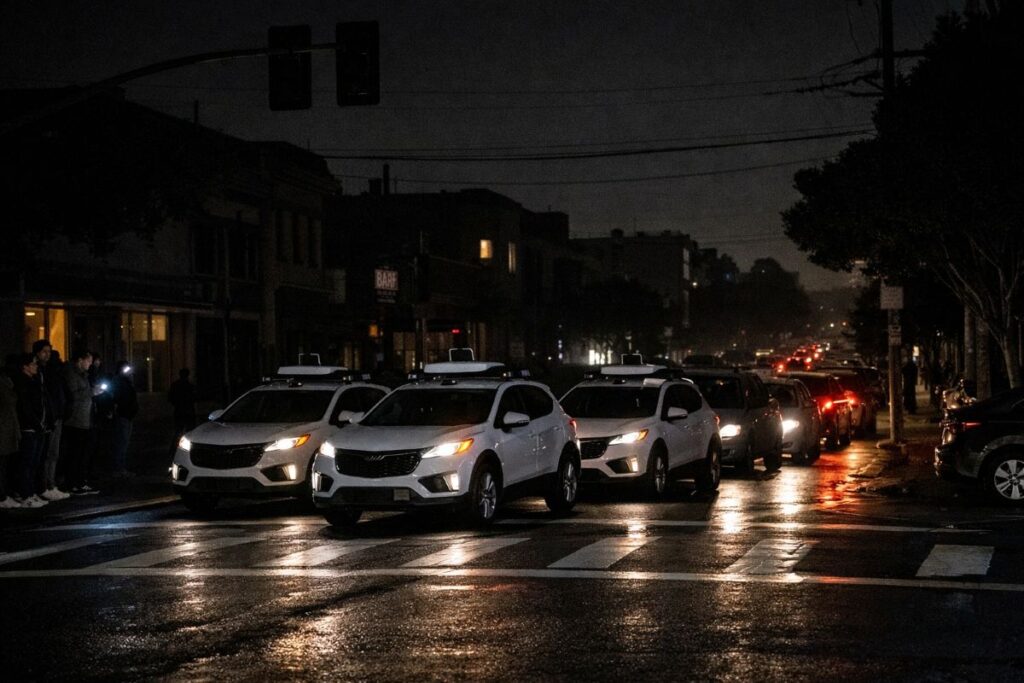
Waymo Vehicles Cause Traffic Chaos During San Francisco Blackout
San Francisco’s large weekend blackout in December 2025 became a stress test for how a modern city functions when the electrical grid falters. The outage darkened neighborhoods, interrupted transit, and knocked out traffic signals across multiple corridors. It also triggered a highly visible secondary problem: Waymo vehicles operating in the city were filmed stopped at dark intersections and in travel lanes, adding to congestion during an already chaotic period. Reuters+2San Francisco Chronicle+2
The episode matters because it connects two realities that are often discussed separately. First, a city’s transportation system depends on reliable power for basics like traffic lights and communication systems. Second, autonomous ride-hailing depends on a predictable operating environment. When both assumptions break at once, the resulting failures are not theoretical; they are immediate and public.
Power Outage Details
What happened in San Francisco
According to PG&E and reporting from major outlets, the outage began Saturday and affected roughly 130,000 customers at its peak, around one-third of PG&E’s San Francisco customers. Restoration progressed into Sunday, with tens of thousands still without power at various points during the recovery. Reuters+2San Francisco Chronicle+2
Reuters reported that PG&E and the city’s emergency management department described widespread disruption and urged residents to avoid non-essential travel. Officials emphasized that non-functioning traffic signals should be treated as four-way stops, and police were deployed to manage key intersections. Reuters This guidance is standard, but its effectiveness depends on how many intersections are affected and how many drivers are moving through them.
Reported cause and broader disruptions
Local reporting tied the outage to a fire at a PG&E substation near Eighth and Mission, describing significant damage and ongoing investigation into the cause. San Francisco Chronicle Other coverage described transportation disruptions that included impacts to BART and Muni service in the affected downtown corridor. Los Angeles Times
This context matters for understanding why traffic conditions became so unstable. Once multiple neighborhoods lose powered traffic control at the same time, the road network stops behaving like a coordinated system and starts behaving like a series of bottlenecks. Even careful drivers cannot maintain normal throughput when every major intersection effectively becomes a negotiation.
Why Waymo Vehicles Became a Visible Part of the Story
Traffic signals failing creates a hard edge case
When traffic lights go dark citywide, human drivers typically slow down, inch forward, and proceed cautiously when they see a safe opening. That’s messy, but it’s adaptable. For autonomous systems, this scenario can become a safety-first trap. If the vehicle’s operational logic treats an unlit signal as an ambiguous control state with elevated risk, stopping can be the “safe” decision.
During this blackout, multiple videos circulated online showing Waymo vehicles stopped at intersections with other cars stacking behind them. ABC7 reported witness accounts that the vehicles appeared “confused” because traffic lights were out, and it reported that Waymo suspended service in response to the outage conditions. ABC7 San Francisco The Guardian also described Waymo vehicles halting and creating hazardous conditions and traffic disruption during the signal failure. The Guardian
This isn’t a claim that Waymo vehicles caused the blackout or created every traffic jam. The blackout and signal failures created the conditions. But the behavior of Waymo vehicles under those conditions can still worsen congestion in specific places, especially if multiple vehicles stop in high-traffic corridors at the same time.
Visibility amplifies public reaction
A broken traffic system is frustrating, but most people expect it during a large outage. The reason this story traveled nationally is that Waymo vehicles are instantly recognizable and heavily associated with the promise of reliable, safer mobility. When Waymo vehicles become stationary obstacles during an emergency, it undermines the narrative that autonomy is a clean upgrade over human drivers in stressful situations.
Media coverage and social sharing also introduce a feedback loop. The more clips that spread, the more the public assumes the stoppages are widespread, and the more pressure builds on the company and city officials to respond quickly.
Impact on Traffic and Street Safety
Congestion effects during the blackout
Reuters described the blackout creating traffic jams and disruption in the city while officials urged residents to stay off the roads and treat dark signals as four-way stops. Reuters In that environment, any vehicle stopping in a travel lane can quickly reduce capacity to the point where a corridor locks up.
The Guardian reported that Waymo vehicles immobilized during the outage contributed to disruption, with online footage showing clusters of vehicles frozen in place. The Guardian ABC7 similarly reported videos of vehicles stuck at intersections and described the company’s service suspension. ABC7 San Francisco The practical effect is straightforward: once one lane blocks, nearby intersections back up, and emergency responders and buses have fewer usable paths through dense streets.
Why a conservative “stop” decision can still be a public hazard
Autonomous driving companies are incentivized to avoid risky maneuvers in ambiguous conditions. But the public hazard in this scenario is not only collision risk. It’s also gridlock risk. If Waymo vehicles stop in a way that prevents traffic from clearing an intersection, the situation can degrade from “slow” to “stalled,” and stalled streets are dangerous during emergencies because they restrict emergency vehicle access.
This is one of the uncomfortable realities of automation in public space: a decision that is individually safe can become collectively harmful when multiplied across a fleet.
Waymo’s Operational Response
Service suspension and coordination
Multiple outlets reported that Waymo temporarily suspended its driverless ride-hailing service in the Bay Area during the blackout, citing coordination with city officials and safety considerations. The Guardian+2ABC7 San Francisco+2 Suspending service is a meaningful admission that the operating environment no longer meets the system’s safe assumptions.
However, the biggest operational question is what happens to Waymo vehicles already on the road when the environment fails suddenly. If vehicles stop in travel lanes, clearing them can require remote assistance, on-the-ground operations staff, or coordination with police to safely manage traffic around them. This is the part of autonomy that often gets less attention than the driving itself: incident management.
Reliability claims versus infrastructure dependence
Waymo’s brand rests on safety and consistency. Incidents like this shift the debate from “can it drive most days?” to “how does it degrade on the worst days?” The blackout demonstrates a dependency chain that matters for city planning: autonomous mobility depends on the grid, and it depends on intersection control behaving predictably. If that chain breaks, Waymo vehicles may not be able to provide the service in a way the public considers acceptable.
That does not mean autonomy cannot work in cities. It means resilience needs to be a core design requirement, and cities need clear protocols for fleet behavior during major outages.
Public Reaction and the Trust Problem
Public reaction after the blackout was a mix of frustration, skepticism, and concern about whether driverless systems are ready for dense urban deployment when conditions turn chaotic. The underlying trust problem is not ideological. People want transportation systems to keep working in emergencies or at least fail in a way that does not make the emergency worse.
When residents see Waymo vehicles stopped at dark intersections, they don’t parse fine distinctions about “signal ambiguity” or “safe state.” They see blocked lanes and time lost. That perception is costly because public acceptance of autonomy is built as much on social confidence as on engineering metrics.
Incidents like this also feed policy arguments. Regulators and city officials evaluating autonomous services may increasingly demand demonstrated contingency plans for blackouts, communication failures, and large-scale signal outages. If Waymo vehicles are going to be a daily presence, they have to fit into emergency response plans the same way buses, taxis, and major employers do.
Bottom Line
The San Francisco blackout showed how quickly urban mobility can degrade when power fails at scale, and why autonomy adds new failure modes that cities have to plan for. The outage affected about 130,000 customers at peak, knocked out traffic signals, and created widespread disruption. Reuters+2San Francisco Chronicle+2 In that environment, Waymo vehicles were reported and filmed stopped at dark intersections, and Waymo paused service while coordinating with officials. The Guardian+1
The takeaway is not that autonomous ride-hailing is impossible. The takeaway is sharper: Waymo vehicles need a proven, city-scale emergency operating model, not just a driving model. If the public keeps seeing Waymo vehicles become obstacles during infrastructure failures, adoption will slow and regulation will tighten. If Waymo vehicles can demonstrate graceful degradation—safe movement rules that keep streets flowing while still prioritizing safety—then events like this become a learning moment rather than a reputational setback.
Further Reading
For the broad outage impacts and official guidance during the restoration, see Reuters’ report on the major power outage and the city’s travel and safety advisories: https://www.reuters.com/business/energy/major-power-outage-hits-san-francisco-2025-12-21/
For local details on the reported substation fire, service disruptions, and closures such as City Hall, read the San Francisco Chronicle’s coverage of the outage and restoration timeline: https://www.sfchronicle.com/sf/article/pge-outage-substation-fire-21255447.php
For coverage connecting the blackout, signal failures, and the stopped Waymo vehicles—and the resulting suspension of Waymo service—see The Guardian’s reporting: https://www.theguardian.com/us-news/2025/dec/21/power-outages-san-francisco-traffic-waymo-taxis-traffic
For eyewitness reporting and video-focused coverage showing Waymo vehicles stuck at intersections and describing the service suspension, see ABC7 (KGO): https://abc7news.com/post/videos-show-waymo-cars-stuck-san-francisco-intersections-during-massive-power-outage-company-suspends-service/18304634/
For an additional regional account tying together the blackout’s transit impacts and reports of Waymo vehicles stalled at darkened intersections, see the Los Angeles Times: https://www.latimes.com/california/story/2025-12-20/san-francisco-power-outage-bart-muni
Connect with the Author
Curious about the inspiration behind The Unmaking of America or want to follow the latest news and insights from J.T. Mercer? Dive deeper and stay connected through the links below—then explore Vera2 for sharp, timely reporting.
About the Author
Discover more about J.T. Mercer’s background, writing journey, and the real-world events that inspired The Unmaking of America. Learn what drives the storytelling and how this trilogy came to life.
[Learn more about J.T. Mercer]
NRP Dispatch Blog
Stay informed with the NRP Dispatch blog, where you’ll find author updates, behind-the-scenes commentary, and thought-provoking articles on current events, democracy, and the writing process.
[Read the NRP Dispatch]
Vera2 — News & Analysis
Looking for the latest reporting, explainers, and investigative pieces? Visit Vera2, North River Publications’ news and analysis hub. Vera2 covers politics, civil society, global affairs, courts, technology, and more—curated with context and built for readers who want clarity over noise.
[Explore Vera2]
Whether you’re interested in the creative process, want to engage with fellow readers, or simply want the latest updates, these resources are the best way to stay in touch with the world of The Unmaking of America—and with the broader news ecosystem at Vera2.
Free Chapter
Begin reading The Unmaking of America today and experience a story that asks: What remains when the rules are gone, and who will stand up when it matters most? Join the Fall of America mailing list below to receive the first chapter of The Unmaking of America for free and stay connected for updates, bonus material, and author news.
